How Much Can I Earn From Forex Trading per Month?

Forex trading has become one of the most popular ways for individuals to participate in the global financial markets. With the rise of online trading platforms and easy access to brokers, many people are curious about the earning potential in forex. One of the most frequently asked questions by beginners is: How much money can I realistically earn from forex trading every month? The truth is that forex income can vary widely depending on several important factors. Some traders earn only a small side income, while others generate significant profits over time. However, consistent success in forex trading requires knowledge, discipline, patience, and proper risk management. In this article, we will explore the realistic earning potential of forex trading, the factors that influence monthly income, different trading strategies, and what traders should expect when entering the forex market. Understanding the Forex Market Before discussing potential earnings, it is important to understand how the forex market works. The foreign exchange market is the largest financial market in the world. Every day, trillions of dollars are traded between banks, institutions, corporations, and individual traders. The market operates through a global network of financial centers and remains active almost twenty-four hours a day during weekdays. In the global currency market, transactions always involve two different currencies. When a trader opens a position, one currency is purchased while another is exchanged at the same time. The trader’s profit or loss comes from the change in the exchange rate between the opening price and the closing price of the trade. For example, if a trader buys a currency pair and its price rises, the trader may close the trade at a profit. If the price falls, the trader may experience a loss. Because of these price movements, traders have opportunities to generate income from both rising and falling markets. Factors That Affect Forex Trading Income The amount of money a trader can earn each month from forex trading depends on multiple factors. No two traders will have exactly the same results because each trader has a different account size, strategy, and level of experience. Several important factors determine potential monthly income. Trading Capital The amount of money a trader starts with plays a significant role in determining how much they can earn. A trader with a larger account balance can typically generate larger profits compared to someone trading with a small account. For example, a trader with a $10,000 account has more capital to trade than someone with a $500 account. However, having more capital does not automatically guarantee profits. Even traders with small accounts can grow their capital over time if they use effective strategies and manage risk properly. Risk Management Risk management is one of the most important skills in forex trading. Professional traders usually risk only a small percentage of their trading account on each trade. Many experienced traders limit risk to around one or two percent per trade. By controlling risk, traders can protect their capital during losing periods and remain in the market long enough to benefit from profitable opportunities. Traders who risk too much money on a single trade often experience large losses that can quickly wipe out their accounts. Trading Strategy Different trading strategies can produce different types of results. Some traders prefer short-term strategies such as scalping or day trading, where positions are opened and closed within the same day. Other traders prefer swing trading, where trades may remain open for several days or weeks. Long-term traders may hold positions for extended periods based on economic trends and macroeconomic factors. Each strategy has its own potential profit targets and risk levels. Market Conditions Market conditions also influence trading performance. Sometimes the market moves strongly in one direction, creating clear trading opportunities. At other times, the market may move sideways or become unpredictable. Experienced traders learn to adapt their strategies depending on market conditions and avoid trading during uncertain periods. Trader Experience Experience plays a major role in trading success. Beginners often take time to understand how the market behaves and may experience losses while learning. Over time, traders who study the market, analyze their mistakes, and improve their strategies may achieve more consistent results. Developing trading skills requires patience and continuous learning. Realistic Monthly Earnings in Forex Trading It is important to approach forex trading with realistic expectations. Some beginners believe they can double their account every month. While this might occasionally happen, it is not a sustainable long-term strategy. Most professional traders aim for steady growth rather than extremely high returns. A commonly discussed target among experienced traders is achieving a monthly return of around 5% to 10% on their trading capital. This level of growth may seem modest, but when compounded over time, it can produce significant results. Example of Monthly Forex Earnings Let’s consider a few examples to understand potential monthly income. If a trader has a trading account of $1,000 and generates a 5% monthly return, the monthly profit would be approximately $50. If the same trader grows the account to $10,000 and maintains the same 5% monthly return, the monthly profit would be around $500. For a trader with a $50,000 account earning 5% per month, the monthly profit could reach approximately $2,500. These examples demonstrate that trading capital plays an important role in determining monthly earnings. Part-Time vs Full-Time Forex Traders Some people trade forex as a part-time activity, while others treat it as a full-time profession. Part-time traders usually trade during specific market sessions or analyze the market after work. Their goal may be to generate additional income alongside their primary job. Full-time traders dedicate more time to studying the market, analyzing economic events, and managing trades throughout the day. The level of commitment and time spent trading can influence potential income. Advantages of Forex Trading Income Forex trading offers several advantages for those who develop the necessary skills. One advantage is flexibility. Traders can participate in the market from almost anywhere with an internet connection. Another advantage is
Who Controls the Forex Market? A Complete Guide to the Global Currency Trading Structure

The global currency trading system, widely referred to as the forex market, represents the largest and most active financial marketplace in the world. Every day, trillions of dollars are exchanged between banks, institutions, corporations, governments, and retail traders. Despite its enormous size and influence on the global economy, many people ask an important question: who actually owns or controls the forex market? Unlike traditional financial markets such as stock exchanges, the forex market does not have a single central authority or owner. Instead, it operates through a decentralized global network of financial institutions and participants. This structure makes forex unique compared to other markets. Understanding how the forex market is organized can help traders gain a clearer perspective on how currency prices move, who influences those movements, and how different participants interact within the market. In this guide, we will explore the structure of the forex market, the key participants involved, how the decentralized system works, and why no single entity owns the global currency trading system. The Nature of the Forex Market The forex market is fundamentally different from many other financial markets because it is decentralized. In a decentralized market, transactions do not occur through a single exchange or central marketplace. Instead, trading occurs electronically through a network of banks, financial institutions, brokers, and electronic trading platforms. These participants connect with each other through digital communication systems, creating a massive global marketplace that operates continuously. Currencies are traded in pairs, meaning one currency is exchanged for another. For example, when someone trades the EUR/USD currency pair, they are exchanging euros for US dollars or vice versa. Because currencies are required for international trade, investment, and financial transactions, the forex market plays an essential role in the global economy. Why the Forex Market Has No Single Owner One of the most interesting aspects of forex trading is that there is no central owner or controlling authority for the market as a whole. The forex market functions through cooperation between multiple financial entities located around the world. These entities include banks, central banks, corporations, hedge funds, investment firms, and individual traders. Instead of operating through a single exchange building or central trading floor, currency trading takes place electronically through interconnected systems that allow participants to trade with each other directly. This decentralized structure ensures that the forex market remains open to participants from different regions and operates continuously as financial centers across the world open and close. Major Participants in the Forex Market Although no single organization owns the forex market, several major groups of participants play key roles in shaping its activity and liquidity. Each group contributes to the overall functioning of the global currency trading system. Central Banks Central banks represent one of the most influential participants in the forex market. A central bank is responsible for managing a country’s monetary policy and maintaining the stability of its national currency. Central banks influence currency values through actions such as adjusting interest rates, managing inflation, and controlling the supply of money within the economy. They may also intervene directly in the forex market to stabilize their currency or influence exchange rates when necessary. Because of their ability to influence national economic policies, central banks can have a significant impact on currency prices. Commercial Banks Large commercial banks form the backbone of the global forex market. These institutions facilitate currency transactions for governments, multinational corporations, investment funds, and other financial institutions. Banks also trade currencies on their own behalf in order to manage financial exposure or generate profit through trading strategies. Major financial institutions connect to each other through interbank trading networks, which allow them to exchange large volumes of currency quickly and efficiently. This network of banks is often referred to as the interbank market, which represents the core layer of forex trading activity. Multinational Corporations International companies frequently participate in the forex market because they conduct business in multiple countries. When a company imports goods, exports products, or operates internationally, it must exchange currencies to complete transactions. For example, a company located in one country may need to convert its domestic currency into another currency in order to pay suppliers or employees in a different region. These currency exchanges create constant demand for the forex market and contribute to its daily trading volume. Corporations also use forex trading to hedge against currency fluctuations that could affect their profits. Investment Funds and Financial Institutions Large financial institutions, including investment funds, asset management firms, and hedge funds, participate actively in the forex market. These organizations trade currencies in order to diversify their portfolios, manage risk, or take advantage of market opportunities. Because these institutions manage significant amounts of capital, their trading activity can influence short-term price movements in currency markets. Many institutional traders use advanced trading strategies and sophisticated technology to analyze market trends and execute trades quickly. Retail Traders Retail traders represent individual participants who trade currencies through online brokers and trading platforms. Over the past two decades, technological advancements have made it easier for individuals to access the forex market from almost anywhere in the world. Retail traders typically trade smaller volumes compared to large institutions, but their collective participation contributes to overall market liquidity. Most retail traders use online trading platforms that provide access to real-time charts, analytical tools, and order execution systems. The Interbank Market Structure At the core of the forex market lies the interbank trading system. The interbank market consists of large financial institutions that trade currencies directly with each other. These institutions quote exchange rates and provide liquidity for other market participants. Interbank transactions typically involve very large volumes of currency, often worth millions or billions of dollars. Because of their size and liquidity, these banks play a critical role in determining exchange rates across the global market. Prices quoted in the interbank market often influence the exchange rates that brokers and trading platforms offer to retail traders. Electronic Trading Networks Modern forex trading relies heavily on electronic communication networks. These digital systems
Understanding the Three Major Financial Markets

Financial markets offer many opportunities for traders and investors to increase their capital. Among the most commonly traded financial markets around the world are Forex, Stocks, and Cryptocurrency. Each of these markets functions differently, carries its own advantages and risks, and attracts different types of participants. Many beginners struggle when deciding which market they should start trading in. Some people prefer the relatively stable nature of stocks and their long-term growth potential. Others are attracted to the strong liquidity of the forex market, while many traders are interested in cryptocurrencies because of their rapid price movements and volatility. In this guide, we will explore the differences between forex, stocks, and cryptocurrency markets, explain how each market works, and help you understand which one might suit your trading style and financial objectives. Understanding the Three Major Trading Markets Before comparing these markets directly, it is important to understand how each of them operates and what makes them unique. Forex Trading Forex trading involves exchanging one currency for another with the goal of benefiting from changes in exchange rates. The forex market is widely recognized as the largest financial market in the world, with daily trading volumes reaching trillions of dollars. Currencies are always traded in pairs, meaning one currency is bought while another currency is sold at the same time. Common examples of currency pairs include EUR/USD, GBP/USD, USD/JPY, and AUD/USD. When traders open a position in one of these pairs, they are simultaneously buying one currency and selling another. For example, entering a trade in EUR/USD means that the trader is purchasing euros while exchanging them against US dollars. Price movements in the forex market are influenced by several global economic factors such as interest rate decisions, economic data releases, central bank policies, political developments, and overall global economic conditions. Another important feature of the forex market is its availability. Trading occurs twenty-four hours a day during weekdays, allowing participants from different regions of the world to trade continuously as financial centers open and close. Stock Market Trading Stock trading involves buying and selling shares of publicly listed companies through organized exchanges. When an individual buys shares of a company, they effectively gain ownership in a small portion of that business. If the company performs well financially and grows over time, the value of its shares may increase. Some of the most recognized companies whose shares are traded globally include Apple, Tesla, Amazon, Microsoft, and Google. These shares are traded on major stock exchanges such as the New York Stock Exchange, NASDAQ, the London Stock Exchange, and the Bombay Stock Exchange. Stock prices change because of various factors including company earnings reports, industry growth, economic performance, investor sentiment, and market demand. Participants in the stock market often focus on long-term investments, dividend income, and portfolio diversification as part of their financial strategy. Cryptocurrency Trading Cryptocurrency trading involves buying and selling digital assets that operate on blockchain technology. Unlike traditional currencies issued by governments, cryptocurrencies are decentralized and operate without direct control from central banks. Some of the most well-known cryptocurrencies include Bitcoin, Ethereum, Binance Coin, Solana, and Ripple. These digital assets are traded on cryptocurrency exchanges and can be purchased using traditional currencies or other cryptocurrencies. One major difference between crypto markets and traditional financial markets is trading availability. Cryptocurrency markets operate twenty-four hours a day and seven days a week, including weekends and holidays. Prices in the crypto market are influenced by factors such as market demand and supply, technological development, blockchain adoption, regulatory announcements, and overall market sentiment. Because the cryptocurrency industry is still relatively new, it often experiences strong price fluctuations compared to more established markets. Market Size Comparison One of the key differences between these markets is their overall size. The forex market dominates the global financial system in terms of daily trading volume. Banks, governments, financial institutions, hedge funds, multinational corporations, and retail traders all participate in currency trading, which contributes to its enormous liquidity. The stock market represents the combined value of publicly traded companies around the world. While it is smaller than the forex market in daily trading volume, it remains one of the most important financial systems globally. The cryptocurrency market is the newest of the three and has a smaller overall market size, although it has experienced rapid growth over the past decade. Because of its smaller size, the crypto market can sometimes experience stronger price swings. Trading Hours Comparison Another major difference between these markets is their trading schedule. The forex market operates twenty-four hours per day during weekdays as trading activity shifts between major financial centers such as London, New York, Tokyo, and Sydney. Stock markets operate during fixed exchange hours. For example, US stock exchanges generally operate between 9:30 AM and 4:00 PM Eastern Time. Cryptocurrency markets, however, operate continuously without closing, allowing traders to buy and sell digital assets at any time. This round-the-clock availability makes crypto markets appealing to traders who prefer flexibility. Volatility Differences Volatility describes how strongly prices move in a market over time. Cryptocurrency markets are generally the most volatile, with prices sometimes moving dramatically within a single day. Forex markets are typically more stable, particularly when trading major currency pairs such as EUR/USD or GBP/USD. Stock markets usually display moderate volatility, although certain individual stocks can experience large price movements after earnings announcements or significant company news. While volatility can create profit opportunities, it also increases trading risk. Liquidity Comparison Liquidity describes how easily an asset can be bought or sold in the market without causing a large change in its price. The forex market offers extremely high liquidity because of the large number of participants involved globally. This allows traders to open and close positions quickly with minimal price impact. Stocks also offer strong liquidity, especially when trading shares of large and well-established companies with high daily trading volumes. Cryptocurrency liquidity varies depending on the digital asset being traded. Major cryptocurrencies such as Bitcoin and Ethereum generally have strong liquidity,
Positioning-Based Reversal Strategy Using Sentiment Extremes
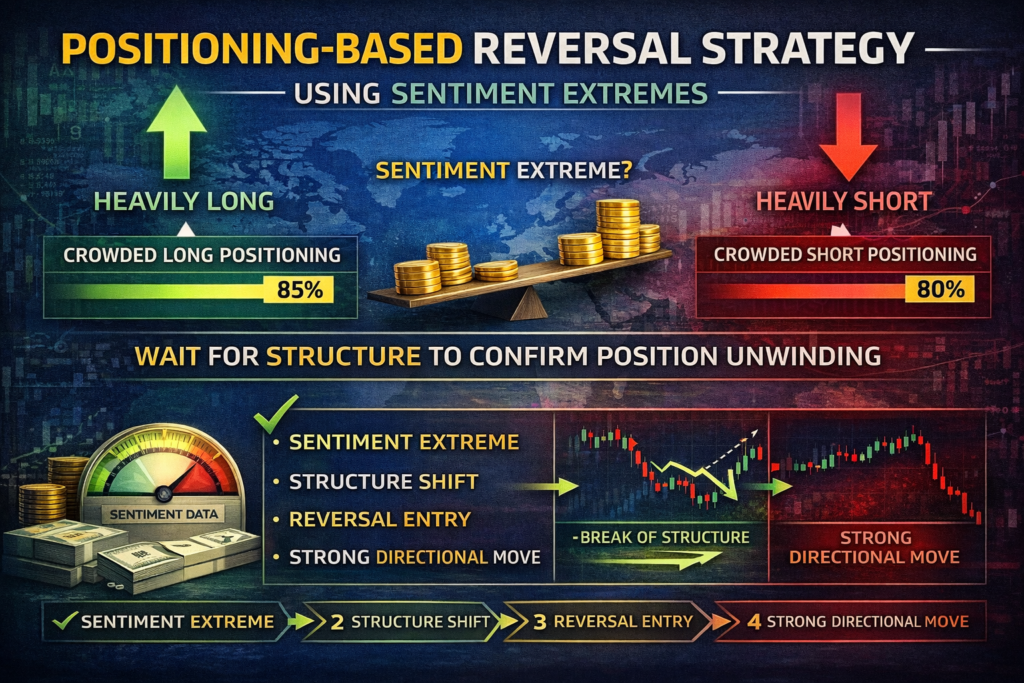
Most major turning points in the forex market do not begin with economic data. They begin with positioning imbalance. They begin with positioning imbalance. When too many traders are positioned in the same direction, the market becomes unstable. The larger the crowd, the more powerful the reversal when sentiment shifts. This is the foundation of a structured Forex reversal strategy built on Forex market positioning and sentiment extremes. Instead of trying to guess tops and bottoms randomly, this method identifies crowded trades and waits for structural confirmation before entering. It is advanced in concept but highly practical for swing traders who aim to capture large directional shifts rather than small intraday moves. Understanding Crowded Trades A crowded trade occurs when a significant portion of market participants share the same directional bias. This can happen after extended trends, strong economic narratives, or prolonged policy divergence between central banks. When positioning becomes heavily one-sided, risk increases. If unexpected information enters the market, participants rush to exit simultaneously. This creates sharp reversals. A disciplined Forex reversal strategy does not fight trends early. It waits until evidence shows positioning is stretched and vulnerable. Why Sentiment Extremes Precede Reversals Sentiment reflects collective belief. When optimism or pessimism becomes extreme, price often reaches exhaustion. If traders overwhelmingly expect continued dollar strength, most buying power may already be deployed. With few new buyers left, the market becomes sensitive to even minor negative catalysts. This is where Currency sentiment trading becomes powerful. It identifies imbalance before price fully reflects it. Extreme sentiment does not guarantee reversal, but it signals rising probability. The Role of Forex Market Positioning Data Several tools help measure positioning: Commitment of Traders reportsRetail sentiment indicatorsOptions positioning dataFunding rate imbalances These tools show whether traders are disproportionately long or short. When positioning reaches historical extremes, it creates asymmetrical opportunity. The greater the imbalance, the stronger the potential unwind. Understanding Forex market positioning transforms reversal trading from guesswork into probability-based analysis. Why Most Traders Fail at Reversal Trading Retail traders often attempt reversals based solely on technical resistance or support levels. Without sentiment context, these trades frequently fail. Markets can remain overbought or oversold for extended periods. Reversals only gain momentum when positioning becomes unstable. A structured Forex reversal strategy requires two components: Sentiment extremeStructural confirmation Without both, the probability decreases significantly. Waiting for Structural Confirmation Sentiment alone is not enough. Structure confirms the shift. For example, if positioning data shows extreme long exposure in a currency pair, traders should not immediately short. Instead, they wait for: Break of higher timeframe structureFailure to create new highsLower high formationMomentum divergence Once structure shifts, the imbalance begins to unwind. This confirmation layer distinguishes disciplined Currency sentiment trading from emotional counter-trend attempts. The Psychology of Position Unwinding When positioning reverses, it often accelerates rapidly. Traders who were previously confident suddenly seek exit liquidity. Stops are triggered. Profits are taken. Leverage is reduced. This cascade effect fuels sharp directional moves. The unwind can be stronger than the initial trend because it combines: Profit-takingStop-loss triggersFresh opposing positions Understanding this dynamic strengthens any Forex reversal strategy. How Positioning-Based Reversals Form in Real Markets Consider a scenario where a currency pair trends upward for months. Economic narratives support continued strength. Retail and institutional positioning becomes heavily long. Suddenly, central bank tone softens slightly. Price struggles to break previous highs. Momentum weakens. Structure breaks on daily timeframe. This is not just a technical signal. It is a positioning signal. The market begins to unwind crowded exposure. This is where structured Forex market positioning analysis aligns with price structure. Risk Management in Reversal Trading Reversal trades carry higher risk than continuation trades. Timing is critical. Best practices include: Reduced position sizeWider stops aligned with higher timeframe structureScaling entries instead of full exposureAvoiding early anticipation Because reversals require confirmation, patience reduces drawdown. Even strong sentiment extremes can persist before breaking. Why Swing Traders Benefit Most Swing traders benefit from this strategy because positioning shifts unfold over days or weeks. Intraday traders may struggle with volatility inside larger transitions. A confirmed positioning unwind can create sustained directional moves ideal for multi-day holding. This makes Currency sentiment trading particularly effective for those focused on larger timeframes. Identifying True Sentiment Extremes Not every imbalance qualifies as extreme. True extremes occur when: Positioning reaches multi-month highs or lowsRetail traders are heavily skewed in one directionMedia narratives become one-sidedVolatility begins to compress These signals suggest emotional saturation. A structured Forex reversal strategy uses this saturation as early warning rather than immediate trigger. Combining Macro and Positioning Reversals become stronger when sentiment extremes align with macro transitions. For example: Interest rate cycle shiftsLiquidity tighteningPolicy divergence narrowingRisk sentiment changes When positioning imbalance meets macro shift, probability increases dramatically. This layered approach enhances reliability. Common Mistakes to Avoid Shorting strong trends without confirmationIgnoring broader macro conditionsOverleveraging earlyAssuming every extreme results in immediate reversalTrading sentiment without structure Each mistake reduces edge. Reversal trading requires discipline more than prediction. Why This Strategy Explains Major Turning Points Large market reversals often begin quietly. Structure shifts before headlines change. Positioning data frequently reveals vulnerability before price collapses. By monitoring Forex market positioning, traders gain early awareness of unstable trends. Once confirmation appears, the move can unfold aggressively. The Emotional Edge Trading reversals requires emotional control. Many traders hesitate because they fear being early. Others enter too soon because they want to catch the exact top or bottom. The correct approach balances awareness with patience. A professional Forex reversal strategy accepts that the exact turning candle is irrelevant. Capturing the middle of the unwind is enough. Consistency matters more than precision. Example Framework Step 1: Identify sentiment extreme using positioning tools.Step 2: Confirm macro context supports potential shift.Step 3: Wait for higher timeframe structural break.Step 4: Enter on pullback after confirmation.Step 5: Manage risk according to invalidation levels. This systematic approach transforms reversal trading into structured probability management. Final Thoughts A positioning-based Forex reversal strategy using Forex market positioning and disciplined Currency sentiment trading offers insight into major
Supply and Demand Strategy for Smart Money Entries

Retail traders often focus on indicators, oscillators, and short-term patterns, while institutions focus on price imbalance. The market does not move because an indicator turns overbought. It moves because large orders create imbalance between buyers and sellers. The foundation of Supply demand forex trading is understanding where institutional orders previously entered the market and where they are likely to defend positions again. This approach forms the backbone of many advanced strategies often labeled as a Smart money forex strategy. Instead of chasing price, this method waits for price to return to institutional trading zones where imbalance originally occurred. Understanding Institutional Trading Zones Institutional participants do not enter positions randomly. They accumulate or distribute positions in areas where liquidity is available. These areas create sharp price moves away from consolidation bases. A demand zone forms when aggressive buying pushes price upward from a consolidation area. A supply zone forms when strong selling drives price downward rapidly. These sharp departures indicate that large orders were filled. In Institutional trading zones, price tends to react again when revisited because unfilled orders may still remain. This concept transforms trading from guessing breakouts to anticipating reactions at high-probability levels. Why Supply and Demand Works Across Timeframes One reason Supply demand forex remains popular is its adaptability. The logic of imbalance applies on every timeframe. On higher timeframes, zones reflect institutional positioning. On lower timeframes, zones reflect short-term liquidity dynamics. Swing traders may focus on daily zones. Intraday traders may use 1-hour or 15-minute zones for entries. The concept remains consistent: price reacts where imbalance previously occurred. This multi-timeframe flexibility makes it one of the most practical components of a structured Smart money forex strategy. Identifying Valid Supply and Demand Zones Not every consolidation area qualifies as a true institutional zone. Strong zones share specific characteristics. First, price leaves the area aggressively with large momentum candles. Second, there is minimal overlap during departure. Third, price does not return immediately. A weak zone forms when price drifts away slowly or revisits repeatedly. The strength of a zone depends on the intensity of imbalance that created it. Precision in identifying valid Institutional trading zones improves win rate significantly. The Psychology Behind Zone Reactions When price returns to a previous demand zone, it revisits an area where buyers previously dominated. If institutional participants are defending that level, buying pressure may appear again. Similarly, when price revisits a supply zone, sellers may re-enter to defend positions. This repeated behavior creates structured reaction points. A disciplined Supply demand forex approach understands that price memory exists in areas where large capital was deployed. Reaction Confirmation Before Entry One common mistake retail traders make is placing blind limit orders at zones. While this may work occasionally, it increases exposure to deeper retracements. A refined Smart money forex strategy waits for confirmation inside the zone. Confirmation may include: Rejection wicksLower timeframe structure shiftsMomentum slowingVolume contraction Waiting for confirmation improves timing and reduces premature entries. Patience increases probability. Entry Refinement Using Lower Timeframes Once price reaches a higher timeframe zone, lower timeframe structure provides tactical entry. For example, if price enters a daily demand zone, a trader may drop to the 15-minute chart to observe: Break of minor structureBullish engulfing candleHigher low formation This alignment improves risk-to-reward ratio. Using this layered method transforms Institutional trading zones into precise execution areas rather than broad guesswork. Stop Placement and Risk Control Stops should sit beyond the edge of the zone, not inside it. Placing stops too tight within the zone increases the risk of being taken out by minor volatility. In a demand zone, stop loss belongs below the lowest structural low of the zone. In a supply zone, stop loss belongs above the highest structural high. Proper risk placement allows the zone to function as intended without unnecessary exposure. Risk management defines long-term consistency more than entry perfection. Why Zones Sometimes Fail No strategy is flawless. Zones fail when broader market structure shifts or when macro forces override technical levels. For example, during major central bank announcements or unexpected geopolitical events, price may slice through zones without meaningful reaction. Context matters. A zone aligned with higher timeframe trend has greater probability than a counter-trend zone. Combining structure with macro awareness strengthens any Supply demand forex framework. Supply and Demand vs Support and Resistance Many traders confuse supply and demand with traditional support and resistance. While related, they differ in logic. Support and resistance focus on repeated price interaction. Supply and demand focus on imbalance and order flow. Support levels may be tested multiple times. True institutional zones often produce strong initial reactions. Understanding this distinction enhances the depth of a Smart money forex strategy. Common Mistakes Traders Make Marking too many zones.Trading every zone without confirmation.Ignoring higher timeframe bias.Placing stops inside zones.Overleveraging on first touch. Simplicity improves performance. Selective zone trading produces better results than constant engagement. Combining Trend and Supply Demand The highest probability setups occur when trend continuation aligns with fresh demand or supply zones. In an uptrend, demand zones are stronger. In a downtrend, supply zones dominate. Counter-trend zone trading requires faster management and tighter expectations. Aligning Institutional trading zones with broader structure increases probability dramatically. The Role of Liquidity Within Zones Zones often coincide with liquidity pools. Stops from previous traders accumulate around prior highs and lows. When price returns, liquidity is absorbed before reversal. Understanding liquidity improves reaction timing. This integration of imbalance and liquidity forms the advanced layer of a Smart money forex strategy. Why This Strategy Appeals to Retail Traders The visual clarity of zones makes the approach accessible. Traders can see imbalance clearly on charts without complex indicators. However, simplicity does not mean ease. Discipline, confirmation, and patience are required. Used correctly, Supply demand forex provides a structured framework for anticipating institutional behavior rather than reacting emotionally. Final Thoughts The Supply demand forex approach is not about predicting every reversal. It is about identifying areas where imbalance previously shifted price and waiting for high-probability reactions. A structured
Financial markets rarely move in isolation. Currencies, equities, bonds, and commodities constantly
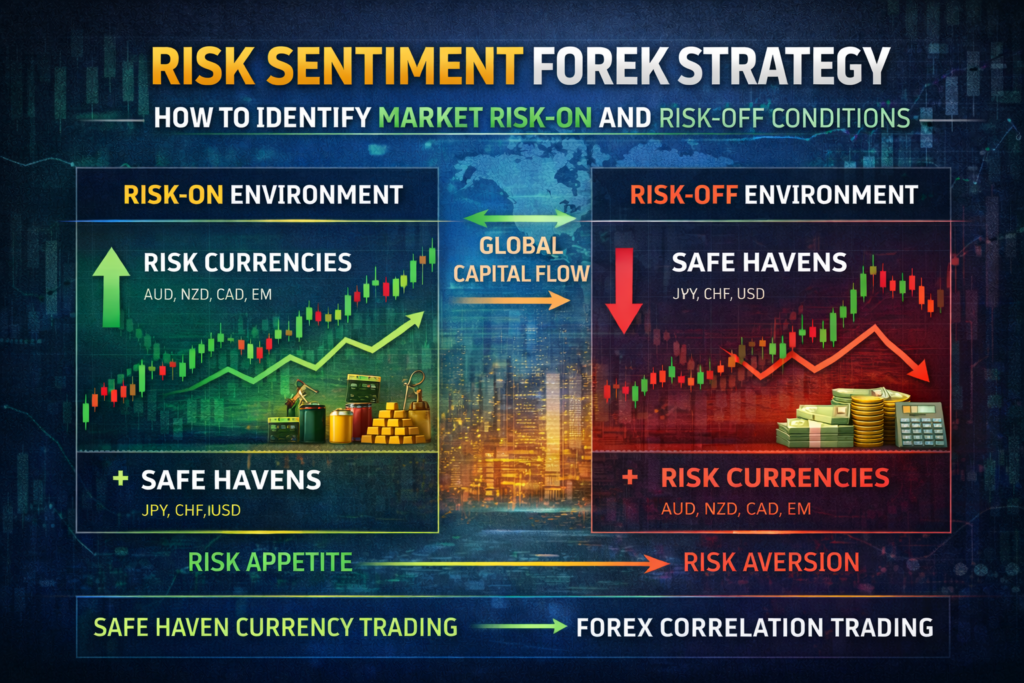
Financial markets rarely move in isolation. Currencies, equities, bonds, and commodities constantly influence one another through shifts in global capital flow. Many traders struggle because they analyze a single forex pair without understanding the broader environment driving it. This is where a structured Risk sentiment forex strategy becomes powerful. Instead of focusing only on technical patterns, this approach combines macro awareness with correlation analysis. It helps traders identify whether markets are in a risk-on or risk-off phase and position accordingly. Understanding these phases reduces overexposure, improves trade selection, and aligns positions with institutional capital flow. Understanding Risk-On and Risk-Off Behavior Risk-on describes an environment where investors are confident and willing to allocate capital toward higher-return assets. Risk-off describes periods of caution, where capital flows into defensive instruments. In risk-on conditions:Equities tend to rise.Commodity-linked currencies strengthen.Safe-haven currencies weaken. In risk-off conditions:Equities tend to decline.Defensive assets gain demand.High-yield currencies weaken. Recognizing this shift early is the foundation of a successful Risk sentiment forex strategy. Safe Haven vs Risk Currencies Certain currencies consistently behave as safe havens. The Japanese yen and Swiss franc are commonly viewed as defensive because of their stability and liquidity. The US dollar can also act as a safe haven during global stress. Risk-sensitive currencies include the Australian dollar, New Zealand dollar, Canadian dollar, and emerging-market currencies. These currencies often strengthen during global growth optimism and weaken during uncertainty. Understanding this distinction allows traders to apply structured Safe haven currency trading principles rather than guessing direction based on local data alone. Why Correlation Matters in Forex Currencies rarely move independently. During strong risk-on or risk-off phases, multiple pairs move in synchronized patterns. For example:If global equities are rallying, AUD/USD and NZD/USD may rise together.If global risk deteriorates, USD/JPY may fall while USD/CHF strengthens. Ignoring correlation can lead to accidental overexposure. A trader holding long AUD/USD, long NZD/USD, and long GBP/USD may believe they are diversified — but in reality, they may be heavily exposed to the same risk sentiment shift. This is why disciplined Forex correlation trading protects capital and reduces unintended concentration. Equity Markets as Confirmation Tools Equities provide a valuable confirmation layer for currency positioning. When stock indices trend strongly upward, risk appetite is generally healthy. When indices experience sharp declines, caution increases. If a trader sees bullish structure forming in a risk currency pair while equities are rallying, alignment increases probability. If technical signals suggest buying a risk currency while equities are falling sharply, caution is necessary. A structured Risk sentiment forex strategy integrates cross-market observation rather than relying solely on candlestick patterns. The Role of Bond Yields in Risk Assessment Bond yields often reflect confidence in growth and monetary conditions. Rising yields driven by strong growth expectations may support risk-on environments. Falling yields during stress periods often signal defensive positioning. When yields rise alongside equities, risk appetite is typically strong. When yields fall sharply during market stress, safe-haven demand increases. Combining equity and yield observation strengthens decision-making within Safe haven currency trading setups. How to Identify Risk-On Environments Risk-on environments usually show several characteristics: Equities trending higher with stable volatility.Commodity prices firming.Higher-yield currencies outperforming safe havens.Credit markets stable. During these phases, continuation trades in risk currencies often offer better probability than counter-trend setups. A disciplined Forex correlation trading framework encourages aligning trades with this broader capital flow. How to Identify Risk-Off Environments Risk-off phases display different signals: Sharp equity sell-offs.Volatility increasing rapidly.Flight into defensive assets.Capital rotating into USD, JPY, or CHF. In these conditions, safe-haven currencies strengthen while growth-linked currencies weaken. Understanding this shift prevents traders from buying dip setups in risk currencies during broader capital retreat. Correlation Filtering to Avoid Overexposure Correlation filtering means reducing duplicate exposure across multiple pairs. For example, if risk sentiment is positive and you hold long AUD/USD, opening long NZD/USD and long EUR/USD may multiply exposure to the same macro factor. Instead, select one or two pairs that offer the clearest structure while maintaining balanced risk. Professional traders think in portfolio terms, not isolated trades. This mindset is essential for effective Forex correlation trading. Combining Macro Bias With Technical Structure Macro awareness alone is insufficient. Technical confirmation refines entries. If risk-on conditions dominate and equities are rising, look for pullbacks in risk currencies to enter continuation trades. Avoid chasing expansion candles. If risk-off conditions dominate, focus on retracements in safe-haven pairs for better risk-reward entries. This balance between macro direction and technical precision defines a mature Risk sentiment forex strategy. When Correlations Break Down Correlations are not permanent. During transitional phases, markets may become choppy and inconsistent. Central bank surprises, geopolitical events, or liquidity shifts can temporarily disrupt correlation patterns. In these periods, position size should be reduced and patience increased. Flexibility improves long-term consistency. Psychological Benefits of Correlation Awareness Many retail traders feel confused when multiple trades move against them simultaneously. This often happens because they unknowingly concentrated exposure. Understanding correlation reduces emotional stress. Traders become aware of systemic risk rather than blaming individual setups. Confidence increases when exposure is controlled. Applying the Strategy in Real Conditions Imagine global equities are trending upward and volatility remains contained. Yields are stable, and commodities are firming. In this environment, continuation setups in AUD/USD or NZD/USD align with broader capital flow. Alternatively, imagine equities are falling sharply with rising volatility. Safe-haven currencies strengthen. In this case, long positions in USD/CHF or short positions in AUD/JPY may align with macro direction. A structured Safe haven currency trading approach uses these signals as context rather than prediction. Why This Strategy Reduces Overtrading When traders understand whether the environment is risk-on or risk-off, they avoid forcing trades that contradict broader sentiment. This naturally reduces frequency and increases quality. A disciplined Risk sentiment forex strategy filters opportunities based on macro alignment, preventing random entries during uncertain transitions. Common Mistakes to Avoid Ignoring cross-market signals.Overloading correlated pairs.Trading against dominant sentiment.Using correlation as a signal instead of confirmation. Correlation is a filter, not a standalone entry trigger. Final Thoughts A structured Risk sentiment forex strategy integrates
News Fade Strategy: How to Trade After High-Impact Economic Releases
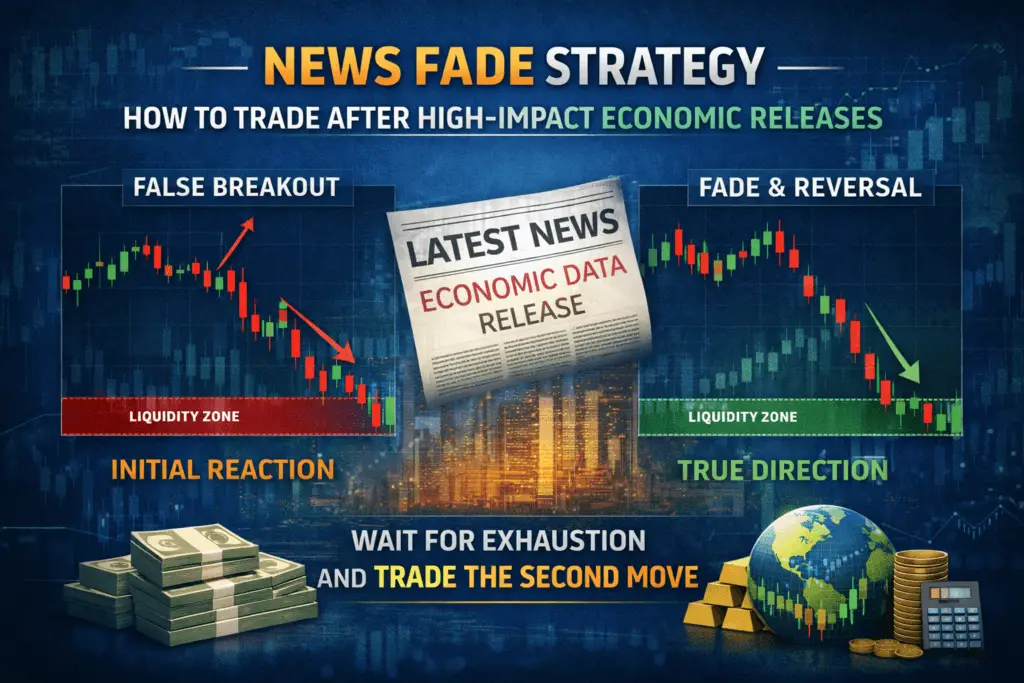
High-impact economic releases create some of the most dramatic moments in the forex market. Prices spike aggressively, spreads widen, stop losses are triggered, and emotional traders rush to enter positions. Within minutes, price often reverses sharply, leaving late participants confused and frustrated. This repeated behavior is the foundation of the News fade forex approach. Instead of chasing the initial reaction, this strategy focuses on trading the reversal that often follows extreme volatility. It is one of the most structured ways to approach a Forex news trading strategy without competing directly with algorithms and institutional order flow. Understanding why fake moves occur after major releases is the first step to applying this strategy effectively. Why the First Move After News Is Often Misleading When high-impact data such as Non-Farm Payroll, CPI, or central bank decisions are released, the first price movement is usually driven by automated trading systems. Algorithms react instantly to headlines and numeric deviations from expectations. However, this initial reaction does not always represent true market direction. It represents speed, not conviction. Large institutions rarely execute full positions during the first spike. Liquidity conditions are unstable, spreads are wider than normal, and slippage risk increases. Instead, institutions allow volatility to unfold before making structured decisions. This disconnect between algorithmic reaction and institutional positioning is what creates opportunity in a Post news reversal setup. Understanding the First Spike vs the Second Move The core concept behind a News fade forex approach is distinguishing between the first spike and the second move. The first spike is emotional, fast, and often exaggerated. It may break key levels, trigger stops, and create panic entries. The second move is slower, more controlled, and often represents the true direction after liquidity has been absorbed. Many traders lose money because they enter during the first expansion candle. The news fade strategy waits for exhaustion. It recognizes that liquidity is often collected before the market decides its real path. Patience transforms volatility from threat into opportunity. Liquidity Sweeps and Stop Hunts After News During high-impact releases, price frequently moves toward obvious liquidity zones. These include recent highs, recent lows, and psychological round numbers. Retail stop losses are clustered in these areas. When news hits, price may spike beyond these levels briefly before reversing. This behavior is not random. It is liquidity-driven. Institutions require liquidity to execute large positions. Stop losses provide that liquidity. Once stops are triggered, price often retraces because the immediate pool of orders has been absorbed. This is where a structured Forex news trading strategy identifies entry opportunities — not during the breakout, but after the liquidity sweep. Why Post-News Reversals Happen Frequently Reversals after economic releases occur for several reasons: Market expectations were already priced in.Positioning was heavily skewed before the release.The initial move overreacted to the data.Liquidity conditions normalized after volatility. If traders were already positioned in anticipation of strong data, they may take profits immediately after confirmation. This profit-taking can reverse price even if the data was positive. Understanding positioning is critical in anticipating a Post news reversal. How to Structure a News Fade Trade A disciplined News fade forex setup follows a process rather than impulse. First, identify the key support and resistance zones before the release. Mark liquidity pools where stops are likely clustered. Second, observe the first spike. Avoid entering during the first 1–3 minutes of extreme volatility. Third, wait for signs of exhaustion. This can include: Rejection wicksLower timeframe structure breakMomentum slowingFailure to hold breakout levels Fourth, enter in the direction opposite to the initial spike once confirmation appears. This structured patience separates professional execution from emotional reaction. Risk Control During High Volatility News trading carries elevated risk. Spreads widen. Slippage increases. Price movement becomes unpredictable. Risk control is critical in a Forex news trading strategy. Position size should be smaller than usual. Stops should be placed beyond recent structure, not too tight. Traders should avoid holding oversized exposure during uncertain macro conditions. Risk management matters more than entry precision. When Not to Use the News Fade Strategy Not every news event produces a clean reversal. Some releases trigger genuine trend continuation. For example, if a central bank unexpectedly shifts policy direction, the move may sustain without retracement. The Post news reversal approach works best when: The data surprise is moderate, not extreme.The market was heavily positioned beforehand.The spike quickly reaches a major liquidity zone. Context always determines probability. The Psychological Edge of Waiting The hardest part of a News fade forex strategy is doing nothing during the initial chaos. Emotion pushes traders to act immediately. However, waiting reduces stress and increases clarity. By allowing the market to reveal whether the breakout holds or fails, traders gain information without taking unnecessary risk. In high-volatility conditions, patience becomes a competitive advantage. Why Fake Breakouts Are Common During News Fake breakouts occur because the first reaction is liquidity-driven rather than structurally driven. Algorithms push price rapidly, stops are triggered, and breakout traders enter late. Once this liquidity is cleared, there may be insufficient follow-through. Price then returns within range, trapping breakout traders. This trap behavior is precisely what a disciplined Forex news trading strategy seeks to exploit. Macro Context Matters News events do not occur in isolation. Broader macro themes such as interest rate cycles, inflation expectations, and global risk sentiment influence how data is interpreted. If the broader trend is bullish and news produces a sharp bearish spike into support, probability may favor a bounce. If the macro backdrop is strongly bearish and news creates a temporary rally into resistance, fading the rally may align with higher timeframe direction. Combining higher timeframe bias with Post news reversal logic increases reliability. Common Mistakes Traders Make Chasing the first candle.Using excessive leverage.Ignoring spread expansion.Trading without pre-marked levels.Entering without confirmation. Each mistake increases risk exposure during already volatile conditions. A structured News fade forex approach avoids emotional reactions and focuses on probability. Why Institutions Rarely Trade the First Reaction Large players require stable liquidity conditions. They cannot risk heavy slippage
Trend Continuation Strategy Using Multi-Timeframe Confirmation
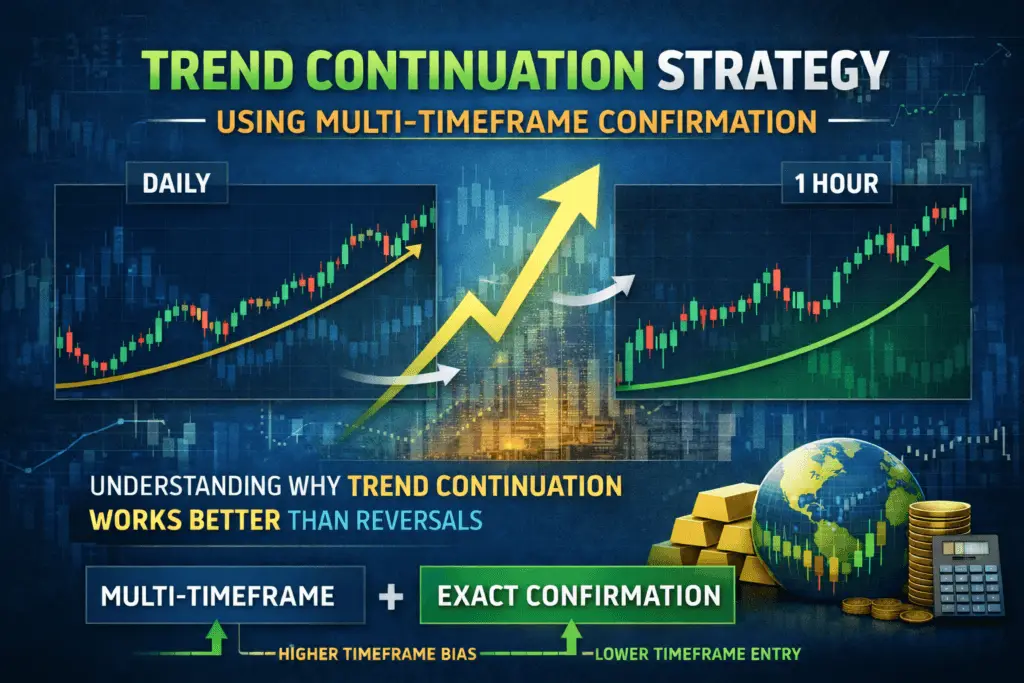
Understanding Why Trend Continuation Works Better Than Reversals Most traders try to predict market turning points. They look for tops, bottoms, and sudden reversals. The problem is that reversals are statistically less frequent than continuation moves. Markets tend to continue in the established direction far longer than most traders expect. A structured Forex trend strategy focuses on joining momentum instead of fighting it. Institutions move markets, and institutions prefer building positions in the direction of prevailing trends. When traders align with this flow using multi timeframe trading, probability increases significantly. Trend continuation trading is not about chasing price. It is about waiting for controlled pullbacks within a confirmed directional structure and entering when the market resumes momentum. Higher Timeframe Bias Is the Foundation Every strong trend begins on a higher timeframe. Daily and 4-hour charts reflect institutional participation. If these timeframes show consistent higher highs and higher lows, the dominant flow is bullish. If they show lower highs and lower lows, the structure is bearish. Without higher timeframe confirmation, traders are simply reacting to noise. A proper Trend continuation setup always begins by asking one question: What is the dominant direction? When higher timeframe bias is clear, lower timeframe entries become much more powerful. Trading against this bias often results in small gains and larger losses because momentum naturally favors the prevailing structure. Why Most Traders Enter Too Early One of the biggest mistakes in trading is confusing momentum with opportunity. Traders often enter during strong expansion candles because they fear missing out. However, expansion is usually the worst location to enter. Institutions typically accumulate during retracements, not during emotional spikes. Pullbacks provide better liquidity and lower risk. This is where multi timeframe trading solves the overtrading problem. Instead of reacting to every movement, traders wait for price to retrace into structure before considering entries. Patience transforms trend trading from gambling into structured decision-making. The Impulse and Pullback Cycle Markets move in repeating cycles: impulse, retracement, continuation. An impulse move shows strength. A retracement shows profit-taking or temporary counter-pressure. The continuation confirms trend persistence. A disciplined Forex trend strategy waits for retracement phases rather than chasing impulse phases. For example, in a bullish trend: The best entries occur during the formation of that higher low — not after the breakout candle closes. Multi-Timeframe Confirmation Explained Clearly Multi-timeframe confirmation simply means aligning entry timeframe with higher timeframe direction. For swing traders:Weekly defines bias, Daily provides entries. For intraday traders:4-hour defines bias, 15-minute or 5-minute provides entries. The higher timeframe answers “where is price likely heading?”Higher timeframes define direction, while lower timeframes refine execution.” When both align, a high-probability Trend continuation setup forms. Structure-Based Risk Management Risk management becomes logical when tied to structure. Stops should not be random distances. They should sit beyond meaningful swing levels. In an uptrend, stop loss belongs below the most recent higher low.In a downtrend, stop belongs above the most recent lower high. This aligns risk with invalidation points rather than emotional fear. A proper Forex trend strategy defines risk before defining reward. This prevents overexposure during volatile conditions. Why Trend Continuation Aligns With Institutional Flow Large institutions cannot enter full positions instantly. They scale in gradually. When price pulls back, liquidity increases and better pricing becomes available. Retail traders chase breakouts. Institutions prefer retracements. By focusing on continuation during pullbacks, traders align themselves with the same logic used by large capital participants. This is why trend continuation strategies work across asset classes, including currencies, commodities, and indices. When Trend Continuation Fails Not all environments support continuation trading. Sideways markets, low liquidity sessions, and major news spikes can distort structure. If higher timeframe shows consolidation, continuation probability decreases. Range conditions require different tactics. Understanding market structure prevents forcing trades where no edge exists. Even the strongest multi timeframe trading approach fails when context is ignored. The Psychology Behind Staying With the Trend Emotionally, traders want excitement. Catching reversals feels impressive. However, continuation requires humility. You are not predicting the future. You are participating in existing momentum. Trend continuation trading reduces ego involvement. You are simply following structure. Consistency in trading often comes from removing the need to be right and replacing it with the need to be aligned. Using Pullbacks to Improve Risk-Reward Entering during retracement allows tighter stops and larger potential upside. This improves risk-reward ratio significantly. For example:Entering after breakout candle may require 40-pip stop.Entering during pullback may require 15-pip stop. Smaller risk with same target improves long-term expectancy. This is why a disciplined Trend continuation setup often outperforms breakout chasing. How Trend Continuation Reduces Overtrading Overtrading happens when traders act on every price movement. Multi-timeframe confirmation filters trades naturally. If higher timeframe bias is unclear, no trade.If retracement is shallow or chaotic, no trade.If structure fails to confirm, no trade. Fewer trades, higher quality. A well-structured Forex trend strategy emphasizes selectivity over frequency. Intraday vs Swing Adaptation Trend continuation works across timeframes because structure behaves consistently. Intraday traders may hold positions for hours. Swing traders may hold for days. The principle remains identical: direction from higher timeframe, entry from lower timeframe. Timeframe changes, logic remains. Why This Strategy Works in Current Market Conditions In recent markets, volatility driven by central bank policy shifts and interest rate expectations has created sustained directional trends. Yield changes, liquidity cycles, and risk sentiment shifts often produce extended moves rather than immediate reversals. This environment favors continuation setups over counter-trend speculation. Traders who apply disciplined multi timeframe trading have clearer structure during these macro-driven cycles. Common Mistakes to Avoid Chasing expansion candles.Ignoring higher timeframe bias.Moving stops emotionally.Overleveraging during pullbacks. Each of these mistakes reduces the probability of success. Structure, patience, and confirmation are the pillars of consistency. Final Thoughts A properly executed Forex trend strategy built on multi timeframe trading principles offers clarity in a market filled with noise. It aligns traders with institutional direction, improves risk management, and reduces emotional decision-making. Trend continuation is not about speed. It is about structure. Higher timeframe defines bias.Lower timeframe
High Probability Forex Breakout Strategy Using Liquidity Zones
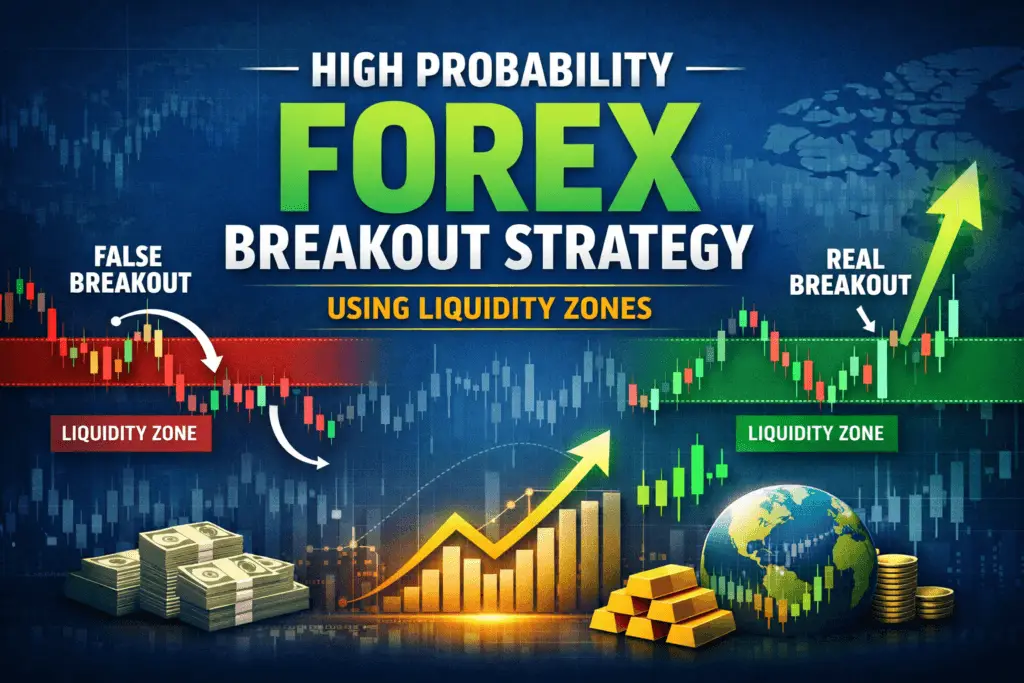
Breakout trading is one of the most popular approaches in the currency market. Every day, traders wait for price to break above resistance or below support, expecting momentum to continue strongly in that direction. However, while breakout trading looks simple, most traders discover that it rarely works consistently. Price breaks a level, triggers entries, and then quickly reverses. The reason most breakouts fail is not because the concept is wrong, but because the execution lacks understanding of liquidity. A high probability Forex breakout strategy does not rely only on visible levels. It combines market structure with liquidity behavior and institutional positioning. When you understand how liquidity functions, breakout trading becomes far more precise and far less emotional. Why most breakouts fail Retail traders are taught to buy when resistance breaks and sell when support breaks. The logic seems straightforward. If a level is broken, price should continue. But the market does not move because of lines on a chart. It moves because of orders. Above recent highs and below recent lows, stop-loss orders accumulate. These clusters of stops create liquidity pools. Large market participants need liquidity to enter or exit positions efficiently. Before a true move begins, price often sweeps these stops. This is why false breakout forex setups occur so frequently. Price briefly pushes beyond a level, triggers stop orders and breakout entries, then reverses sharply once liquidity is collected. Without understanding this process, traders repeatedly enter at the worst possible location. Liquidity zones and why they matter Liquidity zones are areas where orders are concentrated. These areas are often found at equal highs, equal lows, range boundaries, and previous session extremes. They attract price because they contain resting orders. In liquidity trading forex, the trader does not simply react to a breakout. Instead, the trader anticipates where liquidity is resting and waits for the market to interact with it first. When price approaches an obvious level, the question should not be “Will it break?” but rather “Is this level holding liquidity that the market may sweep first?” This shift in perspective dramatically improves breakout accuracy. Identifying real versus false breakouts A real breakout is characterized by expansion and continuation. A false breakout is defined by rejection and lack of follow-through. In a genuine breakout: In a false breakout forex scenario: The key difference is follow-through. Real breakouts expand. False breakouts trap. Liquidity grabs before expansion High probability breakouts often begin with a liquidity grab. This means price temporarily moves beyond an obvious high or low to trigger stop-loss orders before reversing and building momentum in the true direction. For example, during consolidation below resistance, price may briefly spike above resistance. Retail breakout traders enter long. Short sellers’ stops are triggered. Liquidity is absorbed. Then price pulls back slightly before launching into a stronger, sustained move. The first push was a liquidity sweep. The second push is the real breakout. This pattern is common in modern markets, especially during volatile periods influenced by central bank announcements, economic expectations, and risk sentiment shifts. Entry timing after stop runs Instead of entering on the initial breakout candle, a refined Forex breakout strategy waits for confirmation after the liquidity sweep. A high probability sequence includes: Entry is taken after structure confirms direction, not during the first spike. This reduces exposure to traps and aligns the trader with institutional order flow. Patience is critical in this stage. Momentum confirmation is essential Breakouts without momentum are vulnerable. Strong momentum shows commitment. Weak movement shows hesitation. When breakout candles are small, overlapping, or lack follow-through, the probability of failure increases. When breakout candles are wide and close strongly beyond structure, continuation becomes more likely. Momentum validates liquidity behavior. The role of broader market context Breakout reliability improves when aligned with higher timeframe direction. In strong trends, continuation breakouts have higher success rates. In range-bound conditions, breakout traps are more frequent. For example, during strong macro-driven dollar trends, liquidity sweeps often lead to sustained expansion. During low-volatility periods, breakouts may fail repeatedly. A structured liquidity trading forex approach always considers context. Stop placement strategy Many traders place stops just beyond the breakout level. This placement is predictable and often vulnerable to another sweep. A smarter approach is placing stops beyond the liquidity sweep extreme. This protects against minor retests and avoids being part of predictable liquidity clusters. Risk management transforms a strategy from theory into consistent execution. Why patience improves breakout success Many traders lose money not because the strategy is flawed, but because they enter too early. The market frequently tests both sides of liquidity before committing to direction. Patience allows traders to observe whether the breakout is genuine or simply a stop hunt. Waiting for confirmation may reduce early entries, but it improves win rate significantly. Liquidity-based breakout trading rewards discipline over speed. Common mistakes to avoid Chasing the first breakout candle is a major error. Ignoring higher timeframe structure is another. Overtrading during low-liquidity sessions reduces effectiveness. A structured Forex breakout strategy requires context, confirmation, and controlled risk. Final thoughts Breakout trading is not about predicting when price will cross a line. It is about understanding why price moves beyond that line. High probability breakouts occur after liquidity has been collected and structure shifts with momentum. False breakout forex setups occur when traders mistake liquidity sweeps for real expansion. By combining structure analysis with liquidity trading forex, traders significantly improve their consistency and avoid common traps. Markets move toward liquidity before they move toward direction. Traders who understand this trade with clarity. Those who ignore it continue to chase breakouts that were never meant to hold. Visit our Social media pages:https://www.instagram.com/hadyjfx_official/https://www.youtube.com/@hadyjmentor7793https://www.facebook.com/profile.php?id=61562232239915 Join our free telegram channel:https://t.me/hadyjfx
Why Interest Rate Expectations Matter More Than Actual Rate Changes in Forex
In forex markets, some of the strongest price moves occur not when interest rates change, but when they stay exactly the same. Traders often expect major reactions after a rate hike or cut, yet are surprised when currencies barely move—or move sharply in the opposite direction. This confusion comes from misunderstanding how markets process information. Forex markets do not trade interest rates themselves. They trade expectations about future rates. This is why forex interest rate expectations often matter far more than the actual rate decision. To understand the true currency reaction to rates, traders must focus on how expectations shift, not on the headline announcement. expectations versus reality in forex markets Before every central bank meeting, markets already have an opinion. Traders, institutions, and algorithms collectively price in what they believe will happen. By the time the decision is announced, that expectation is already reflected in price. If the outcome matches expectations, the market often shows little reaction. If the outcome contradicts expectations, price can move aggressively—even if the rate itself does not change. This is why reality often matters less than whether expectations were challenged or confirmed. how forward pricing works in forex Forex markets are forward-looking. Prices adjust based on where traders believe interest rates are heading, not where they are today. Yield curves, futures markets, and swap pricing all reflect expected policy paths months in advance. When expectations shift—such as a delay in expected rate cuts or an earlier tightening cycle—currencies adjust immediately. This repricing happens even if the current rate remains unchanged. Understanding forward pricing is essential for interpreting central bank impact on forex. why markets move before rate decisions Currencies often trend well before a rate decision because expectations evolve gradually. Economic data, central bank communication, and global conditions all influence how traders position themselves ahead of meetings. By the time the decision arrives, much of the move may already be complete. The announcement becomes a confirmation event rather than a catalyst. This is why traders sometimes see strong trends into a meeting and limited follow-through afterward. when actual rate changes fail to move the market Rate changes fail to move the market when they are fully anticipated. If a rate hike has been expected for weeks, it is already priced in. Traders may even take profits once the decision is confirmed, causing a reversal. This behavior explains why a currency can fall after a rate hike or rise after a rate cut. The reaction reflects positioning and expectations, not the direction of the rate change itself. how central bank language reshapes expectations Central banks influence markets not only through actions, but through communication. Subtle changes in tone, emphasis, or risk assessment can shift expectations significantly. A rate decision paired with cautious language may weaken a currency. A neutral decision paired with firm guidance may strengthen it. Markets respond to what central banks suggest about the future. This is why press conferences often move currencies more than the rate announcement. currency reaction to rates depends on relative expectations Forex is a relative market. What matters is not just one central bank’s policy, but how it compares to others. A currency strengthens when its expected rate path looks more favorable than alternatives. If one central bank is expected to remain restrictive while others turn accommodative, its currency may strengthen even without any immediate rate change. Relative expectations drive capital flows and long-term trends. why good rate news can be bad for a currency Sometimes positive developments push expectations in an unfavorable direction. Strong economic data or firm policy signals can delay expected easing, tighten financial conditions, or reduce liquidity. In these cases, “good news” can trigger selling because it alters future expectations. This dynamic explains many confusing currency reaction to rates scenarios. interest rate expectations and volatility Shifts in expectations force traders to reposition quickly. This repositioning creates volatility, especially when markets are heavily biased in one direction. Even small changes in outlook can cause large moves if positioning is crowded. Volatility reflects adjustment, not surprise alone. common mistakes traders make with rate decisions Many traders focus only on the headline rate change. Others assume higher rates automatically mean a stronger currency. Ignoring expectations leads to frustration and poor timing. Rate decisions should be viewed as checkpoints, not triggers. Understanding what the market expected—and whether that expectation changed—is far more important. how traders can use interest rate expectations effectively Interest rate expectations should be used as a directional framework. Traders can: This approach reduces emotional reactions and improves consistency. final conclusion: expectations drive forex, not headlines Interest rate expectations matter more than actual rate changes because forex markets are forward-looking. Prices adjust based on what traders believe central banks will do next, not what they just did. This is why forex interest rate expectations shape trends, why currency reaction to rates often feels counterintuitive, and why central bank impact on forex is strongest through guidance and communication. Traders who understand expectations trade with clarity. Those who focus only on headlines often trade confusion. Visit our Social media pages:https://www.instagram.com/hadyjfx_official/https://www.youtube.com/@hadyjmentor7793https://www.facebook.com/profile.php?id=61562232239915 Join our free telegram channel:https://t.me/hadyjfx