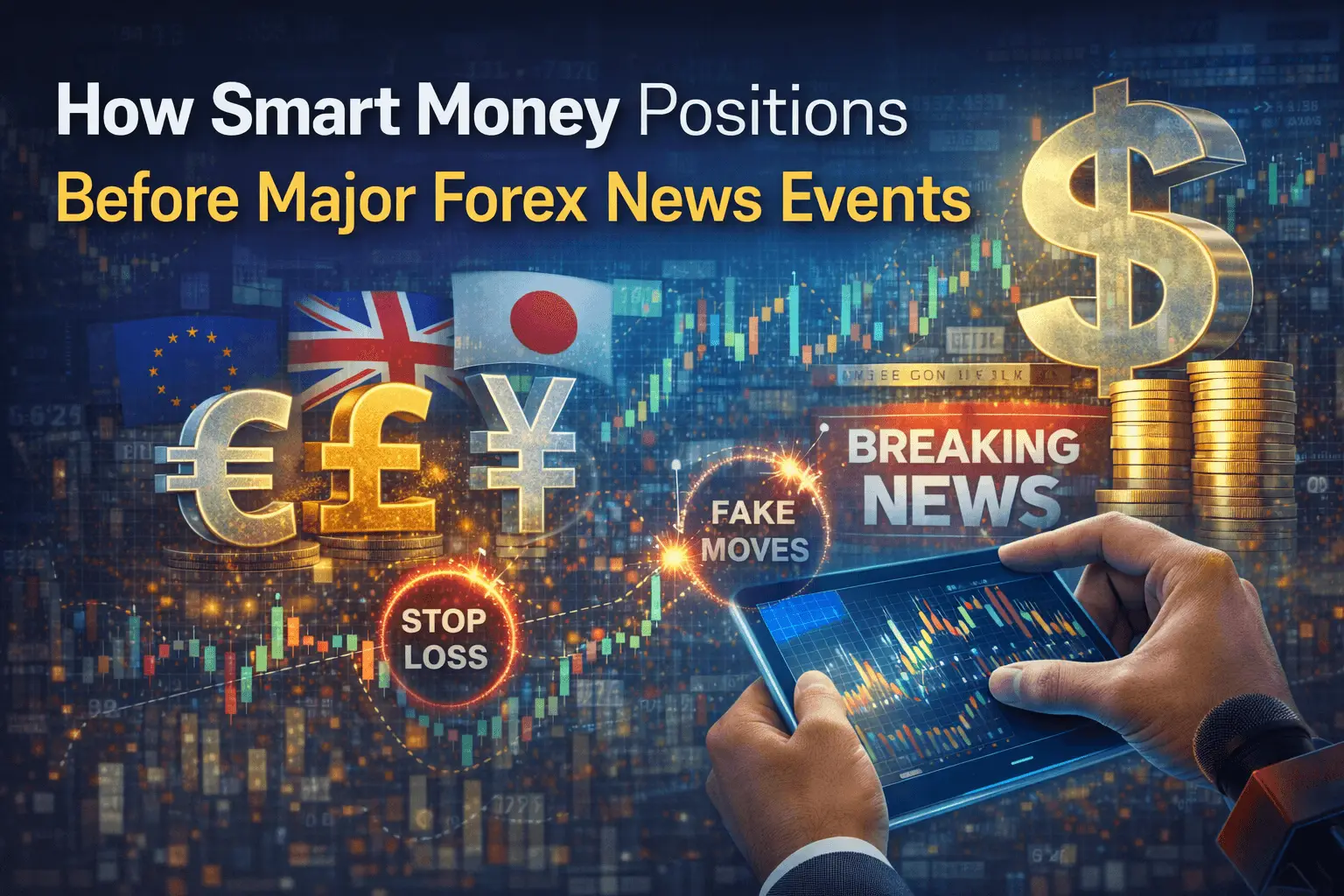
Few moments in forex trading trigger more emotion than major economic news releases. Prices spike, spreads widen, stop losses are hit in seconds, and charts often reverse just as retail traders enter. Many traders walk away believing the market is manipulated or deliberately designed to trap them. In reality, what they are witnessing is the difference between retail reaction and smart money positioning.
Institutions do not trade news the way retail traders do. They prepare for it. Understanding how forex smart moneypositions before major events explains why volatility explodes, why fake moves occur, and why stop hunt forex behavior is so common during news releases. This article breaks down what actually happens behind the scenes and how professional participants approach news trading forex.
What “Smart Money” Really Means in Forex
Smart money refers to institutional participants such as banks, hedge funds, asset managers, and large proprietary trading firms. These players control massive amounts of capital and cannot enter or exit positions instantly without impacting price.
Because of their size, institutions must think ahead. They cannot chase price during news releases. Instead, they position before the event, manage risk through structure, and use volatility to adjust exposure.
Retail traders focus on the number. Smart money focuses on liquidity.
Why Major News Events Create Extreme Volatility
Volatility around news is not random. It is the result of several forces colliding at once. Liquidity temporarily drops as market makers widen spreads. Algorithms react instantly to headlines. Retail traders rush in with market orders. Stops cluster around obvious technical levels.
This combination creates sharp price movement that often has little to do with true direction. Institutions understand this environment well and plan accordingly.
The volatility itself is the opportunity.
Pre-News Positioning: The Hidden Phase Retail Traders Miss
The most important activity happens before the news, not after. Smart money uses the days or weeks leading into an event to gradually build positions at favorable prices.
If institutions expect a longer-term bullish outcome, they often accumulate positions quietly before the release. If they expect downside, they distribute exposure ahead of time. By the time the news arrives, much of the real positioning is already in place.
This is why price often moves sharply against the news reaction shortly after release.
Why News Reactions Often Look Illogical
Retail traders expect price to move cleanly in the direction of the data. Institutions expect liquidity disruption.
When news hits, initial price movement is frequently driven by algorithms and stop orders, not by informed decision-making. Smart money uses this burst of volatility to complete positioning, reduce exposure, or enter at better prices.
This is why many strong-looking breakouts fail within minutes. The market is not choosing direction yet—it is clearing orders.
Stop-Loss Clustering and Liquidity Zones
Retail traders tend to place stop losses in predictable areas: above recent highs, below recent lows, or near round numbers. Institutions are fully aware of this behavior.
During news releases, price often accelerates toward these zones because that is where liquidity exists. When stops are triggered, they become market orders, providing institutions with the liquidity needed to execute large trades.
This process is often described as a stop hunt, but it is better understood as liquidity seeking. Without these clusters, large players could not trade efficiently.
Why Fake Moves Are So Common After News
Fake moves occur because the first reaction is mechanical, not strategic. Algorithms respond to keywords. Retail traders chase momentum. Stops are triggered rapidly.
Only after this initial chaos settles does the market begin to reflect genuine positioning. This is why the second move—often opposite the first—is more reliable than the initial spike.
Smart money waits for volatility to do the work first.
How Institutions Trade News Without Chasing It
Institutions rarely trade at the exact moment of release. Instead, they:
- Reduce exposure before the event
- Observe how price reacts to liquidity zones
- Add or exit positions after volatility stabilizes
They understand that direction becomes clearer after emotional and forced orders are cleared from the market.
This approach contrasts sharply with retail traders who feel pressure to act immediately.
Why News Trading Is So Difficult for Retail Traders
Retail traders face multiple disadvantages during news:
- Slippage
- Spread widening
- Emotional decision-making
- Poor fills
Without deep liquidity access or execution advantages, chasing news becomes a high-risk activity. This is why most retail losses occur around major releases.
The issue is not intelligence—it is structure.
How Smart Money Uses Expectations, Not Headlines
Institutions trade expectations rather than numbers. They compare the data to what the market has already priced in. If news confirms expectations, they may take profits. If it contradicts expectations, they adjust positioning.
This explains why “good news” can lead to selling and “bad news” can trigger rallies. The reaction is about positioning, not the data itself.
Why Volatility Explodes Even When Data Is Neutral
Even neutral data can produce large moves because volatility is driven by uncertainty resolution, not surprise alone. When an event passes, traders rebalance exposure, hedge risk, and reposition.
This repositioning creates movement regardless of whether the data was dramatic.
How Retail Traders Can Avoid Smart Money Traps
Retail traders do not need to compete with institutions. They need to stop reacting emotionally. Smarter approaches include:
- Avoiding entries during the first minutes after news
- Waiting for volatility to settle
- Trading in the direction of higher-timeframe bias
- Reducing position size around releases
Patience is a competitive advantage.
Using News as Context, Not a Trigger
Professional traders use news as context, not as a signal. News helps explain why volatility occurs, but direction is determined by broader trends, liquidity, and positioning.
When traders stop trying to predict the number and start observing how price behaves after the release, consistency improves.
Why Smart Money Behavior Feels Personal (But Isn’t)
Many retail traders feel targeted during news events. In reality, institutions are not trading against individuals. They are trading against liquidity patterns.
Stops are not hunted because traders are wrong—they are triggered because they are predictable.
Understanding this removes emotion from the process.
Final Conclusion: How Smart Money Really Trades Forex News
Smart money does not chase news. It prepares for it. Institutions position ahead of events, allow volatility to clear liquidity, and then act once structure returns.
This is why forex smart moneyconsistently outperforms emotional news trading forex approaches. Stop hunts, fake moves, and sharp reversals are not signs of manipulation—they are signs of professional execution.
For retail traders, the lesson is simple: stop racing the market. Let volatility pass. Read price behavior, not headlines.
Those who understand smart money behavior trade with awareness. Those who ignore it continue to trade emotion.
Visit our Social media pages:
https://www.instagram.com/hadyjfx_official/
https://www.youtube.com/@hadyjmentor7793
https://www.facebook.com/profile.php?id=61562232239915
Join our free telegram channel:
https://t.me/hadyjfx
1 Comment
[…] Join our free telegram channel:https://t.me/hadyjfxWeb post: https://hadyjfx.com/how-smart-money-positions-before-major-forex-news-events/ […]