Advanced Breaker Block Strategy: Smart Money Trap Reversal Model
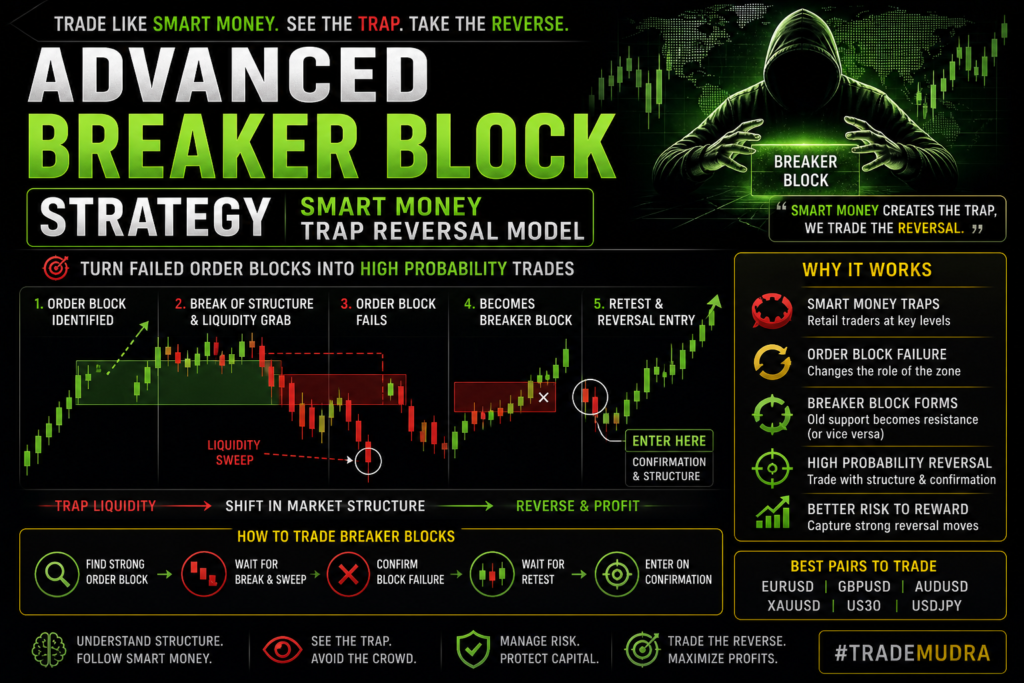
In forex trading, one of the most misunderstood concepts is why strong support or resistance zones suddenly fail. Traders often enter trades based on order blocks or key levels, only to see price break through and move aggressively in the opposite direction. This is not random behavior—it is a result of smart money manipulation. Institutions often create traps by invalidating key zones to capture liquidity. This phenomenon leads to the formation of breaker blocks. Understanding this concept can give traders a significant edge. This is where breaker block trading strategy, smart money trap reversal, and failed order block concept become essential. Most retail traders assume that every order block will hold. However, professional traders know that when a strong level fails, it often creates an even stronger opportunity in the opposite direction. By mastering breaker block trading strategy, smart money trap reversal, and failed order block concept, traders can turn losing setups into high-probability trades. What is a Breaker Block A breaker block is formed when an order block fails and price breaks through it with strong momentum. Instead of acting as support or resistance, the broken zone flips its role. For example, a bullish order block that fails can become resistance. A bearish order block that fails can become support. This shift happens because traders who entered positions at the original zone are trapped. Their stop losses and exits create liquidity for the new move. This concept is the foundation of breaker block trading strategy, smart money trap reversal, and failed order block concept. Why Breaker Blocks Work Breaker blocks work because they represent trapped traders. When price breaks an order block, traders who expected it to hold are forced to exit their positions. This creates additional momentum in the direction of the breakout. Institutions use this liquidity to push price further. As a result, the broken level becomes a strong zone for future reactions. Understanding this behavior is key to breaker block trading strategy, smart money trap reversal, and failed order block concept. Difference Between Order Block and Breaker Block Order blocks are zones where institutions enter positions, expecting price to react. Breaker blocks, on the other hand, are formed when these zones fail. While order blocks are used for continuation trades, breaker blocks are used for reversal trades. Recognizing the transition from order block to breaker block is essential for applying breaker block trading strategy, smart money trap reversal, and failed order block concept effectively. How Breaker Blocks Are Formed Breaker blocks form through a specific sequence. First, price creates a strong order block. Next, traders enter positions expecting a reaction. Then, price breaks through the zone, triggering stop losses. Finally, price returns to the broken zone, which now acts as a new support or resistance. This sequence is central to breaker block trading strategy, smart money trap reversal, and failed order block concept. Market Structure and Breaker Blocks Market structure plays an important role in identifying breaker blocks. A break of structure often confirms the failure of an order block. A change of character may signal the beginning of a reversal. By combining these concepts, traders can identify high-probability setups. This integration strengthens breaker block trading strategy, smart money trap reversal, and failed order block concept. Step-by-Step Breaker Block Strategy The first step is identifying a strong order block. Next, observe whether price respects or breaks the zone. If the zone fails with strong momentum, mark it as a potential breaker block. Wait for price to return to this zone. Look for confirmation before entering trades. This structured approach defines breaker block trading strategy, smart money trap reversal, and failed order block concept. Entry Confirmation Techniques Confirmation is essential to avoid false signals. Traders should look for rejection candles showing strong reaction. Break of structure confirms the new direction. Liquidity sweeps provide additional confirmation. These signals improve accuracy in breaker block trading strategy, smart money trap reversal, and failed order block concept. Bullish Breaker Block Example Price is in a downtrend and forms a bearish order block. Traders expect price to drop from this zone. However, price breaks above the order block with strong momentum. This creates a bullish breaker block. When price returns to this zone, it acts as support. Traders can enter buy trades with stops below the zone. This setup reflects breaker block trading strategy, smart money trap reversal, and failed order block concept. Bearish Breaker Block Example Price is in an uptrend and forms a bullish order block. Traders expect price to rise, but it breaks below the zone. This creates a bearish breaker block. When price returns to the zone, it acts as resistance. Traders can enter sell trades with proper risk management. This example demonstrates breaker block trading strategy, smart money trap reversal, and failed order block concept. Risk Management in Breaker Block Trading Risk management is essential for success. Stop losses should be placed beyond the breaker block zone. Position size should be controlled to manage risk. Risk reward ratio should be favorable. These principles support breaker block trading strategy, smart money trap reversal, and failed order block concept. Multi-Timeframe Analysis Using multiple timeframes improves accuracy. Higher timeframes help identify major order blocks and structure. Lower timeframes provide precise entry points. This approach enhances breaker block trading strategy, smart money trap reversal, and failed order block concept. Combining Breaker Blocks with Other Concepts Breaker blocks become more powerful when combined with other smart money concepts. Liquidity sweeps confirm market intent. Fair value gaps provide additional entry zones. Trend analysis ensures alignment with market direction. This combination strengthens breaker block trading strategy, smart money trap reversal, and failed order block concept. Common Mistakes Traders Make Many traders assume every broken level is a breaker block. Another mistake is entering trades without confirmation. Ignoring market structure and overtrading also lead to losses. Avoiding these mistakes is crucial for mastering breaker block trading strategy, smart money trap reversal, and failed order block concept. Psychology Behind Breaker Blocks Breaker blocks reflect trader
Session Liquidity Rotation Strategy: Trade Currency Strength Between Sessions
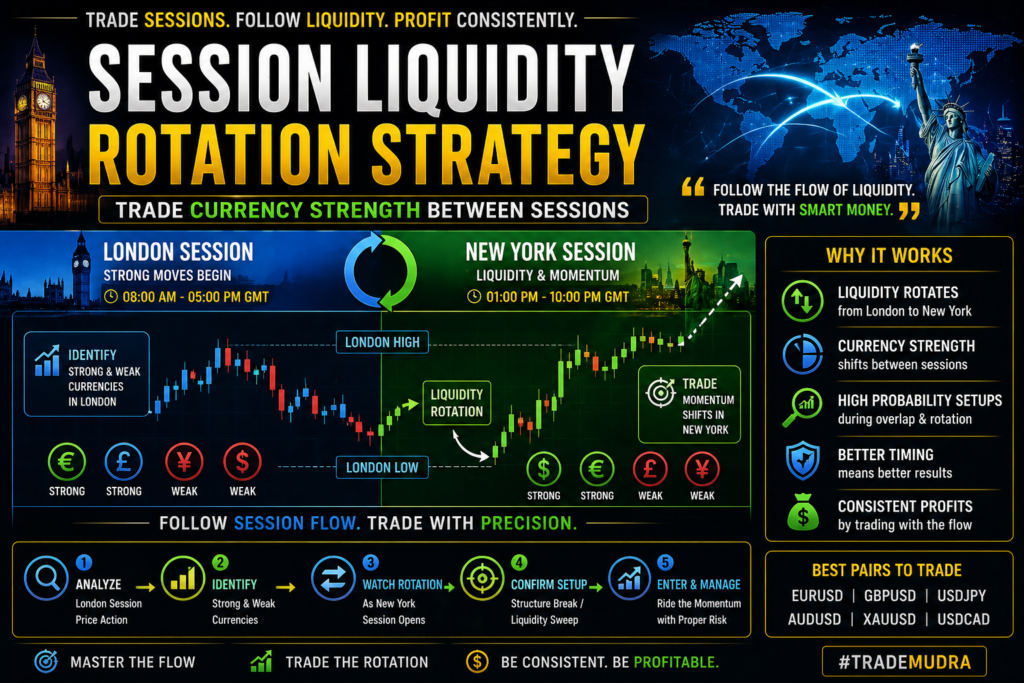
Forex trading is not just about indicators or patterns. One of the most important factors that many traders ignore is timing. The market behaves differently during different trading sessions, and understanding this behavior can give traders a strong advantage. The concept of session liquidity rotation focuses on how money flows from one market session to another, especially between the London and New York sessions. This is where session liquidity rotation strategy, currency strength trading forex, and intraday session trading become essential. Many beginners enter trades randomly without considering which session they are trading in. As a result, they face low volatility, fake moves, or inconsistent results. Professional traders, on the other hand, focus on session timing and liquidity flow. By understanding session liquidity rotation strategy, currency strength trading forex, and intraday session trading, traders can align their trades with high-probability market movements. What is Session Liquidity in Forex Liquidity refers to the availability of buyers and sellers in the market. In forex, liquidity changes throughout the day depending on which financial centers are active. The market is divided into major sessions such as the Asian session, London session, and New York session. Each session has its own characteristics in terms of volatility and trading volume. Liquidity increases when major markets overlap. This creates strong price movements and better trading opportunities. Understanding this concept is the foundation of session liquidity rotation strategy, currency strength trading forex, and intraday session trading. Understanding Market Sessions The forex market operates 24 hours a day, but not all hours are equal. The Asian session is usually slow and range-bound. The London session brings high volatility and strong trends. The New York session adds further momentum and often creates reversals or continuations. The most important period is the overlap between London and New York sessions. This is when liquidity is at its peak. This behavior is central to session liquidity rotation strategy, currency strength trading forex, and intraday session trading. What is Liquidity Rotation Liquidity rotation refers to the shift of market activity from one session to another. For example, a currency may be strong during the London session but lose momentum during the New York session. At the same time, another currency may gain strength. This rotation creates trading opportunities. Traders who understand these shifts can anticipate market direction instead of reacting to it. This concept is a key part of session liquidity rotation strategy, currency strength trading forex, and intraday session trading. Why London and New York Sessions Matter Most The London and New York sessions are the most important for forex trading because they involve major financial institutions. London is the largest forex trading center in the world. It sets the initial direction for the day. New York follows London and often either continues the trend or reverses it. The interaction between these two sessions creates strong market movements. This makes them ideal for applying session liquidity rotation strategy, currency strength trading forex, and intraday session trading. Currency Strength and Weakness Currency strength refers to how strong or weak a currency is compared to others. For example, if the euro is strong and the dollar is weak, the EUR/USD pair is likely to move upward. Strength and weakness change throughout the day based on economic data, market sentiment, and liquidity flow. Understanding these shifts is essential for session liquidity rotation strategy, currency strength trading forex, and intraday session trading. How to Identify Currency Strength There are several ways to identify currency strength. Traders can observe price action and trends. They can use currency strength meters. They can analyze economic news and events. Strong currencies tend to show consistent movement, while weak currencies struggle to gain momentum. This analysis supports session liquidity rotation strategy, currency strength trading forex, and intraday session trading. Session Liquidity Rotation Strategy Explained The strategy focuses on tracking how currency strength changes from the London session to the New York session. During the London session, traders identify the strongest and weakest currencies. This helps determine the initial market direction. As the New York session begins, traders observe whether the same trend continues or if a reversal occurs. Trades are taken based on this shift in momentum. This structured approach defines session liquidity rotation strategy, currency strength trading forex, and intraday session trading. Step-by-Step Strategy Setup First, identify the London session high and low. Next, observe the direction of the market during London. Determine which currency is strong and which is weak. Then, wait for the New York session to open. Watch how price reacts to the London levels. If the trend continues, traders can enter in the same direction. If there is a reversal, traders can look for opposite trades. This process is the core of session liquidity rotation strategy, currency strength trading forex, and intraday session trading. Entry Confirmation Techniques Confirmation is important to avoid false signals. Traders should look for break of structure in the direction of the trade. Liquidity sweeps can indicate smart money activity. Rejection candles show strong market reaction. These signals help traders enter with confidence and improve accuracy in session liquidity rotation strategy, currency strength trading forex, and intraday session trading. Example of Trend Continuation Trade During the London session, EUR/USD shows strong bullish movement. As the New York session opens, price retraces slightly but continues upward. A break of structure confirms the continuation. Traders can enter buy trades with proper risk management. This example shows session liquidity rotation strategy, currency strength trading forex, and intraday session trading in action. Example of Reversal Trade During the London session, GBP/USD moves upward. At the New York open, price sweeps liquidity above highs and reverses downward. A break of structure confirms the bearish move. Traders can enter sell trades. This setup reflects session liquidity rotation strategy, currency strength trading forex, and intraday session trading. Risk Management in Session Trading Risk management is essential for long-term success. Stop losses should be placed beyond key levels such as highs and lows. Position size should be controlled to
Liquidity Void Trading Strategy: How to Trade Fast Price Movements Efficiently
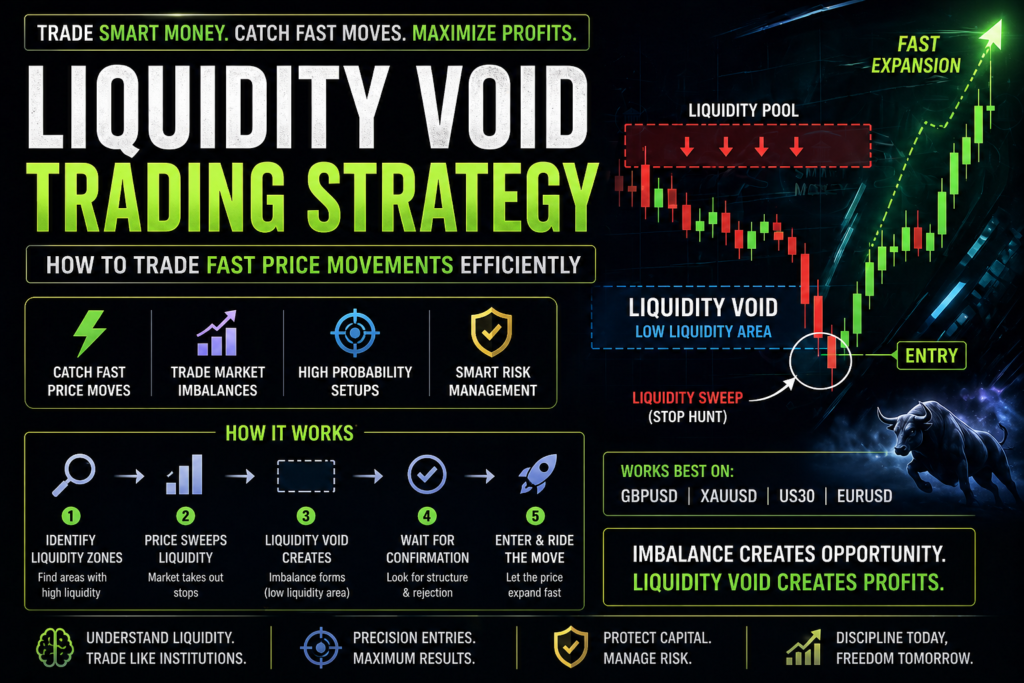
In the forex market, some of the fastest and most powerful price movements occur when there is an imbalance between buyers and sellers. These rapid moves often leave behind areas where little to no trading activity has taken place. These areas are known as liquidity voids. For traders who understand how to identify and trade these zones, they offer high-probability opportunities with strong momentum. This is where liquidity void trading strategy, imbalance trading forex, and smart money fast moves become essential. Most retail traders struggle to understand why price suddenly moves aggressively in one direction. They often enter late or get caught in reversals. However, professional traders recognize that these moves are not random—they are driven by liquidity gaps and institutional activity. By mastering liquidity void trading strategy, imbalance trading forex, and smart money fast moves, traders can enter trades earlier and ride strong market momentum. What is a Liquidity Void A liquidity void is a price area where minimal trading activity has occurred due to a strong and impulsive move. This happens when price moves quickly, leaving little opportunity for orders to be filled at intermediate levels. These zones represent inefficiencies in the market. Because price moved too fast, the market often revisits these areas later to rebalance. Liquidity voids are closely related to fair value gaps but are typically larger and more aggressive. Understanding this concept is fundamental to liquidity void trading strategy, imbalance trading forex, and smart money fast moves. Why Liquidity Voids Are Created Liquidity voids are created when there is a sudden imbalance between buying and selling pressure. This often happens due to institutional orders, major news events, or strong market sentiment. When large players enter the market, price can move rapidly, skipping levels. As a result, certain price areas are left with low liquidity. These become targets for future price action. This behavior is central to liquidity void trading strategy, imbalance trading forex, and smart money fast moves. Characteristics of Liquidity Voids Liquidity voids have specific features that make them easy to identify. They are formed during strong impulsive moves with large candles. There is little overlap between candles, showing rapid price movement. They often appear after breakouts or major news events. Price tends to revisit these areas later. Recognizing these characteristics is essential for applying liquidity void trading strategy, imbalance trading forex, and smart money fast moves effectively. Difference Between Liquidity Void and Fair Value Gap While both concepts involve imbalances, there are key differences. A fair value gap is usually smaller and occurs between three candles. A liquidity void is larger and spans a wider price range. Liquidity voids are associated with strong momentum, while FVGs are more precise entry zones. Understanding this distinction improves accuracy in liquidity void trading strategy, imbalance trading forex, and smart money fast moves. How Price Reacts to Liquidity Voids Price behavior around liquidity voids follows predictable patterns. After a strong move, price may continue in the same direction without returning immediately. This is known as continuation. In other cases, price retraces into the void to fill the imbalance before continuing. Sometimes, liquidity voids act as support or resistance zones. These reactions form the basis of liquidity void trading strategy, imbalance trading forex, and smart money fast moves. Trading Strategy: Continuation Setup One way to trade liquidity voids is through continuation setups. When price creates a void during a strong trend, it often continues in the same direction. Traders can enter trades on minor pullbacks within the trend, targeting further movement. This approach aligns with liquidity void trading strategy, imbalance trading forex, and smart money fast moves. Trading Strategy: Retracement Entry Another approach is to wait for price to return to the liquidity void. When price retraces into the void, traders look for confirmation signals such as rejection or structure breaks. This provides a high-probability entry with better risk reward. This method is widely used in liquidity void trading strategy, imbalance trading forex, and smart money fast moves. Entry Confirmation Techniques Entering trades without confirmation can be risky. Traders should look for strong rejection candles, indicating a reaction from the void. Break of structure confirms the direction of the move. Liquidity sweeps provide additional confirmation. These signals improve accuracy in liquidity void trading strategy, imbalance trading forex, and smart money fast moves. Example of Bullish Liquidity Void Trade Price moves upward aggressively, creating a liquidity void. After the move, price retraces into the void. It shows rejection and forms higher lows. A break of structure confirms continuation. Traders can enter buy trades with stops below the retracement. This setup reflects liquidity void trading strategy, imbalance trading forex, and smart money fast moves. Example of Bearish Liquidity Void Trade Price drops sharply, creating a liquidity void. It retraces upward into the void and shows rejection. A break of structure confirms the bearish move. Traders can enter sell trades with stops above the retracement. This example demonstrates liquidity void trading strategy, imbalance trading forex, and smart money fast moves. Risk Management in Liquidity Void Trading Risk management is critical due to the fast nature of these moves. Stop losses should be placed beyond key levels or outside the void. Position size must be controlled to avoid large losses. Risk reward ratios should be favorable to ensure profitability. Proper risk control supports liquidity void trading strategy, imbalance trading forex, and smart money fast moves. Multi-Timeframe Analysis Using multiple timeframes improves trade accuracy. Higher timeframes help identify major liquidity voids and overall trend. Lower timeframes provide precise entry points. This approach enhances liquidity void trading strategy, imbalance trading forex, and smart money fast moves. Combining Liquidity Void with Smart Money Concepts Liquidity voids become more powerful when combined with other concepts. Order blocks provide strong entry zones. Liquidity sweeps confirm market intent. Market structure ensures alignment with trend. This combination strengthens liquidity void trading strategy, imbalance trading forex, and smart money fast moves. Common Mistakes to Avoid Many traders enter trades too late after the move has already happened. Another
AI-Based Forex Trading Strategy: Using Smart Algorithms for Precision Entries

The forex market is evolving rapidly, and traditional trading methods are no longer enough to stay competitive. In 2026, artificial intelligence is transforming the way traders analyze markets, execute trades, and manage risk. Instead of relying solely on manual analysis, traders are now leveraging smart algorithms to make faster and more accurate decisions. This shift is creating a new era of trading where data, automation, and machine learning play a central role. This is where AI forex trading strategy, algorithmic trading systems, and data-driven trading models become essential. Artificial intelligence allows traders to process massive amounts of data in seconds. It can identify patterns, predict market behavior, and execute trades with precision. Unlike human traders, AI systems are not affected by emotions such as fear or greed. This makes them highly effective in maintaining discipline and consistency. Understanding AI forex trading strategy, algorithmic trading systems, and data-driven trading models can give traders a significant edge in modern markets. What is AI-Based Forex Trading AI-based forex trading refers to the use of artificial intelligence and machine learning algorithms to analyze market data and execute trades. These systems are designed to learn from historical data and adapt to changing market conditions. Unlike traditional strategies, AI does not rely on fixed rules. Instead, it evolves based on new data and market behavior. This makes it more flexible and efficient. AI systems can analyze price action, volume, news, and even sentiment data from social media. This multi-dimensional analysis improves accuracy and decision-making. This concept forms the foundation of AI forex trading strategy, algorithmic trading systems, and data-driven trading models. How Smart Algorithms Work in Forex Smart algorithms follow a structured process to generate trading signals. First, they collect large amounts of historical and real-time data. This includes price movements, economic indicators, and market sentiment. Next, they analyze this data using mathematical models and machine learning techniques. These models identify patterns that are not visible to the human eye. Finally, the system generates trade signals and executes them automatically or with minimal human intervention. This process defines AI forex trading strategy, algorithmic trading systems, and data-driven trading models. Types of AI Trading Strategies There are several types of AI-based strategies used in forex trading. Trend-following algorithms identify strong market trends and trade in the same direction. Mean reversion models look for overbought or oversold conditions and trade reversals. Arbitrage systems exploit price differences across different markets. Sentiment analysis models use news and social media data to predict market direction. Each type offers unique advantages and contributes to AI forex trading strategy, algorithmic trading systems, and data-driven trading models. Advantages of AI in Forex Trading AI provides several advantages over traditional trading methods. It eliminates emotional decision-making, ensuring consistent execution. It processes data faster than humans, allowing quick responses to market changes. It can operate 24/7 without fatigue, making it ideal for forex markets. It improves accuracy by analyzing multiple factors simultaneously. These benefits make AI forex trading strategy, algorithmic trading systems, and data-driven trading models highly effective in modern trading. Role of Machine Learning in Trading Machine learning is a key component of AI trading systems. It allows algorithms to learn from past data and improve over time. As the system processes more data, its predictions become more accurate. Machine learning models can adapt to different market conditions, making them more reliable than static strategies. This adaptability is essential for AI forex trading strategy, algorithmic trading systems, and data-driven trading models. Data Sources Used in AI Trading AI systems rely on multiple data sources to make decisions. Price data is the most basic input, including open, high, low, and close values. Economic data such as interest rates and inflation provide macro insights. News and sentiment data help predict market reactions. Volume and liquidity data reveal institutional activity. Combining these sources enhances AI forex trading strategy, algorithmic trading systems, and data-driven trading models. Building an AI Trading Strategy Creating an AI-based trading strategy involves several steps. First, define the trading objective, such as trend-following or reversal trading. Next, collect and clean historical data for analysis. Then, choose a suitable machine learning model. Train the model using historical data and test its performance. Finally, deploy the system in live markets with proper risk controls. This structured approach is essential for AI forex trading strategy, algorithmic trading systems, and data-driven trading models. Backtesting and Optimization Backtesting is crucial for evaluating an AI trading strategy. It involves testing the strategy on historical data to measure its performance. This helps identify strengths and weaknesses. Optimization improves the strategy by adjusting parameters for better results. However, over-optimization should be avoided as it can reduce real-world performance. Proper testing supports AI forex trading strategy, algorithmic trading systems, and data-driven trading models. Risk Management in AI Trading Risk management remains essential even with advanced technology. Stop losses should be integrated into the algorithm to limit losses. Position sizing should be controlled based on account size. Diversification can reduce overall risk. AI systems can automate risk management, ensuring consistent application. This strengthens AI forex trading strategy, algorithmic trading systems, and data-driven trading models. Multi-Timeframe Analysis with AI AI systems can analyze multiple timeframes simultaneously. Higher timeframes provide the overall trend, while lower timeframes offer precise entries. This multi-layered analysis improves accuracy and reduces false signals. It is an important aspect of AI forex trading strategy, algorithmic trading systems, and data-driven trading models. Combining AI with Smart Money Concepts AI can be combined with smart money concepts for better results. Algorithms can identify liquidity zones, order blocks, and fair value gaps. They can detect stop hunts and market manipulation patterns. This combination enhances precision and aligns trading with institutional behavior. It represents the future of AI forex trading strategy, algorithmic trading systems, and data-driven trading models. Common Mistakes in AI Trading Many traders make mistakes when using AI. Relying completely on automation without understanding the system can be risky. Using poor-quality data can lead to inaccurate predictions. Over-optimizing strategies can reduce real-world performance. Avoiding
Liquidity Grab Reversal Strategy: Trade Smart Money Stop Hunts with Precision
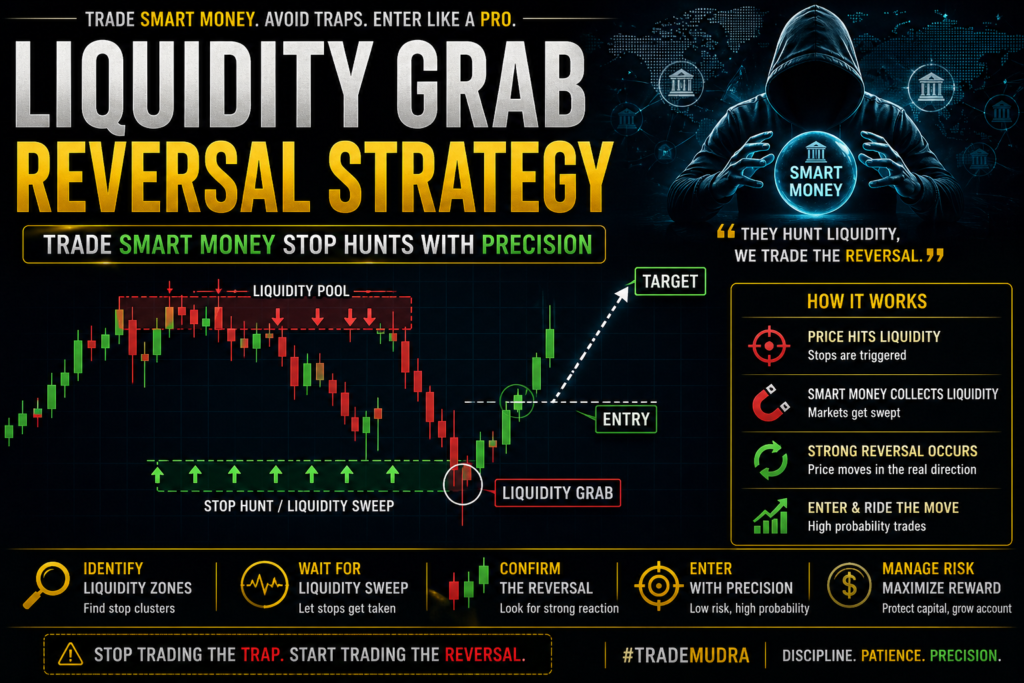
In the forex market, many traders experience the same frustrating pattern—price hits their stop loss and then moves in the expected direction. This is not bad luck; it is a result of how the market is designed. Institutions and large players require liquidity to execute trades, and they often create movements that target retail traders’ stop losses. This process is known as a liquidity grab. Understanding how to trade these stop hunts can transform your trading results. This is where liquidity grab reversal strategy, stop hunt trading forex, and smart money reversal setups become essential. Retail traders often chase breakouts or enter trades at obvious levels. Institutions take advantage of this behavior by pushing price into those areas to collect liquidity. Once enough liquidity is gathered, the market reverses. By learning liquidity grab reversal strategy, stop hunt trading forex, and smart money reversal setups, traders can stop being trapped and start trading alongside institutions. What is a Liquidity Grab in Forex A liquidity grab is a price movement designed to trigger stop losses and pending orders. It occurs when price moves beyond key levels such as highs, lows, or support and resistance zones. These levels are where retail traders typically place stop losses. When price reaches these areas, a large number of orders are triggered, creating liquidity. Institutions use this liquidity to enter or exit trades. Once their orders are filled, price often reverses direction. This concept is central to liquidity grab reversal strategy, stop hunt trading forex, and smart money reversal setups. Why Liquidity Grabs Happen Liquidity grabs occur because institutions need volume to execute large trades. Without sufficient liquidity, their orders would significantly move the market. To solve this, they push price into areas where orders are concentrated. This creates the necessary liquidity for them to operate. This process explains why price often moves against retail traders before reversing. Understanding this behavior is key to liquidity grab reversal strategy, stop hunt trading forex, and smart money reversal setups. Common Areas Where Liquidity Exists Liquidity is usually found in predictable areas. Above equal highs, where stop losses of sellers are placed. Below equal lows, where stop losses of buyers are located. Around support and resistance levels. Near trendlines and psychological price levels. These zones act as targets for liquidity grabs. Identifying them is crucial for applying liquidity grab reversal strategy, stop hunt trading forex, and smart money reversal setups. What is a Liquidity Sweep A liquidity sweep is the actual movement where price takes out these liquidity zones. It is often sharp and quick, creating the illusion of a breakout. After sweeping liquidity, price usually reverses direction. This reversal provides trading opportunities. Understanding the difference between a breakout and a liquidity sweep is essential for liquidity grab reversal strategy, stop hunt trading forex, and smart money reversal setups. Difference Between Breakout and Liquidity Grab A breakout continues in the same direction after breaking a level, while a liquidity grab reverses after the break. Breakouts are usually supported by strong momentum and follow-through. Liquidity grabs often show rejection, such as long wicks or quick reversals. Recognizing this difference helps traders avoid false entries and improves decision-making. This distinction is a key part of liquidity grab reversal strategy, stop hunt trading forex, and smart money reversal setups. Market Structure and Liquidity Grabs Market structure plays an important role in identifying liquidity grabs. In an uptrend, price may move downward to sweep sell-side liquidity before continuing upward. In a downtrend, price may move upward to sweep buy-side liquidity before dropping. These movements are part of the market’s natural behavior. Understanding this helps traders align with liquidity grab reversal strategy, stop hunt trading forex, and smart money reversal setups. Step-by-Step Liquidity Grab Reversal Strategy The first step is identifying key liquidity zones. Look for equal highs, equal lows, and major levels. Next, wait for price to sweep these zones. Do not enter trades immediately. Observe price action after the sweep. Look for signs of rejection or reversal. Enter the trade only after confirmation. This approach aligns with liquidity grab reversal strategy, stop hunt trading forex, and smart money reversal setups. Entry Confirmation Techniques Confirmation is essential to avoid false signals. Look for rejection candles with long wicks. Watch for break of structure in the opposite direction. Observe strong momentum away from the liquidity zone. These signals indicate that the market is likely reversing. Using confirmation improves accuracy in liquidity grab reversal strategy, stop hunt trading forex, and smart money reversal setups. Example of Bullish Reversal Setup Price is in an uptrend and retraces downward. It sweeps previous lows, triggering sell stops. After the sweep, price shows strong rejection and starts moving upward. A break of structure confirms the reversal. Traders can enter buy trades with stops below the sweep. This is a practical example of liquidity grab reversal strategy, stop hunt trading forex, and smart money reversal setups. Example of Bearish Reversal Setup Price is in a downtrend and moves upward to sweep previous highs. After triggering buy stops, price shows rejection and starts moving downward. A break of structure confirms the bearish move. Once confirmation appears, traders can take short positions while following strict risk control rules. This setup reflects liquidity grab reversal strategy, stop hunt trading forex, and smart money reversal setups. Risk Management in Liquidity Trading Risk management is critical for long-term success. Stop losses should be placed beyond the liquidity zone to avoid being triggered again. Trade size should be carefully adjusted to keep risk under control and protect capital. Maintaining a proper risk reward ratio ensures profitability over time. These principles support liquidity grab reversal strategy, stop hunt trading forex, and smart money reversal setups. Multi-Timeframe Approach Using multiple timeframes improves accuracy. Higher timeframes help identify major liquidity zones and overall trend. Lower timeframes provide precise entry points after the sweep. This approach enhances liquidity grab reversal strategy, stop hunt trading forex, and smart money reversal setups. Common Mistakes Traders Make Many traders enter trades too early
Supply and Demand Trading Strategy: Institutional Zones for High RR Trades
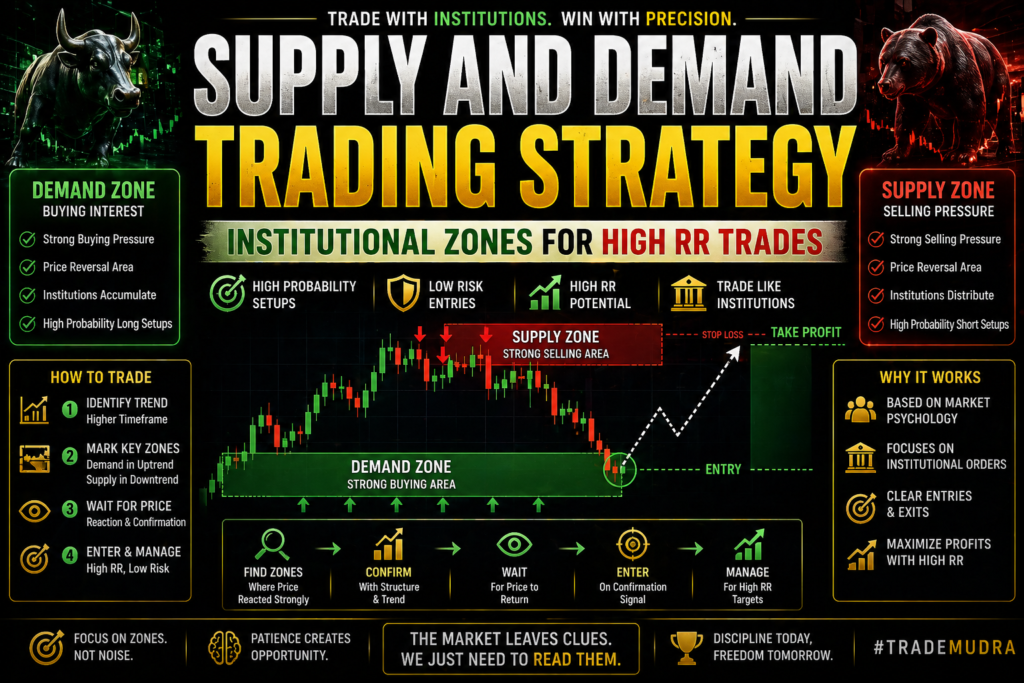
In the forex market, price moves based on imbalance between buyers and sellers. While many traders rely on indicators, professional traders focus on areas where large orders are placed. These areas are known as supply and demand zones. Understanding how to identify and trade these zones can significantly improve trading accuracy and risk reward ratio. This is where supply and demand trading strategy, institutional zone trading, and high RR forex setups become essential. Most retail traders enter trades randomly without understanding where institutions are active. This leads to poor entries and unnecessary losses. Supply and demand zones provide a structured way to trade by focusing on areas where price is most likely to react. By mastering supply and demand trading strategy, institutional zone trading, and high RR forex setups, traders can align with smart money and improve consistency. What is Supply and Demand in Forex Supply and demand represent the balance between sellers and buyers in the market. When demand is stronger than supply, price moves upward. When supply is stronger than demand, price moves downward. Supply zones are areas where selling pressure is strong, causing price to drop. Demand zones are areas where buying pressure is strong, causing price to rise. These zones are created by institutional activity. Large players place significant orders in these areas, which leads to strong price reactions. This concept is central to supply and demand trading strategy, institutional zone trading, and high RR forex setups. Why Supply and Demand Zones Work Supply and demand zones work because they reflect real market behavior. Institutions cannot execute large trades instantly, so they build positions in specific areas. When price returns to these zones, institutions often continue their activity, causing price to react again. This creates high-probability trading opportunities. Unlike indicators, which lag behind price, supply and demand zones provide real-time insights. This makes supply and demand trading strategy, institutional zone trading, and high RR forex setups highly effective. Difference Between Support Resistance and Supply Demand Many traders confuse supply and demand with support and resistance. While they are related, they are not the same. Support and resistance are horizontal levels where price reacts. Supply and demand are zones where strong buying or selling occurred. Supply and demand zones are more dynamic and reflect institutional activity. They provide deeper insights compared to simple support and resistance. Understanding this difference is important for applying supply and demand trading strategy, institutional zone trading, and high RR forex setups. Types of Supply and Demand Zones There are mainly two types of zones: supply zones and demand zones. Supply zones are formed when price drops sharply after a consolidation. These zones act as resistance. Demand zones are formed when price rises strongly after consolidation. These zones act as support. Another classification includes fresh zones and tested zones. Fresh zones are more reliable because price has not revisited them yet. These types are essential for mastering supply and demand trading strategy, institutional zone trading, and high RR forex setups. How to Identify Strong Zones Not all zones are equal. Strong zones have specific characteristics. They are formed after strong impulsive moves, indicating institutional involvement. They often break market structure, confirming their importance. Strong zones have little or no overlap with previous price action. They are clean and well-defined. These factors help traders identify high-quality setups using supply and demand trading strategy, institutional zone trading, and high RR forex setups. Market Structure and Zone Alignment Market structure plays a key role in supply and demand trading. In an uptrend, traders should focus on demand zones for buying opportunities. In a downtrend, supply zones are more relevant. Trading in alignment with market structure increases the probability of success. This combination strengthens supply and demand trading strategy, institutional zone trading, and high RR forex setups. Entry Strategy Using Supply and Demand A proper entry strategy is essential for success. First, identify the overall trend using market structure. Then, mark key supply and demand zones on the chart. Wait for price to return to these zones. Do not enter trades blindly. Look for confirmation such as rejection candles, liquidity sweeps, or break of structure. This approach aligns with supply and demand trading strategy, institutional zone trading, and high RR forex setups. Risk Reward Advantage of Zone Trading One of the biggest advantages of supply and demand trading is high risk reward ratio. Entries are taken near the edges of zones, allowing tight stop losses. Targets are usually far from the entry point. This creates favorable risk reward setups, often 1:2 or higher. This benefit makes supply and demand trading strategy, institutional zone trading, and high RR forex setups highly attractive. Stop Loss and Take Profit Placement Stop loss placement should be logical and based on zone structure. For demand zones, stop loss is placed below the zone. For supply zones, it is placed above the zone. Take profit levels can be set at opposing zones or key liquidity levels. Proper placement ensures effective risk management in supply and demand trading strategy, institutional zone trading, and high RR forex setups. Multi-Timeframe Approach Using multiple timeframes improves accuracy. Higher timeframes provide strong zones and overall trend. Lower timeframes offer precise entry points. For example, a trader may identify a demand zone on the 4-hour chart and enter on the 5-minute chart. This approach enhances supply and demand trading strategy, institutional zone trading, and high RR forex setups. Combining Supply Demand with Smart Money Concepts Supply and demand zones become more powerful when combined with smart money concepts. Liquidity sweeps, order blocks, and fair value gaps can provide additional confirmation. For example, a demand zone combined with a liquidity sweep increases the probability of a bullish move. This combination strengthens supply and demand trading strategy, institutional zone trading, and high RR forex setups. Common Mistakes Traders Make Many traders mark too many zones, leading to confusion. Another mistake is trading weak zones without confirmation. Ignoring market structure and overtrading are also common issues. Avoiding these mistakes is crucial
Market Maker Model Strategy: Accumulation, Manipulation, Distribution Explained
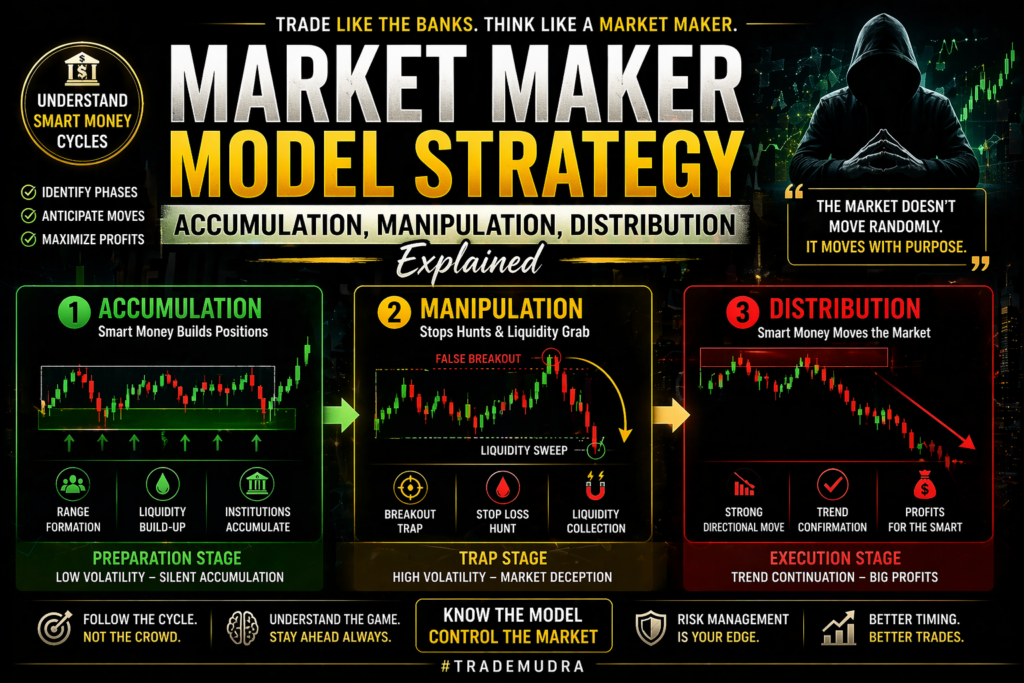
In the forex market, price does not move randomly. Behind every strong move lies a structured process driven by institutions and market makers. Retail traders often enter trades without understanding this process, which leads to losses and confusion. Professional traders, however, study how smart money builds positions and moves the market in phases. One of the most powerful frameworks to understand this behavior is the Market Maker Model. This model explains how price cycles through accumulation, manipulation, and distribution before making significant moves. This is where market maker model strategy, smart money trading cycle, and accumulation manipulation distribution become essential. Understanding this model gives traders a clear roadmap of market behavior. Instead of reacting to price, traders can anticipate moves by identifying where the market is in its cycle. This shift in perspective allows traders to align with institutional flow rather than being trapped by it. What is the Market Maker Model The Market Maker Model is a structured approach that explains how institutions control price movement. It is based on the idea that markets move in cycles, driven by liquidity and order flow. The model consists of three main phases: accumulation, manipulation, and distribution. Each phase has a specific purpose and plays a role in the overall movement of price. By understanding these phases, traders can identify high-probability setups and avoid common traps. This concept forms the foundation of market maker model strategy, smart money trading cycle, and accumulation manipulation distribution. Phase 1: Accumulation Explained Accumulation is the first phase of the cycle. During this phase, institutions quietly build positions without causing major price movements. Price typically moves in a range during accumulation. This range creates a sense of uncertainty among retail traders, leading to indecision. Institutions use this phase to collect liquidity and prepare for the next move. Since they cannot enter large positions at once, they accumulate orders over time. Recognizing accumulation is crucial in market maker model strategy, smart money trading cycle, and accumulation manipulation distribution. Characteristics of Accumulation Phase The accumulation phase has specific characteristics that traders can identify. Price moves sideways within a defined range. Volatility is relatively low compared to trending markets. There are multiple false breakouts within the range, which trap retail traders. Liquidity builds above the highs and below the lows of the range. These areas become targets for the next phase. Understanding these traits helps traders apply market maker model strategy, smart money trading cycle, and accumulation manipulation distribution effectively. Phase 2: Manipulation Explained Manipulation is the most deceptive phase of the cycle. During this phase, price moves outside the accumulation range to trigger stop losses and trap traders. This move is often mistaken for a breakout. Retail traders enter trades expecting continuation, but the move quickly reverses. The purpose of manipulation is to collect liquidity. By triggering stop losses and breakout orders, institutions gather the volume needed to execute large trades. This phase is a key component of market maker model strategy, smart money trading cycle, and accumulation manipulation distribution. Types of Manipulation Moves Manipulation can occur in both directions. In a bullish scenario, price may drop below the range to trigger sell stops before moving upward. In a bearish scenario, price may rise above the range to trigger buy stops before dropping. These moves are often fast and sharp, creating confusion in the market. Recognizing these patterns is essential for mastering market maker model strategy, smart money trading cycle, and accumulation manipulation distribution. Phase 3: Distribution Explained Distribution is the final phase where the real move happens. After collecting liquidity during manipulation, institutions drive the market in the intended direction. This phase is characterized by strong momentum and clear trends. Price moves away from the accumulation range with conviction. Retail traders who entered during manipulation are often trapped, which fuels the trend further. Understanding distribution helps traders capture large moves using market maker model strategy, smart money trading cycle, and accumulation manipulation distribution. How to Identify Each Phase on Charts Identifying the phases requires careful observation of price behavior. Look for consolidation ranges to identify accumulation. Watch for false breakouts to spot manipulation. Strong directional moves indicate distribution. Using these signals, traders can determine where the market is in its cycle. This is a practical application of market maker model strategy, smart money trading cycle, and accumulation manipulation distribution. Entry Strategy Using Market Maker Model The best entries occur after the manipulation phase. Instead of chasing breakouts, traders should wait for liquidity sweeps and confirmation. Once manipulation is complete and price shows rejection, traders can enter in the direction of distribution. This approach aligns with market maker model strategy, smart money trading cycle, and accumulation manipulation distribution. Combining Market Structure with the Model Market structure enhances the effectiveness of the model. During distribution, traders should look for break of structure in the direction of the move. Change of character may signal the transition from accumulation to distribution. Combining these concepts improves accuracy and supports market maker model strategy, smart money trading cycle, and accumulation manipulation distribution. Multi-Timeframe Analysis for Better Accuracy Using multiple timeframes helps identify phases more clearly. Higher timeframes show accumulation ranges and major trends. Lower timeframes reveal manipulation and entry points. This approach increases precision and reduces risk. Multi-timeframe analysis is an important part of market maker model strategy, smart money trading cycle, and accumulation manipulation distribution. Risk Management in Market Maker Trading Risk management is essential when trading this model. Stop losses should be placed beyond manipulation zones to avoid being triggered. Position sizing should be controlled to manage risk effectively. Maintaining a proper risk reward ratio ensures long-term profitability. These principles complement market maker model strategy, smart money trading cycle, and accumulation manipulation distribution. Common Mistakes Traders Make Many traders misinterpret manipulation as a breakout. Another mistake is entering trades during accumulation without confirmation. Overtrading and ignoring market context also lead to losses. Avoiding these mistakes is crucial for mastering market maker model strategy, smart money trading cycle, and accumulation manipulation distribution.
Fair Value Gap + Order Block Confluence Strategy: High Probability Entry Model

In forex trading, the difference between average traders and consistently profitable traders lies in how they read price. Most retail traders rely on single concepts like support and resistance or indicators. However, professional traders focus on confluence—where multiple high-probability factors align. One of the most powerful combinations in smart money trading is the use of Fair Value Gaps (FVG) together with Order Blocks (OB). This confluence creates a strong framework for precision entries and improved accuracy. This is where fair value gap order block strategy, smart money confluence trading, and institutional entry model become essential. Markets move based on liquidity and institutional participation. When institutions enter trades, they leave behind footprints such as imbalances and accumulation zones. FVGs represent price inefficiencies, while Order Blocks represent areas of institutional order placement. When both align, it signals a high-probability zone where smart money is likely active. Understanding fair value gap order block strategy, smart money confluence trading, and institutional entry model allows traders to shift from guesswork to structured trading. Understanding Fair Value Gaps (FVG) A Fair Value Gap is an imbalance created when price moves aggressively, leaving a gap between candles. This happens when institutional orders push the market quickly, skipping certain price levels. These gaps indicate areas where price did not trade efficiently. As a result, price often returns to these zones to rebalance before continuing in the original direction. This behavior is central to fair value gap order block strategy, smart money confluence trading, and institutional entry model. FVGs act like magnets in the market. They attract price because the market seeks equilibrium. Traders who understand this concept can anticipate where price is likely to retrace. Understanding Order Blocks (OB) Order Blocks are zones where institutions place large buy or sell orders. They are usually identified as the last bullish or bearish candle before a strong impulsive move. A bullish order block forms before a strong upward move, while a bearish order block forms before a downward move. These zones represent institutional accumulation or distribution. When price returns to an order block, it often reacts because institutions may continue executing their orders. This concept is a key part of fair value gap order block strategy, smart money confluence trading, and institutional entry model. Why FVG + Order Block Confluence is Powerful Individually, both FVGs and Order Blocks are strong concepts. However, when they align, they create a high-probability zone. An FVG shows imbalance, while an Order Block shows where institutions entered. When both exist in the same area, it confirms strong institutional interest. This confluence reduces false signals and increases accuracy. It provides traders with a clear area to focus on instead of random entries. This is why fair value gap order block strategy, smart money confluence trading, and institutional entry model are highly effective. Market Structure Role in Confluence Strategy Market structure provides the direction, while FVG and Order Blocks provide entry zones. In an uptrend, traders should look for bullish FVG and bullish Order Block confluence. In a downtrend, bearish confluence is more relevant. Structure helps filter trades and ensures alignment with the overall trend. This combination strengthens fair value gap order block strategy, smart money confluence trading, and institutional entry model. Step-by-Step Strategy Setup The first step is identifying the higher timeframe trend. This sets the overall bias. Next, mark key Order Blocks on the chart. Focus on those that caused strong moves or broke structure. Then, identify Fair Value Gaps within or near those Order Blocks. This creates your confluence zone. Wait for price to return to this area. Do not rush into trades. Patience is essential in fair value gap order block strategy, smart money confluence trading, and institutional entry model. Entry Confirmation Techniques Entering blindly at a confluence zone is risky. Traders should wait for confirmation. Confirmation can include rejection candles, liquidity sweeps, or lower timeframe break of structure. These signals indicate that smart money is active in the zone. Once confirmation appears, traders can enter with confidence. This approach aligns with fair value gap order block strategy, smart money confluence trading, and institutional entry model. Example of Bullish Confluence Trade In a bullish scenario, the market is in an uptrend. Price retraces into a bullish Order Block. Within this Order Block, a Fair Value Gap is present. Price enters the zone and shows rejection. A liquidity sweep may occur, taking out previous lows before reversing. This confirms smart money activity. Traders can enter buy positions with stops below the zone. This is a practical application of fair value gap order block strategy, smart money confluence trading, and institutional entry model. Example of Bearish Confluence Trade In a bearish setup, the market is trending downward. Price retraces into a bearish Order Block. A Fair Value Gap exists within this zone. Price enters the area and shows signs of rejection. Liquidity above highs may be swept before price drops. This indicates institutional selling. Traders can enter sell trades with proper risk management. This setup reflects fair value gap order block strategy, smart money confluence trading, and institutional entry model. Risk Management in Confluence Trading Risk management is essential for long-term success. Stop losses should be placed beyond the confluence zone. This prevents trades from being stopped out by minor fluctuations. Position sizing should be calculated based on account size and risk tolerance. Maintaining a strong risk reward ratio ensures profitability even with fewer winning trades. This complements fair value gap order block strategy, smart money confluence trading, and institutional entry model. Multi-Timeframe Approach Using multiple timeframes improves accuracy. Higher timeframes provide strong Order Blocks, while lower timeframes refine entries. For example, a trader may identify a confluence zone on the 4-hour chart and execute entries on the 5-minute chart. This approach increases precision and reduces risk. It is a key component of fair value gap order block strategy, smart money confluence trading, and institutional entry model. Common Mistakes to Avoid Many traders mark too many Order Blocks and FVGs, leading to confusion. Quality
Session-Based Trading Strategy: London & New York Kill Zones Explained

In forex trading, timing is just as important as strategy. Many traders focus only on setups and indicators but ignore when the market is most active. The forex market operates 24 hours, but not all hours are equal. Certain sessions provide higher liquidity, stronger moves, and better trading opportunities. This is where session-based trading becomes powerful. Understanding London and New York kill zones can help traders enter the market at the right time with higher probability. This is where session based trading forex, london session strategy, and new york kill zone trading become essential. Professional traders do not trade all day. They focus on specific time windows when institutional activity is highest. These time windows are known as kill zones. By mastering session based trading forex, london session strategy, and new york kill zone trading, traders can improve accuracy and avoid unnecessary trades. What is Session-Based Trading in Forex Session-based trading refers to analyzing and trading the market based on different trading sessions. The forex market is divided into major sessions: Asian, London, and New York. Each session has unique characteristics. The Asian session is generally slow, while the London and New York sessions are more volatile and active. Understanding these sessions helps traders choose the best time to trade. This concept is central to session based trading forex, london session strategy, and new york kill zone trading. What are Kill Zones in Forex Kill zones are specific time periods within trading sessions when the market experiences high liquidity and volatility. These are the times when institutions are most active. The most active trading windows are typically seen during the London and New York sessions, where market movement and volatility create stronger trading opportunities. Kill zones are not random. They are based on institutional trading behavior and market overlaps. This makes session based trading forex, london session strategy, and new york kill zone trading highly effective. London Kill Zone Explained The London session is one of the most important trading sessions. It usually starts with a strong move as liquidity enters the market. The London kill zone typically occurs in the early hours of the London session. During this time, price often makes significant moves, breaking key levels and setting the tone for the day. This session is known for creating liquidity sweeps and strong trends. Traders who understand session based trading forex, london session strategy, and new york kill zone trading can take advantage of these moves. New York Kill Zone Explained The New York session overlaps with the London session, creating one of the most volatile periods in the market. The New York kill zone occurs during the opening hours of the New York session. This period often continues the London trend or creates reversals. High-impact news events are also released during this time, adding to volatility. Understanding session based trading forex, london session strategy, and new york kill zone trading helps traders navigate this session effectively. Why Kill Zones Work Kill zones work because they represent periods of high institutional activity. During these times, large players enter the market, creating strong price movements. Liquidity is highest during these sessions, making it easier for institutions to execute trades. This leads to clearer trends and better setups. This behavior is a key part of session based trading forex, london session strategy, and new york kill zone trading. Session Timing and Market Behavior Each session has a unique behavior. The Asian session often creates a range. The London session tends to break that range, and the New York session either continues or reverses the move. Understanding this cycle helps traders anticipate market movements. It also prevents them from trading during low-probability times. This cycle is essential for mastering session based trading forex, london session strategy, and new york kill zone trading. London Session Trading Strategy A common strategy during the London session is trading the breakout of the Asian range. Price often consolidates during the Asian session and breaks out during London. Traders can identify the high and low of the Asian session and watch for breakouts during the London kill zone. Confirmation is important. Traders should wait for structure breaks or strong momentum before entering trades. This approach aligns with session based trading forex, london session strategy, and new york kill zone trading. New York Session Trading Strategy The New York session offers opportunities for both continuation and reversal trades. If the London session establishes a strong trend, the New York session often continues that trend. However, it can also create reversals, especially after liquidity sweeps. Traders should analyze the London session and look for setups during the New York kill zone. This strategy is part of session based trading forex, london session strategy, and new york kill zone trading. Combining Kill Zones with Smart Money Concepts Kill zones become more powerful when combined with smart money concepts such as liquidity sweeps, order blocks, and fair value gaps. For example, a trader may identify a liquidity sweep during the London kill zone and enter a trade based on confirmation. This combination increases accuracy and provides high-probability setups. It is a core part of session based trading forex, london session strategy, and new york kill zone trading. Multi-Timeframe Analysis in Session Trading Using multiple timeframes improves session-based trading. Higher timeframes provide the overall trend, while lower timeframes offer precise entry points during kill zones. This approach ensures that trades are aligned with the market direction. It enhances session based trading forex, london session strategy, and new york kill zone trading. Risk Management in Session Trading Risk management is essential. Traders should not overtrade during kill zones, even though opportunities are higher. Stop losses should be placed at logical levels, and position sizes should be controlled. Maintaining a proper risk reward ratio ensures long-term profitability. This complements session based trading forex, london session strategy, and new york kill zone trading. Common Mistakes Traders Make Many traders make mistakes such as trading outside kill zones, overtrading, and ignoring market context. Another
Liquidity & Stop Hunting in Forex: How Big Players Trap Retail Traders

The forex market is often seen as a battlefield where retail traders try to predict price movements using indicators and signals. However, behind every price movement lies a deeper mechanism controlled by institutions, banks, and large players often referred to as smart money. Understanding how these players operate is essential for survival and long-term profitability. One of the most critical yet misunderstood concepts in trading is liquidity and stop hunting. These mechanisms explain why price often moves against retail traders before going in the expected direction. This is where liquidity trading strategy, smart money concept, and forex market manipulation come into play. Most retail traders believe that the market moves randomly, but in reality, price moves with a purpose. That purpose is liquidity. Institutions require large volumes to execute their trades, and they cannot enter or exit positions without sufficient liquidity. This leads to engineered price movements that target areas where retail traders place their stop losses. By understanding liquidity trading strategy, smart money concept, and forex market manipulation, traders can shift from being victims to becoming aligned with institutional flow. Understanding Liquidity in Forex Market Liquidity refers to the availability of buyers and sellers in the market. In simple terms, it is the ease with which trades can be executed without significantly affecting price. In the forex market, liquidity is highest during major sessions such as London and New York. However, the real importance of liquidity lies in where it is located, not just when it is available. Liquidity is often found above highs and below lows. Retail traders tend to place stop losses in predictable locations such as above resistance or below support. These areas become liquidity pools. Institutions target these zones to fill their large orders. This is the foundation of liquidity trading strategy, smart money concept, and forex market manipulation. When price approaches these liquidity zones, it often spikes suddenly, triggering stop losses and breakout traders. This creates the necessary volume for institutions to enter trades in the opposite direction. Understanding this behavior helps traders avoid common traps and align with the real market direction. What is Stop Hunting in Forex Stop hunting is a process where price deliberately moves to trigger stop losses placed by retail traders. It is not a random event but a calculated move by large players to gather liquidity. When many traders place their stops at similar levels, it creates an opportunity for institutions to push price into those zones. Once stops are triggered, a surge of orders enters the market. This provides the liquidity needed for institutions to execute their positions. After collecting liquidity, price often reverses sharply. This is why many traders experience being stopped out before the market moves in their predicted direction. This behavior is deeply connected with liquidity trading strategy, smart money concept, and forex market manipulation. Stop hunting is most common near key levels such as support and resistance, trendlines, and psychological levels. Traders who understand this concept can avoid placing their stops in obvious locations and instead position themselves strategically. Why Smart Money Needs Liquidity Smart money refers to institutional traders such as banks, hedge funds, and large financial entities. These players operate with massive capital, which requires significant liquidity to enter and exit trades. Unlike retail traders, they cannot simply click buy or sell without impacting the market. To solve this problem, institutions create liquidity by pushing price into areas where retail orders are concentrated. This is often done through stop hunts and false breakouts. Once liquidity is collected, they execute their trades and drive the market in the intended direction. This process highlights the importance of liquidity trading strategy, smart money concept, and forex market manipulation. Understanding this concept changes the way traders view the market. Instead of chasing price, they begin to anticipate where liquidity is located and how institutions might use it. Types of Liquidity in Forex There are two main types of liquidity in the forex market: buy-side liquidity and sell-side liquidity. Buy-side liquidity exists above highs where stop losses of short sellers are placed. Sell-side liquidity exists below lows where stop losses of buyers are located. Institutions target both types of liquidity depending on their market bias. For example, if smart money wants to buy, they may first push price down to collect sell-side liquidity before moving price upward. This concept is a core part of liquidity trading strategy, smart money concept, and forex market manipulation. Equal highs and equal lows are also important liquidity zones. These levels attract retail traders who expect breakouts. However, institutions often use these levels to trap traders before reversing the market. Market Structure and Liquidity Connection Market structure plays a crucial role in understanding liquidity. Trends are formed by higher highs and higher lows in an uptrend and lower highs and lower lows in a downtrend. However, before continuing a trend, price often retraces to collect liquidity. For example, in an uptrend, price may temporarily move downward to trigger sell-side liquidity before continuing upward. This movement often confuses retail traders, leading them to believe that the trend has reversed. In reality, it is just a liquidity grab. This behavior aligns with liquidity trading strategy, smart money concept, and forex market manipulation. Break of structure and change of character are also important signals. A break of structure confirms trend continuation, while a change of character may indicate a reversal. Both concepts are influenced by liquidity. Common Stop Hunting Patterns There are several patterns that indicate stop hunting activity. One of the most common is the false breakout. In this pattern, price breaks a key level, attracting breakout traders, and then quickly reverses. Another common pattern is the liquidity sweep. This occurs when price moves beyond a previous high or low, triggers stop losses, and then reverses direction. These patterns are essential for traders using liquidity trading strategy, smart money concept, and forex market manipulation. Wicks on candlesticks often reveal stop hunts. Long wicks indicate rejection and liquidity collection. Traders who learn to