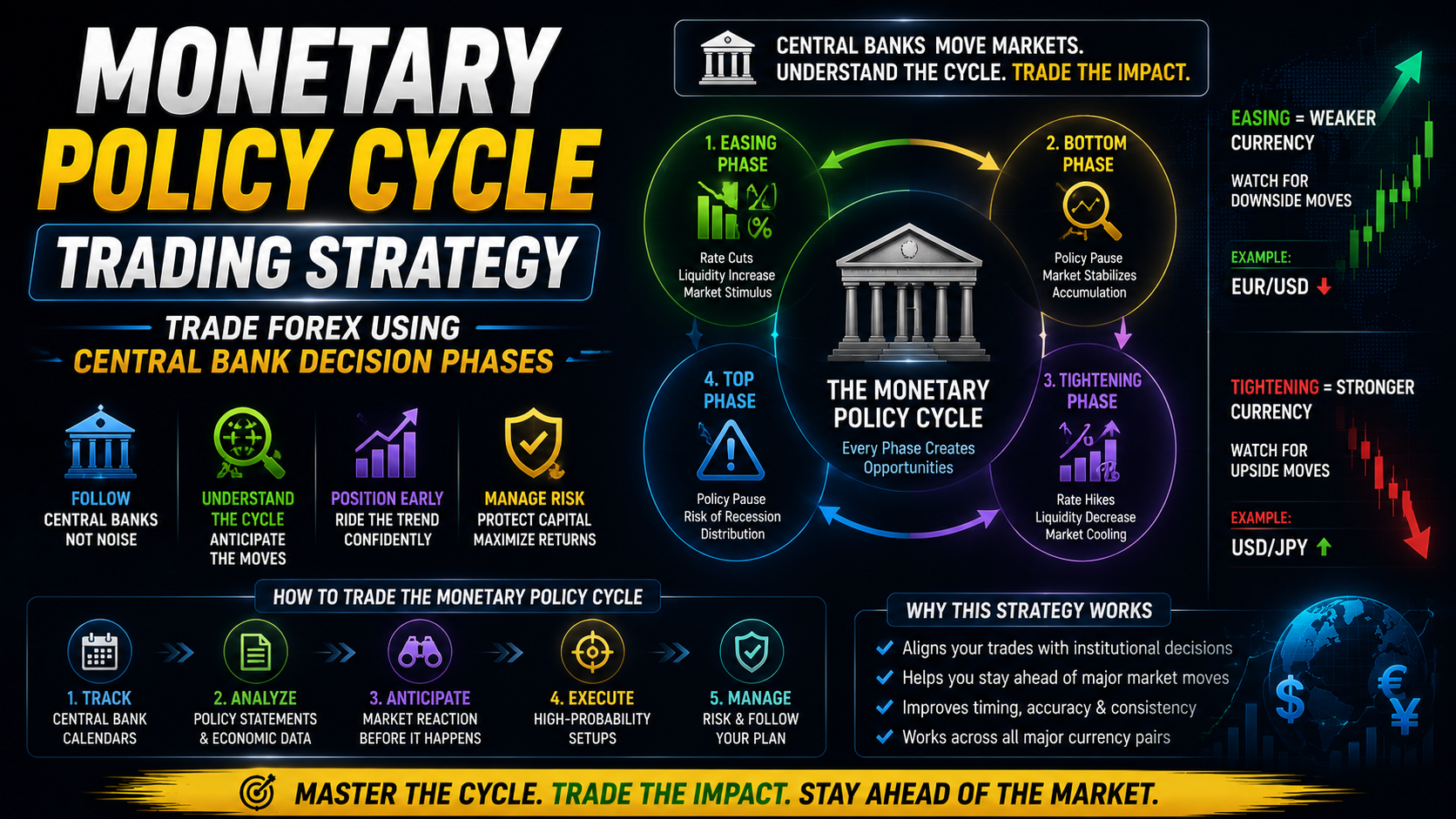
Modern forex trading is no longer driven only by chart patterns and technical indicators. In 2026, institutional traders increasingly focus on macroeconomic cycles and central bank behavior to predict long-term currency direction. One of the most powerful approaches in macro trading is understanding monetary policy cycles. Central banks influence global capital flows through interest rates, liquidity conditions, inflation control, and economic guidance. Traders who understand these cycles gain a significant advantage because currencies often move months before economic headlines become obvious. This is why monetary policy cycle trading strategy, central bank forex analysis, and interest rate cycle trading have become some of the most valuable concepts in professional trading.
Most beginner traders only react to news after major market moves have already happened. Institutional traders operate differently. They analyze central bank phases to anticipate market direction before the majority of traders recognize the shift. By understanding easing cycles, tightening cycles, and policy pivots, traders can align themselves with larger market flows. Mastering monetary policy cycle trading strategy, central bank forex analysis, and interest rate cycle trading allows traders to build stronger macro conviction and improve long-term execution.
Understanding Monetary Policy
Monetary policy refers to the actions central banks take to influence economic conditions. Their primary goals usually include controlling inflation, supporting employment, maintaining financial stability, and encouraging sustainable growth.
Central banks achieve these objectives mainly through interest rate decisions, liquidity management, and communication with financial markets.
Understanding these actions forms the foundation of monetary policy cycle trading strategy, central bank forex analysis, and interest rate cycle trading.
Why Monetary Policy Matters in Forex
Currencies are highly sensitive to changes in monetary policy because capital moves toward stronger returns.
When a country offers higher interest rates, investors may shift capital into that currency to seek better yields. When rates fall, capital may leave.
As a result, currencies frequently trend according to policy expectations rather than current economic conditions.
Understanding this relationship strengthens monetary policy cycle trading strategy, central bank forex analysis, and interest rate cycle trading.
What is a Monetary Policy Cycle
A monetary policy cycle refers to the changing stages of central bank decisions over time.
Markets usually move through periods of tightening, stability, easing, and policy transition.
Each phase creates different trading opportunities.
Recognizing these phases is central to monetary policy cycle trading strategy, central bank forex analysis, and interest rate cycle trading.
The Tightening Phase Explained
A tightening phase occurs when central banks increase interest rates or reduce liquidity.
This usually happens when inflation rises above target levels or economic activity becomes too strong.
Higher rates often strengthen the currency because investors seek improved returns.
Understanding tightening cycles improves monetary policy cycle trading strategy, central bank forex analysis, and interest rate cycle trading.
The Easing Phase Explained
An easing cycle occurs when central banks lower interest rates or inject liquidity into markets.
This is often done to support growth during economic slowdowns.
Lower rates generally reduce currency attractiveness and may weaken exchange rates.
Recognizing easing conditions strengthens monetary policy cycle trading strategy, central bank forex analysis, and interest rate cycle trading.
Understanding Policy Pivot Points
Policy pivots are among the most powerful moments in macro trading.
A pivot happens when a central bank shifts direction after maintaining a previous stance for an extended period.
For example, moving from aggressive tightening toward neutral policy can dramatically change currency trends.
Understanding pivots improves monetary policy cycle trading strategy, central bank forex analysis, and interest rate cycle trading.
The Role of Interest Rates
Interest rates directly influence investment decisions.
Higher interest rates increase capital inflows and often support currency appreciation.
Lower interest rates may encourage capital outflows and weaken currency demand.
Interest rates remain one of the strongest drivers of monetary policy cycle trading strategy, central bank forex analysis, and interest rate cycle trading.
Federal Reserve and Currency Markets
The Federal Reserve plays a major role because the US dollar influences global financial markets.
Changes in Federal Reserve expectations affect forex pairs, commodities, and global risk sentiment.
Dollar movements frequently begin before official decisions are announced.
Understanding Federal Reserve behavior supports monetary policy cycle trading strategy, central bank forex analysis, and interest rate cycle trading.
European Central Bank Influence
The European Central Bank strongly impacts EUR-based currency pairs.
Policy changes influence lending conditions, growth expectations, and capital movement across Europe.
ECB communication often drives major EUR/USD movements.
This strengthens monetary policy cycle trading strategy, central bank forex analysis, and interest rate cycle trading.
Bank of England Market Impact
The Bank of England heavily influences GBP pairs.
Changes in inflation outlook and growth expectations often create strong directional moves.
Institutional traders monitor these developments closely.
Understanding BOE decisions improves monetary policy cycle trading strategy, central bank forex analysis, and interest rate cycle trading.
Bank of Japan and Global Capital Flow
Japan operates differently because of its long history of lower rates and unique yield policies.
BOJ shifts can influence global carry trades and USD/JPY movement.
Understanding these dynamics supports monetary policy cycle trading strategy, central bank forex analysis, and interest rate cycle trading.
Inflation and Policy Cycles
Inflation is one of the most important variables central banks monitor.
Persistent inflation often increases the probability of tighter policy.
Weak inflation may encourage easing.
Understanding inflation expectations strengthens monetary policy cycle trading strategy, central bank forex analysis, and interest rate cycle trading.
Economic Growth and Currency Strength
Growth data influences policy decisions.
Strong economic performance may support tighter conditions and stronger currencies.
Weak growth often leads to supportive measures.
This relationship improves monetary policy cycle trading strategy, central bank forex analysis, and interest rate cycle trading.
Market Expectations vs Reality
Markets often react more to expectations than actual decisions.
If traders already expect a rate increase, the currency may not strengthen after the announcement.
Unexpected policy shifts create the largest moves.
Understanding expectations supports monetary policy cycle trading strategy, central bank forex analysis, and interest rate cycle trading.
How Institutions Position Before Decisions
Institutions rarely wait for official announcements.
They gradually build positions based on economic trends and policy expectations.
This positioning often causes market movement before news becomes obvious.
Understanding institutional behavior strengthens monetary policy cycle trading strategy, central bank forex analysis, and interest rate cycle trading.
Step-by-Step Monetary Policy Trading Framework
The first step is identifying the current economic environment.
Next, traders analyze inflation, employment, and growth conditions.
Then, they compare central bank expectations across countries.
Finally, traders combine macro direction with technical execution.
This structured process defines monetary policy cycle trading strategy, central bank forex analysis, and interest rate cycle trading.
Bullish Currency Scenario
Suppose inflation remains elevated while growth remains stable.
Markets expect additional rate increases.
Bond yields rise and institutional positioning strengthens.
The currency may appreciate for an extended period.
This reflects monetary policy cycle trading strategy, central bank forex analysis, and interest rate cycle trading.
Bearish Currency Scenario
Economic activity slows while inflation falls.
Markets begin pricing future rate cuts.
Capital rotates into stronger alternatives.
The currency weakens over time.
This example demonstrates monetary policy cycle trading strategy, central bank forex analysis, and interest rate cycle trading.
Risk Management in Macro Trading
Macro trading requires patience because trends develop gradually.
Position sizes should remain controlled.
Stop losses should reflect broader market structure.
Risk management strengthens monetary policy cycle trading strategy, central bank forex analysis, and interest rate cycle trading.
Common Mistakes Traders Make
Many traders focus only on announcements without understanding broader policy cycles.
Another mistake is ignoring expectations and trading emotionally.
Short-term reactions often distract from long-term trends.
Avoiding these mistakes improves monetary policy cycle trading strategy, central bank forex analysis, and interest rate cycle trading.
Psychology of Macro Trading
Macro trading rewards patience and discipline.
Traders must accept that large trends require time to develop.
Institutions think in months rather than minutes.
This mindset supports monetary policy cycle trading strategy, central bank forex analysis, and interest rate cycle trading.
Combining Monetary Policy with Technical Analysis
Macro direction becomes stronger when combined with technical execution.
Support resistance, liquidity zones, and market structure can improve timing.
Combining both approaches creates higher-probability setups.
This strengthens monetary policy cycle trading strategy, central bank forex analysis, and interest rate cycle trading.
Why Monetary Policy Will Matter More in 2026
Global markets are increasingly sensitive to policy changes, debt levels, and inflation dynamics.
Institutional capital continues moving according to interest rate expectations.
Traders who understand policy cycles gain a deeper understanding of market behavior.
This reinforces monetary policy cycle trading strategy, central bank forex analysis, and interest rate cycle trading.
Final Thoughts on Monetary Policy Cycle Trading
Monetary policy cycles remain one of the most powerful drivers of forex markets. Understanding how central banks move through easing, tightening, and pivot phases allows traders to think more like institutions and less like short-term speculators.
Mastering monetary policy cycle trading strategy, central bank forex analysis, and interest rate cycle trading requires patience, macro awareness, and disciplined execution.
In the end, successful forex trading is not about predicting every market move. It is about understanding the larger economic cycle and positioning alongside institutional capital flow.
For more information:-
Instagram: https://www.instagram.com/hadyjfx_official
YouTube: https://www.youtube.com/@hadyjmentor7793
Facebook: https://www.facebook.com/profile.php?id=61562232239915
Join Telegram: https://t.me/hadyjfx