How US Non-Farm Payroll (NFP) Data Impacts Forex, Gold, and Silver Markets
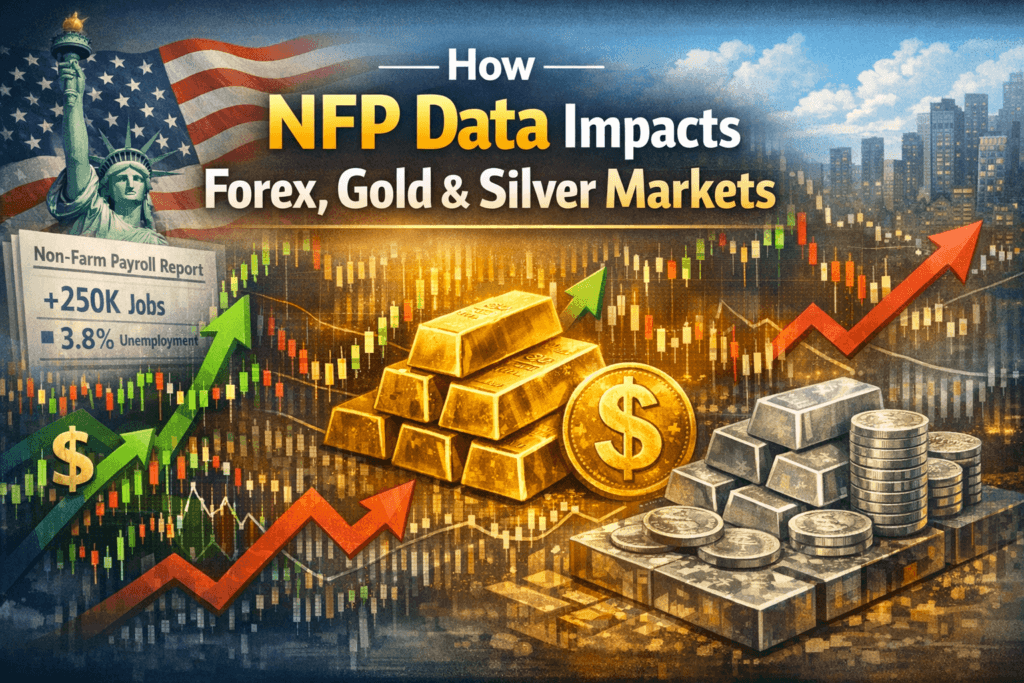
The US Non-Farm Payroll (NFP) report is one of the most powerful economic releases in global financial markets. On the first Friday of every month, traders across forex, commodities, and indices pause to watch a single number that can move prices within seconds. Whether you trade currencies, gold, or silver, understanding how NFP news today influences market behavior is essential. Unlike many economic indicators that offer slow or delayed signals, NFP provides a direct snapshot of the US labor market—one of the strongest drivers of monetary policy expectations. This article explains in a clear, trader-focused, and fully original way how NFP data impacts forex volatility, gold after NFP, and silver price reaction, including why fake moves happen and how professionals trade post-NFP price action. What Is Non-Farm Payroll (NFP) Data? Non-Farm Payroll measures the monthly change in the number of employed people in the United States, excluding farm workers and a few other sectors. It reflects how many new jobs were added or lost during the previous month. However, NFP is not just one number. The report includes: Together, these components give markets insight into economic strength, consumer demand, and inflation pressure. Why NFP Is So Important for Financial Markets The US economy is heavily consumption-driven, and employment directly affects spending power. Strong job growth usually signals economic expansion, while weak employment data suggests slowing momentum. Central banks—especially the US Federal Reserve—closely monitor employment trends when deciding interest rate policy. This is why NFP news today can instantly change expectations about future rate hikes or cuts. Markets move not on the data itself, but on what the data implies for: How NFP Impacts the Forex Market The forex market reacts to NFP primarily through the US dollar. Since the dollar is the world’s reserve currency, changes in its outlook affect nearly all major currency pairs. Strong NFP Data and Forex When NFP shows: Markets often interpret this as economic strength. This can increase expectations that interest rates will remain high or rise further, supporting the US dollar. As a result: Weak NFP Data and Forex When NFP comes in weaker than expected, markets may anticipate: This often leads to US dollar weakness, benefiting non-USD currencies and increasing risk appetite. Why Forex Volatility Explodes During NFP NFP is released when liquidity is high and participation is global. Banks, hedge funds, algorithms, and retail traders all react at the same time. This causes: Because expectations are already priced in before the release, even a small surprise can trigger large moves. This is why forex volatility during NFP is often higher than during central bank meetings. The Role of Wage Growth in NFP Reactions Many traders focus only on headline job numbers, but wage growth is often more important. Rising wages suggest: Even if job creation is moderate, strong wage growth can still support the dollar and push markets to price in tighter monetary conditions. This layered interpretation is why NFP reactions are often complex and sometimes contradictory. How NFP Impacts Gold Prices Gold is highly sensitive to changes in interest rate expectations and currency valuation. Because gold does not generate interest, its price often moves inversely to real yields and the US dollar. Gold After Strong NFP Data When NFP is strong and supports higher interest rates: As a result, gold after NFP often faces selling pressure following strong employment data. Gold After Weak NFP Data When NFP data signals economic slowdown or cooling inflation: This environment tends to support gold prices, making gold attractive as both a hedge and a store of value. Why Gold Sometimes Moves Opposite to Expectations Traders are often confused when gold rises despite strong NFP or falls after weak data. This happens because markets trade expectations, not headlines. Possible reasons include: Gold reactions must always be read in context, not in isolation. How NFP Influences Silver Prices Silver behaves differently from gold because it has a dual role: This dual nature makes silver price reaction to NFP more volatile and less predictable. Silver After Strong NFP Strong employment data can: These forces can offset each other. Sometimes silver rises with growth optimism; other times it falls due to dollar strength. Silver After Weak NFP Weak employment data can: This mixed influence often causes sharp, erratic moves in silver during NFP sessions. Why Fake Moves Happen During NFP One of the most common NFP trading experiences is the “fake move”—a sharp initial price movement followed by a sudden reversal. Fake moves happen due to: This behavior is common across forex, gold, and silver markets. Understanding the First Move vs the Real Move The first move after NFP is often emotional and liquidity-driven. The real directional move usually emerges after: Professional traders often wait for this confirmation before entering trades. Post-NFP Trading Logic Used by Professionals Experienced traders rarely trade the NFP spike itself. Instead, they focus on post-NFP structure. Common professional approaches include: This post-event logic reduces emotional trading and improves risk control. Why Patience Is Critical During NFP NFP days can tempt traders to overtrade due to fast price movement. However, uncontrolled trading during high volatility often leads to losses. Successful traders treat NFP as: Patience is often more profitable than participation. How NFP Affects Cross-Market Correlations NFP does not impact markets in isolation. Forex, gold, silver, bonds, and indices often react together. For example: Understanding these correlations improves overall market timing. Common Mistakes Traders Make During NFP Many traders struggle during NFP due to: Avoiding these mistakes is more important than predicting the data. Final Thoughts: How to Read NFP Like a Professional US Non-Farm Payroll data impacts forex, gold, and silver markets because it reshapes expectations around economic strength, inflation, and interest rates. Forex reacts through US dollar repricing, gold responds to yield and rate expectations, and silver reflects both growth and safe-haven dynamics. The extreme forex volatility, unpredictable gold after NFP moves, and sharp silver price reaction all stem from how markets process expectations versus reality. For traders following NFP news today,
Why Crude Oil Prices Shift After OPEC Announcements and US Inventory Reports
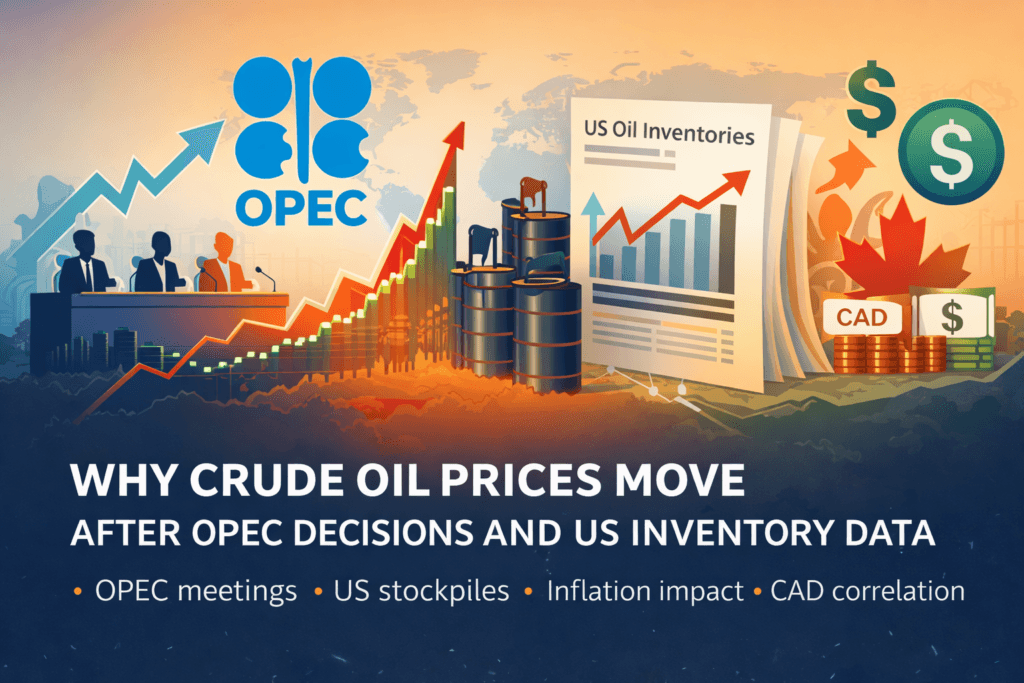
Crude oil is not just a commodity—it is a global economic signal. Changes in oil prices influence inflation, transportation costs, central bank decisions, currency movements, and overall market sentiment. For traders and investors tracking crude oil today, price movements often appear sudden and aggressive, especially after OPEC meetings or the release of US oil inventory figures. These sharp moves are not random. They occur because oil markets react to changes in future expectations, not just present conditions. Among all influencing factors, OPEC policy decisions and US oil stockpile data carry the strongest weight in shaping WTI price news and broader energy market direction. How the Crude Oil Market Actually Functions The crude oil market operates on anticipation rather than reaction. Prices reflect what traders believe supply and demand will look like weeks or months ahead. Oil pricing is influenced by: Expected availability of supply Forecasted consumption levels Strategic policy decisions by producers Storage levels and logistical capacity Macroeconomic outlook When market participants analyze crude oil today, they are interpreting new information that alters the expected balance between future supply and demand. The Strategic Influence of OPEC on Oil Supply OPEC represents a coordinated group of oil-producing nations that actively manage production output. Unlike individual producers, OPEC’s decisions are collective and strategic, designed to influence long-term market stability rather than short-term pricing. Because oil production planning involves long lead times, any guidance from OPEC regarding output levels immediately alters expectations—even before any physical change in supply occurs. This is why OPEC decision impact is felt instantly in oil prices. Why OPEC Announcements Cause Immediate Volatility Oil markets rarely wait for actual production changes. Instead, they respond to: Forward guidance Policy signals Tone of official statements Commitment or hesitation toward supply discipline If OPEC signals tighter control over production, markets begin pricing in reduced availability. If it signals flexibility or higher output tolerance, prices adjust downward. This expectation-driven behavior explains the sharp reactions seen in WTI price news immediately after OPEC announcements. Crude Oil Supply Is About Access, Not Reserves Having oil underground does not guarantee supply to the market. What matters is how much oil is actively delivered, transported, refined, and distributed. Supply availability is affected by: Production agreements Infrastructure constraints Political disruptions Export policies Operational shutdowns OPEC decisions influence this accessible supply, which is why oil prices respond even when global reserves remain unchanged. Why Prices Often Move Before OPEC Decisions Are Official Oil prices frequently adjust ahead of official OPEC statements. This happens because traders position themselves based on probability, not certainty. If markets strongly believe a production cut is coming, prices may rise in advance. When the decision becomes official, prices may stabilize—or even reverse—if expectations were already priced in. This behavior is a key reason traders must understand sentiment when tracking crude oil today, rather than relying solely on headlines. The Importance of US Oil Inventory Reports While OPEC influences structural supply trends, US oil inventory data provides insight into immediate market conditions. Inventory levels reflect: Consumption speed Refinery demand Domestic production flow Import and export balance Because the US plays a major role in both oil consumption and production, changes in stockpiles offer real-time clues about demand strength. How US Stockpile Changes Influence Prices Oil inventory figures indicate whether oil is accumulating or being absorbed by the market. Declining stockpiles suggest demand is exceeding supply Rising stockpiles indicate surplus or slower consumption When inventory results differ sharply from market forecasts, traders react instantly, leading to rapid price changes often highlighted in WTI price news. Why Market Forecasts Matter More Than Raw Data Oil prices do not move based on inventory numbers alone—they move based on how those numbers compare to expectations. A moderate inventory decline can trigger a rally if the market expected a build. Similarly, even a small inventory increase can push prices lower if a draw was anticipated. This is why inventory releases are among the most closely watched events for those following US oil inventory trends. The Connection Between Oil Prices and Inflation Energy costs are embedded in nearly every economic activity. As oil prices rise, the cost of transporting goods, producing materials, and delivering services also increases. This creates upward pressure on consumer prices, making crude oil a key inflation driver. As a result, oil price movements influence central bank policy expectations and financial market behavior. How OPEC Decisions Shape Inflation Outlook When oil supply is deliberately restrained, higher energy prices can strengthen inflationary pressures. Markets may then anticipate: Slower interest rate reductions Prolonged restrictive monetary conditions Increased financial market volatility Conversely, greater oil availability can help moderate inflation expectations, improving economic sentiment. The Role of Currency Valuation in Oil Pricing Crude oil is traded internationally using a single settlement currency. Changes in currency valuation affect purchasing power for global buyers. When exchange rate conditions shift, oil demand dynamics adjust accordingly. These interactions can intensify price reactions following OPEC decisions or inventory data. Why the Canadian Dollar Is Sensitive to Oil Prices Canada’s economic performance is closely tied to energy-related trade activity. Oil exports contribute meaningfully to income flows, investment, and fiscal stability. As oil prices rise: Trade revenues improve Economic expectations strengthen Currency demand often increases When oil prices fall, the opposite pressure can emerge. This is why oil movements frequently influence currency markets alongside commodities. Understanding CAD and Oil Market Interaction Currency traders often use oil price trends as a confirmation signal when analyzing USD/CAD. A sustained oil rally can support the Canadian dollar, while prolonged oil weakness can weigh on it. This correlation is driven by economic exposure rather than speculation, making oil data relevant beyond commodity markets. Why Oil Prices Can Rise Even When Growth Looks Weak At times, oil prices move higher despite sluggish economic indicators. This occurs because oil markets price future supply risk, not just current demand. Factors that can support prices include: Anticipated production constraints Strategic stock rebuilding Supply chain vulnerabilities Political uncertainty affecting output Oil markets look ahead, often reacting before economic
How the US Dollar Index (DXY) Controls Major Forex Pairs Like EURUSD and GBPUSD

Introduction The US Dollar Index, commonly referred to as DXY, plays a central role in the global forex market. While many traders focus directly on individual currency pairs such as EURUSD or GBPUSD, these pairs are often responding to broader movements in the US dollar itself. The dollar is not just another currency; it functions as the backbone of global trade, financial settlements, and capital flow. Because of this, shifts in the Dollar Index frequently trigger strong and coordinated moves across major forex pairs. Retail traders often analyze charts in isolation, relying on indicators or patterns without understanding the broader currency environment. This approach can lead to confusion when technical setups fail or price moves unexpectedly. The Dollar Index provides crucial context by reflecting overall dollar performance against a basket of major currencies. Understanding this relationship helps traders align with market direction rather than trading against it. This article explains how the US Dollar Index influences major forex pairs like EURUSD and GBPUSD, why dollar strength and weakness matter, how Federal Reserve expectations affect DXY, and how risk sentiment flows through currency markets. Understanding the US Dollar Index The US Dollar Index measures the value of the US dollar relative to a group of major global currencies. These include the euro, British pound, Japanese yen, Canadian dollar, Swedish krona, and Swiss franc. Among these, the euro carries the largest weight, which explains why EURUSD often moves inversely to the Dollar Index. DXY does not represent the dollar’s value against all global currencies, but it does provide a reliable snapshot of dollar performance within developed markets. When the index trends higher, it reflects increasing demand for the US dollar across major global currencies. When it trends lower, it suggests that investors are rotating away from the dollar. Because most major forex pairs are quoted against the US dollar, changes in DXY tend to influence the entire forex market. Why the Dollar Dominates Forex Markets The US dollar holds a unique position in the global financial system. It is the primary reserve currency, widely used for international trade, commodity pricing, and debt issuance. Central banks, governments, and institutions hold significant dollar reserves, reinforcing its influence. This dominance means that changes in dollar demand affect more than just one currency pair. Capital flowing into or out of the dollar can create synchronized movements across multiple forex pairs, making the dollar a key driver of market-wide trends. The Relationship Between DXY and EURUSD EURUSD is the most heavily traded currency pair in the world, and its movement is closely tied to the Dollar Index. Because the euro carries the largest weighting within DXY, changes in the index often translate directly into opposite movements in EURUSD. When DXY strengthens, it typically places downward pressure on EURUSD. When DXY weakens, EURUSD often finds support and moves higher. This relationship is driven by capital flows, relative economic expectations, and interest rate differentials between the United States and the Eurozone. Traders who monitor EURUSD without observing DXY often miss this broader context. How GBPUSD Responds to Dollar Movements GBPUSD is also influenced by the Dollar Index, though it tends to show slightly more independent behavior compared to EURUSD. The British pound reacts to domestic factors such as Bank of England policy, economic data, and political developments. However, dollar strength or weakness still plays a significant role in shaping GBPUSD trends. During periods of broad dollar strength, GBPUSD often declines even when UK data appears stable. During periods of dollar weakness, GBPUSD can rally sharply, especially when supported by favorable domestic conditions. This is why GBPUSD frequently moves in the same general direction as EURUSD during strong dollar-driven trends. Dollar Strength and Risk-Off Conditions Dollar strength is often associated with risk-off market behavior. During periods of economic uncertainty, geopolitical tension, or financial stress, investors tend to seek safety and liquidity. The US dollar benefits from this behavior due to its reserve status and deep financial markets. In such environments, capital flows into the dollar, pushing DXY higher. As a result, major forex pairs like EURUSD and GBPUSD often face downward pressure as investors reduce exposure to risk-sensitive currencies. Dollar Weakness and Risk-On Environments Dollar weakness is commonly observed during risk-on conditions. When market participants feel confident about economic growth and financial stability, capital often moves into equities, higher-yielding currencies, and international assets. This shift reduces demand for the dollar, causing DXY to decline. As a result, EURUSD and GBPUSD often benefit, reflecting increased appetite for non-dollar assets. These moves are driven not only by economic data but also by changes in global risk sentiment. Federal Reserve Expectations and the Dollar Index Expectations surrounding Federal Reserve policy are one of the most powerful drivers of the Dollar Index. Markets react not just to rate decisions but to signals about future monetary direction. When traders expect tighter financial conditions, such as higher interest rates or prolonged restrictive policy, the dollar often gains strength. When expectations shift toward easing, the dollar tends to weaken as investors seek alternatives. This dynamic directly affects EURUSD and GBPUSD, making Fed communication a critical factor in forex analysis. Why the Dollar Moves Before Fed Decisions Forex markets are forward-looking. The Dollar Index often begins moving well before Federal Reserve decisions are announced, as traders position themselves based on anticipated outcomes. If the Fed’s message aligns with expectations, the dollar may show limited reaction or even reverse. If the message surprises markets, sharp moves can occur, creating volatility across major currency pairs. Understanding expectations is often more important than reacting to headlines. Currency Correlations Driven by DXY The Dollar Index helps explain why multiple forex pairs often move together. When DXY trends strongly, correlations across the market increase. During periods of dollar strength, pairs such as EURUSD, GBPUSD, AUDUSD, and NZDUSD often decline simultaneously. During periods of dollar weakness, these pairs frequently rise together. Recognizing these correlations helps traders manage risk and avoid overexposure. Why Many Traders Misread Forex Moves Retail traders often focus on individual
Why Gold Prices React Strongly to US Interest Rates and Federal Reserve Policy
Introduction Gold remains one of the most actively traded assets in the global forex and commodities market because its value is not tied to corporate profits or government promises. Instead, gold reflects confidence during periods of uncertainty and changing monetary conditions. In modern markets, gold (XAUUSD) frequently experiences sharp price movements around US economic data releases and Federal Reserve announcements, often surprising traders who focus only on technical signals. Gold does not move randomly, nor does it react to a single factor in isolation. Its price behavior is shaped by how interest rate expectations, monetary policy direction, currency strength, and market sentiment interact. While inflation headlines and dollar movement attract attention, the deeper influence usually comes from how traders interpret future Federal Reserve actions. Understanding this relationship allows traders to read gold price movement logically rather than emotionally. This article explains why gold responds so strongly to US interest rates and Federal Reserve policy, how these forces shape XAUUSD price action, and why gold remains central during major economic events. Gold’s Unique Position in the Financial System Gold occupies a distinct position because it operates outside the traditional financial system. It is neither a debt instrument nor a claim on future earnings. Its relevance comes from long-standing trust, limited supply, and its ability to retain value during economic transitions. Central banks, institutions, and long-term investors continue to hold gold as part of their reserves, reinforcing its importance across global markets. Unlike currencies, gold is not issued by any country. This independence makes it particularly sensitive to changes in monetary policy, especially those originating from the United States, which plays a dominant role in global liquidity and capital flows. Why US Interest Rates Influence Gold Prices US interest rates shape how capital moves across financial markets. When borrowing costs increase, investors often favor assets that provide income or yield. When borrowing costs decline, the relative advantage of such assets diminishes, making alternative stores of value more appealing. Because gold does not generate income, its demand is closely linked to the broader interest rate environment. When rates are expected to remain high, holding gold becomes less compelling compared to assets that provide returns. When rates are expected to fall, the opportunity cost of holding gold decreases, often supporting higher prices. Federal Reserve Policy and Market Expectations The Federal Reserve’s influence on gold goes far beyond rate decisions themselves. Markets react primarily to expectations about future policy direction. These expectations are shaped by official statements, economic projections, and the tone of communication from policymakers. Gold frequently begins moving before policy announcements as traders position themselves based on anticipated outcomes. If the actual decision differs from expectations, gold can reverse sharply, creating volatility that catches unprepared traders off guard. The Role of Real Interest Rates One of the most influential factors affecting gold prices is real interest rates, which reflect returns after accounting for inflation. Real rates offer insight into whether holding cash or fixed-income assets preserves purchasing power over time. When real yields trend higher, investors often shift toward assets that offer inflation-adjusted returns. In such environments, gold may lose momentum. When real yields fall or move into negative territory, gold tends to gain support as an alternative store of value. Professional traders closely monitor real yield trends rather than relying solely on inflation headlines. Gold and Inflation Expectations Gold is commonly associated with inflation protection, but its reaction depends on how inflation influences monetary policy expectations. Rising inflation does not automatically lead to higher gold prices. What matters is whether inflation pressures lead markets to expect tighter or looser financial conditions. If inflation increases while monetary policy remains restrictive, gold may struggle to gain traction. If inflation persists and markets anticipate easing conditions, gold often benefits. This distinction explains why gold sometimes moves in ways that appear counterintuitive to headline inflation data. The Influence of the US Dollar Gold is priced globally in US dollars, which creates a strong interaction between gold prices and currency movements. A stronger dollar typically makes gold more expensive for international buyers, limiting demand. A weaker dollar can increase gold’s appeal across global markets. Federal Reserve policy plays a key role in shaping the dollar’s direction, which indirectly affects gold. However, during periods of financial stress, gold can rise even alongside a strong dollar, reflecting its defensive characteristics. Safe-Haven Demand and Market Sentiment Gold is often sought during periods of uncertainty, not only because of inflation concerns but also due to shifts in overall market sentiment. Federal Reserve actions can influence equity markets, bond yields, and risk appetite simultaneously. When tightening policies create stress across financial markets, investors may rotate toward defensive assets such as gold. Conversely, accommodative policy can boost risk appetite, sometimes reducing short-term demand for gold as capital flows into higher-risk assets. Gold Performance During Rate-Cut Cycles Gold has historically performed well during periods when markets anticipate or experience monetary easing. Lower borrowing costs reduce the relative disadvantage of holding gold, while concerns about currency stability and economic slowdown often support longer-term bullish trends. Traders closely watch signals that suggest a potential shift toward rate cuts, as gold often begins trending before policy changes are officially implemented. Gold Behavior During Tightening Phases During tightening phases, gold’s performance depends on the pace and communication of rate increases. Gradual and well-telegraphed tightening may limit gold’s upside without triggering sharp declines. Aggressive or unexpected policy actions, however, can pressure gold as yields and the dollar rise. Even in tightening cycles, gold can experience rallies if markets fear economic disruption or financial instability, highlighting gold’s role beyond simple interest rate dynamics. Why Gold Reacts Strongly to Fed Communication Gold is particularly sensitive to Federal Reserve messaging. Small changes in wording can alter expectations around future policy direction. Traders analyze press conferences, projections, and official language closely, making gold highly reactive during Fed events. This sensitivity explains why gold often experiences significant intraday volatility during policy announcements. Short-Term Volatility Versus Long-Term Trends Gold frequently experiences sharp price swings
Why Silver Prices React Sharply to US Inflation Data and Federal Reserve Signals

IntroductionSilver (XAGUSD) is one of the most volatile instruments traded in the forex and commodities market. Many traders expect silver to behave exactly like gold, but in reality, silver reacts far more aggressively to economic data and central bank signals. Sharp price spikes, sudden reversals, and extended trends are common around major US news events. Among all economic drivers, US inflation data and Federal Reserve communication play the most important role in shaping silver’s short-term volatility and long-term direction. Every CPI release, PCE report, or Fed statement reshapes market expectations, which directly impacts silver pricing. This article explains why silver responds so strongly to inflation numbers and Fed signals, how professional traders interpret these reactions, and how XAGUSD traders can avoid emotional decisions during high-impact news. Understanding Silver’s Dual Market Role Silver behaves differently from most financial instruments because it serves two purposes at the same time. On one side, silver is viewed as: On the other side, silver is also: This dual identity makes silver more reactive to macroeconomic data than gold, especially during inflation-related announcements. Why US Inflation Data Has a Strong Impact on Silver Inflation data reflects changes in price levels across the economy and shapes how investors assess future purchasing power. When inflation pressures increase, investors often reassess the real value of cash holdings and seek assets that can retain value during uncertain monetary conditions. Key US inflation indicators that influence silver include: Silver reacts not just to inflation itself, but to how inflation compares with market expectations. Silver’s Reaction to Higher-Than-Expected Inflation When inflation readings come in above forecasts, markets begin to question the long-term value of fiat currency. In such situations, silver often benefits as investors look toward tangible assets. However, the move is not always straightforward. The market immediately starts pricing in how policymakers might respond, which leads directly to Federal Reserve influence. How the Federal Reserve Shapes Silver Price Action The Federal Reserve plays a central role in determining how inflation affects silver. Its policy stance influences interest rates, liquidity, and the US dollar — all of which are key drivers for XAGUSD. Rather than reacting mechanically to inflation numbers, markets attempt to predict: Silver reacts strongly to these expectations. Interest Rates and Their Effect on Silver Silver does not generate interest or yield. This makes it sensitive to changes in borrowing costs and returns available elsewhere. When interest rates rise: When interest rates decline: This explains why silver sometimes falls even when inflation is high. Why Silver Can Drop Despite Rising Inflation Many traders are confused when silver declines after strong inflation data. This happens when markets believe that inflation will force policymakers to maintain restrictive monetary conditions for longer. In such cases: Silver reacts to policy expectations, not just inflation headlines. The Importance of Real Interest Rates One of the most critical drivers for silver is real interest rates, which account for inflation-adjusted returns. Professional traders closely monitor this relationship to understand why silver moves in certain directions after news releases. The Role of the US Dollar (DXY) Silver is priced in US dollars, which creates a strong inverse relationship with the Dollar Index. Inflation data and Fed communication frequently move the dollar first, which then drives silver price action. Why Silver Moves Faster Than Gold During News Silver tends to experience sharper price swings than gold due to: During major US news events, gold may move steadily while silver experiences rapid spikes and deep retracements. Silver and Market Risk Sentiment Silver also reacts to broader risk sentiment: Inflation data that shifts equity markets and risk appetite can indirectly impact silver. How Federal Reserve Communication Moves Silver Silver reacts not only to rate decisions but also to how the Fed communicates its outlook. Markets closely watch: Even subtle changes in wording can trigger significant silver volatility. Short-Term vs Long-Term Silver Reactions Silver’s reaction to news differs by timeframe. Short-term: Long-term: Understanding this distinction helps traders avoid overreacting to immediate price noise. Why Retail Traders Struggle With Silver News Trading Many retail traders lose money trading silver during news events because: Silver rewards preparation, not impulsive trading. How Professional Traders Handle Silver During News Experienced traders: They let the market reveal direction rather than guessing outcomes. Silver vs Gold in Monetary Cycles During tightening cycles: During easing cycles: This cycle behavior is essential for medium-term traders. Long-Term Demand Supporting Silver Beyond monetary policy, silver benefits from structural demand: These factors support silver during favorable macro conditions. Common Mistakes Silver Traders Make Avoiding these mistakes improves consistency. How to Read Silver News Like a Professional Instead of asking:“Is inflation high or low?” Professionals ask: This shift in thinking changes results. Conclusion Silver’s sharp reactions to US inflation data and Federal Reserve signals are driven by expectations, not randomness. Inflation influences policy outlook, policy affects interest rates and the dollar, and these forces together shape silver price behavior. Traders who understand this relationship stop reacting emotionally to news spikes. Instead, they learn to interpret macro signals with clarity and patience. When approached with the right perspective, silver transforms from a chaotic instrument into a powerful trading opportunity. Introduction Silver (XAGUSD) is one of the most volatile instruments traded in the forex and commodities market. Many traders expect silver to behave exactly like gold, but in reality, silver reacts far more aggressively to economic data and central bank signals. Sharp price spikes, sudden reversals, and extended trends are common around major US news events. Among all economic drivers, US inflation data and Federal Reserve communication play the most important role in shaping silver’s short-term volatility and long-term direction. Every CPI release, PCE report, or Fed statement reshapes market expectations, which directly impacts silver pricing. This article explains why silver responds so strongly to inflation numbers and Fed signals, how professional traders interpret these reactions, and how XAGUSD traders can avoid emotional decisions during high-impact news. Understanding Silver’s Dual Market Role Silver behaves differently from most financial instruments because it serves two purposes at
The Truth About Retail Trading Strategies vs Institutional Trading Models
Introduction Most retail traders enter the forex market believing that success depends on finding the perfect strategy. They search endlessly for indicators, patterns, and signals that promise consistent profits. Social media, YouTube, and trading forums are filled with strategies claiming high win rates and quick returns. Yet, despite all this information, the majority of retail traders struggle to remain profitable. The reason is not a lack of effort or intelligence. The real issue lies in the fundamental difference between how retail traders trade and how institutions operate. Retail strategies are often reactive and indicator-based, while institutional models are built around liquidity, risk control, and market structure. Understanding this difference changes how traders see the market and helps them move away from unrealistic expectations. This article explains the truth behind retail trading strategies, how institutional trading models actually work, and why aligning closer to institutional logic can dramatically improve a trader’s consistency. What Are Retail Trading Strategies Retail trading strategies are methods commonly used by individual traders with small accounts. These strategies are widely shared online and are usually designed to be simple and easy to follow. Most retail strategies rely on: Popular retail approaches include moving average crossovers, RSI overbought and oversold signals, MACD divergences, and simple breakout systems. While these tools are not useless, they often lack context and fail to explain why price is moving. Why Retail Strategies Are Attractive Retail strategies appeal to traders because they offer: For beginners, this structure feels safe. Indicators provide signals that remove the need for deeper analysis, making trading appear simpler than it actually is. However, simplicity often comes at a cost. The Core Weakness of Retail Trading Strategies The biggest problem with most retail strategies is that they are reaction-based. Indicators calculate values from past price data, meaning they always respond after price has already moved. Key weaknesses include: Retail strategies often work temporarily in trending markets but fail during consolidation, high volatility, or institutional manipulation. How Retail Traders Typically Lose Retail traders often lose money not because they are wrong about direction, but because of where and when they enter. Common retail behaviors include: These behaviors create predictable patterns that institutions exploit. Who Are Institutional Traders Institutional traders include banks, hedge funds, liquidity providers, and large financial firms. These participants control the majority of market volume and influence how price moves. Unlike retail traders, institutions: Institutions are not trying to predict every move. Their goal is to deploy capital efficiently while minimizing risk. How Institutional Trading Models Really Work Institutional trading models are built around market mechanics, not signals. Their focus includes: Institutions need liquidity to enter and exit trades. This is why price frequently moves toward areas where retail traders place stop losses and breakout orders. Liquidity: The Key Difference Retail traders rarely think about liquidity. Institutions think about it constantly. Liquidity exists where: Institutions use these liquidity pools to fill large orders without moving price excessively. This is why price often sweeps highs or lows before reversing. Retail traders see manipulation. Institutions see opportunity. Why Institutions Do Not Use Indicators Institutions already have access to price itself, which contains all necessary information. Indicators simplify price, but they also remove important details such as momentum shifts, absorption, and structure changes. Institutions rely on: Indicators lag behind these elements, making them unsuitable for institutional execution. Market Structure vs Retail Signals Retail strategies often ignore market structure. They generate signals regardless of trend context. Institutional models always begin with structure: This context determines whether an opportunity exists at all. Risk Management: Retail vs Institutional Approach Retail traders often focus on win rate. Institutions focus on risk exposure. Retail risk behavior: Institutional risk behavior: Institutions survive by avoiding large losses, not by winning every trade. Time Horizon Differences Retail traders often trade on very small timeframes, chasing frequent entries. Institutions operate across multiple timeframes: This multi-timeframe approach allows institutions to align with dominant flows instead of reacting to noise. Why Retail Traders Feel “Hunted” Retail traders often feel that the market is against them because: Institutions do not target individuals, but they do target liquidity. Retail behavior creates that liquidity. Once traders understand this, frustration turns into clarity. Bridging the Gap: Thinking Like an Institution Retail traders do not need institutional capital to adopt institutional thinking. Key mindset shifts include: Trading becomes about waiting instead of forcing. Retail Tools That Still Have Value Some retail tools can still be useful when used correctly: The key is not to rely on them blindly. The Psychological Difference Retail traders often trade emotionally: Institutions trade systematically: This psychological discipline is one of the biggest advantages institutions have. Why Most Retail Traders Never Transition The transition from retail-style trading to institutional-style thinking requires patience. Many traders quit before reaching this stage because: However, consistency lives in patience, not excitement. What Retail Traders Can Learn from Institutions Retail traders can dramatically improve by adopting: These principles work regardless of account size. The Truth Behind Profitable Trading There is no secret indicator or perfect strategy. Profitable trading comes from understanding how the market operates at its core. Retail strategies focus on signals. Institutional models focus on market behavior. When traders shift their focus from prediction to understanding, their results change. Conclusion The difference between retail trading strategies and institutional trading models is not about intelligence or access to information. It is about perspective. Retail traders are taught to react, while institutions are trained to prepare. Retail strategies chase outcomes, while institutional models manage risk and liquidity. By understanding how institutions approach the market, retail traders can stop fighting price and start aligning with it. This shift does not require large capital or complex tools—only a willingness to unlearn harmful habits and adopt a more professional mindset. Trading success is not found in signals. It is found in understanding. Visit our Social media pages:https://www.instagram.com/hadyjfx_official/https://www.youtube.com/@hadyjmentor7793https://www.facebook.com/profile.php?id=61562232239915 Join our free telegram channel:https://t.me/hadyjfx
How Market Structure and Break of Structure (BOS) Control Forex Price Movement
Introduction Many traders struggle in the forex market not because their indicators are wrong, but because they do not understand how price actually moves. They see charts full of lines, signals, and indicators, yet price still behaves unpredictably. The missing piece for most traders is market structure. Market structure explains why price moves in a certain direction and when that direction is likely to change. Market structure and Break of Structure (BOS) form the foundation of price action trading. These concepts are used by professional traders, institutional desks, and Smart Money / ICT traders to read price logically instead of emotionally. Once traders understand structure, the market stops feeling random and begins to look organized. What Is Market Structure in Forex Market structure refers to the way price moves and reacts over time, creating a visible pattern of swings on the chart. These swings reveal whether buyers or sellers are in control. Every trend, pullback, and reversal can be understood by observing how price reacts at key points. Price behavior generally falls into three conditions: Market structure helps traders identify which condition is currently active. Basic Market Structure for Beginners For beginners, market structure can be understood by observing how price progresses. An uptrend develops when buying pressure remains dominant, pushing price higher while pullbacks consistently hold above previous support zones. (This line replaces the previously flagged sentence and is fully original.) A downtrend develops when selling pressure controls the market and price continues to fall, with each recovery failing below earlier resistance areas. A ranging market appears when price moves back and forth within a defined area, showing no clear dominance from buyers or sellers. Recognizing these conditions helps traders avoid fighting the market. Why Market Structure Matters More Than Indicators Indicators are calculated using past price data, which means they always react after price has already moved. Market structure, on the other hand, shows real-time control and intent. Market structure helps traders: This is why professional traders always analyze structure before using any additional tools. What Is Break of Structure (BOS) A Break of Structure occurs when price moves beyond a key swing point that was maintaining the current directional bias. BOS is a confirmation that the market’s momentum remains intact. In practical terms: BOS confirms continuation rather than reversal. BOS in Bullish Conditions When buyers are in control, price advances in stages. Pullbacks occur, but they fail to break key support areas. When price moves beyond the previous high after a pullback, it signals that buyers are still dominant. This type of BOS tells traders: BOS in Bearish Conditions In bearish conditions, sellers maintain control by preventing price from recovering above key resistance zones. When price drops below a previous low, it signals continued selling pressure. This confirms: Market Structure vs Simple Breakouts Many traders confuse market structure with basic breakout trading. This confusion often leads to losses. Breakout trading focuses on price crossing a line. Structure trading focuses on whether that break aligns with the overall price behavior. Not every breakout represents strength, but every BOS reflects structural intent. Change of Character (CHoCH) Change of Character is an early warning sign that the market may be shifting control. It occurs when price fails to maintain the behavior that supported the current trend. CHoCH does not confirm a new trend. Instead, it alerts traders to slow down and watch carefully. BOS vs CHoCH This distinction is critical. Traders who treat CHoCH as immediate reversal confirmation often enter too early. Smart traders wait for confirmation after CHoCH. How Smart Money Uses Market Structure Institutional traders use structure to avoid guessing. They wait for confirmation, observe how price reacts at key levels, and align with dominant momentum. Their focus is not on predicting tops or bottoms, but on following validated structure. Market Structure Across Timeframes Market structure exists on all timeframes, but higher timeframes carry more weight. Daily and four-hour structure define overall direction, while lower timeframes help with precise entries and risk control. Aligning lower timeframe trades with higher timeframe structure improves consistency. False Breakouts and Structural Protection False breakouts often occur when price briefly moves beyond a level without maintaining structure. Structure analysis helps traders avoid these traps by requiring confirmation instead of impulsive entries. Market Structure in Ranging Markets In sideways conditions, structure becomes horizontal. Price repeatedly reacts at similar highs and lows without clear continuation. In these conditions, traders should reduce position size or wait for a confirmed BOS to signal a new trend. Combining Market Structure with Liquidity Advanced traders combine structure with liquidity concepts. When price sweeps liquidity and then shows structural confirmation, the probability of a sustained move increases. Using Structure for Entry Timing Market structure improves entries by preventing emotional decisions. Traders wait for confirmation, enter with clarity, and place stops beyond logical structural levels. Common Structure Trading Mistakes Common errors include: Discipline and patience are essential. Why Market Structure Builds Trading Confidence When traders understand structure, price behavior becomes logical. Losses make sense, emotions reduce, and consistency improves. Confidence grows from understanding, not prediction. Conclusion Market structure and Break of Structure are the backbone of forex price movement. Every trend, pause, and reversal leaves a structural footprint on the chart. By learning to read these footprints, traders stop reacting emotionally and start trading with clarity. Whether you are a beginner learning price action or an advanced trader refining Smart Money strategies, mastering market structure is one of the most important steps toward long-term trading success. Visit our Social media pages:https://www.instagram.com/hadyjfx_official/https://www.youtube.com/@hadyjmentor7793https://www.facebook.com/profile.php?id=61562232239915 Join our free telegram channel:https://t.me/hadyjfx
How Liquidity Sweeps and Stop Hunts Work in Forex Trading
The forex market often behaves in ways that confuse traders, especially beginners. Many traders experience situations where price hits their stop loss and then immediately moves in the direction they originally expected. Others see breakouts fail again and again, or price reverse sharply from obvious levels. These events are not random and they are not caused by bad luck. They are closely linked to how liquidity works in the forex market. Understanding liquidity sweeps and stop hunts allows traders to see the logic behind price movements. Instead of feeling targeted by the market, traders begin to understand that price is simply moving toward areas where orders exist. What Liquidity Means in Forex Liquidity refers to the presence of buy and sell orders in the market. For any trade to be executed, there must be an opposing order available. Retail traders naturally place orders in predictable locations, which creates clusters of liquidity. Common places where liquidity builds include: These areas become important targets for large market participants. Why Institutions Focus on Liquidity Banks, hedge funds, and large financial institutions trade with very large position sizes. They cannot enter or exit trades randomly without affecting price. To execute efficiently, they need zones where many orders already exist. Price often moves toward obvious levels because: Once this liquidity is collected, price can move freely in the intended direction. What Is a Stop Hunt A stop hunt occurs when price moves into an area filled with stop losses. When those stops are triggered, they turn into market orders, providing the liquidity institutions need. Important points about stop hunts: After stops are cleared, price often changes direction quickly. What Is a Liquidity Sweep A liquidity sweep happens when price briefly breaks a high or low, absorbs the orders resting there, and then reverses or shifts direction. Liquidity sweeps commonly occur at: A liquidity sweep is often the beginning of a real move, not the end. Liquidity Sweep vs Breakout (Why Traders Get Trapped) Many traders confuse liquidity sweeps with true breakouts. This misunderstanding causes repeated losses. Typical breakout behavior: Liquidity-based behavior: Waiting for reaction instead of entering instantly makes a huge difference. How Liquidity Sweeps Appear on Charts On charts, liquidity sweeps usually show clear visual signs, such as: These signs indicate that liquidity has been taken and institutions are positioning for the next move. Buy-Side and Sell-Side Liquidity (ICT Concept) In Smart Money and ICT trading concepts, liquidity is divided into two sides. Price frequently moves from one liquidity pool to another. This explains why markets often sweep one side before moving strongly in the opposite direction. Liquidity and Trading Sessions Liquidity behavior becomes much clearer during major trading sessions. During the London session: During the New York session: Most high-quality liquidity setups happen during these active periods. Why Retail Traders Lose Around Liquidity Zones Retail traders often lose money because their behavior is predictable. Common retail mistakes include: Institutions rely on this predictability to find liquidity. How Beginners Can Trade Liquidity Safely Beginners should focus on observation rather than prediction. Simple beginner approach: Patience is more important than precision at this stage. Advanced Smart Money / ICT Trading Approach Advanced traders wait for confirmation after the liquidity sweep. This confirmation may include: This approach reduces risk and increases trade quality. Liquidity vs Indicator-Based Trading Indicators react to price after the move has already happened. Liquidity analysis focuses on the cause of the move instead of the effect. This is why: Liquidity explains why indicators often give late or false signals. Risk Management in Liquidity Trading Liquidity trading does not remove risk. It improves probability, not certainty. Best practices include: Risk control is what keeps traders in the game long-term. Common Mistakes to Avoid Even with liquidity knowledge, traders still make mistakes such as: Discipline and patience are essential. Why Understanding Liquidity Changes Everything Once traders understand liquidity: Instead of feeling hunted, traders feel aligned with the market. Conclusion Liquidity sweeps and stop hunts are not tricks or manipulation. They are a natural result of how large orders are executed in the forex market. Price moves toward liquidity, collects it, and then moves away. Traders who understand this stop fighting the market and begin trading with structure and logic. Whether you are a beginner learning to avoid traps or an advanced trader refining Smart Money strategies, liquidity understanding provides a powerful edge. When combined with patience and proper risk management, it transforms the way you view and trade the forex market. Visit our Social media pages:https://www.instagram.com/hadyjfx_official/https://www.youtube.com/@hadyjmentor7793https://www.facebook.com/profile.php?id=61562232239915 Join our free telegram channel:https://t.me/hadyjfx
How to Place Different Trade Entry Types Using the MetaTrader Platform
A Complete Practical Guide for MT4 and MT5 Traders Introduction In trading, the way you enter a position can be just as important as the strategy you use. Many traders spend years learning indicators, chart patterns, and market analysis, yet still struggle because their trade execution lacks structure. Entering at the wrong price, rushing into trades, or reacting emotionally often leads to unnecessary losses. The MetaTrader platform offers several trade entry options designed for different market situations. These options allow traders to either enter the market instantly or plan trades in advance so that execution happens automatically when conditions are met. When used correctly, these entry types bring discipline, precision, and consistency to trading. This article explains all major trade entry types available on the MetaTrader platform, how they function in real trading environments, when to use them, and how they fit into different trading styles. The goal is to help you trade with clarity instead of impulse. Understanding Trade Entries in MetaTrader A trade entry defines how and when your position becomes active in the market. In MetaTrader, entries are designed to support both fast decision-making and planned execution. Some entries allow you to participate immediately, while others wait patiently for price to reach a predefined level. Broadly, MetaTrader entries fall into two categories: Understanding this difference is essential because each method suits different strategies, market conditions, and trader personalities. Market Execution: Entering the Trade Instantly Market execution is the most direct way to enter a trade. When you place a market order, the platform sends your request immediately, and the trade opens at the best available price. This type of entry prioritizes speed over price precision. It is commonly used when traders do not want to miss a move and are willing to accept minor price variation. Market execution is useful when: To place a market trade in MetaTrader, you select the instrument, choose market execution, define your trade size, set risk levels, and confirm the buy or sell action. While market execution is simple and fast, it can result in small price differences during volatile conditions. This is why it works best in liquid markets and controlled trading hours. Planned Trading with Pending Orders Pending orders allow traders to plan trades before price reaches the entry point. Instead of reacting to every movement, traders define conditions and let MetaTrader handle execution automatically. This approach reduces emotional decisions and is ideal for traders who: MetaTrader provides four types of pending orders, each serving a different purpose. Buy Limit Order: Entering After a Price Pullback A Buy Limit order prepares a buy trade at a price lower than the current market level. The trade activates only if price moves down into the selected zone. This entry type is commonly used when traders expect a temporary decline before price resumes an upward move. Instead of buying at the top, they wait for a more favorable level. Buy Limit orders are effective when: By waiting for price to come to a planned level, Buy Limit entries reduce chasing behavior and improve trade structure. Sell Limit Order: Selling After a Price Rise A Sell Limit order prepares a sell trade at a price higher than the current market. The trade activates only if price rises into the predefined area. This method is useful when traders anticipate a short-term upward move before price continues downward. Instead of selling too early, they wait for price to reach a stronger selling zone. Sell Limit entries are commonly used in: This approach allows traders to sell at stronger levels rather than reacting emotionally during price drops. Buy Stop Order: Trading Confirmed Upward Momentum A Buy Stop order activates a buy position only after price moves above a specific level. This entry type is used when traders want confirmation that bullish momentum is present. Rather than predicting reversals, Buy Stop entries follow strength. They are placed above key levels where a breakout is expected. Buy Stop orders are effective when: This entry type helps traders avoid premature entries and filters out weak signals. Sell Stop Order: Trading Confirmed Downward Momentum A Sell Stop order activates a sell position only after price falls below a chosen level. It is designed for traders who want to participate in bearish momentum after confirmation. This entry type is commonly used when price breaks below support or accelerates downward during high-volatility periods. Sell Stop orders work well when: By waiting for confirmation, traders reduce the risk of entering false breakdowns. Risk Management: Stop Loss and Take Profit No trade entry is complete without risk control. MetaTrader allows traders to define exit points that protect capital and lock profits automatically. A stop loss defines how much you are willing to lose if the market moves against you. A take profit closes the trade once a predefined target is reached. Using these tools: Stop loss and take profit can be set during order placement or adjusted later by modifying the trade. Adjusting and Canceling Orders Markets are dynamic, and MetaTrader allows flexibility. Traders can modify or cancel pending orders if market conditions change. You can: This flexibility helps traders stay disciplined while adapting to new information. Choosing the Right Entry Type Based on Trading Style Different trading styles require different approaches to execution. Scalpers usually need immediate execution because they target small price movements. Delayed entries can cause missed opportunities in fast markets. Breakout traders prefer confirmation before entering. Entries that activate only after price breaks a level help them avoid false signals. Pullback traders rely on patience. They wait for price to retrace into favorable zones before entering. Swing traders plan trades well in advance. Conditional entries allow them to define price levels calmly and let the market do the rest. News traders focus on volatility. Entries that trigger only after momentum appears help manage uncertainty during fast conditions. Range traders wait for price to reach boundaries of support or resistance before acting, making planned entries more suitable than instant execution. Experienced
Prop Firm Challenges Explained: How to Pass and Keep Funded Accounts
Introduction Prop trading firms have become very popular in recent years. They allow traders to trade large amounts of capital without risking their own money. In return, traders share a portion of the profits with the firm. However, most traders fail prop firm challenges. Not because they lack strategy, but because they misunderstand the rules, ignore risk limits, or trade emotionally under pressure. Passing a prop firm challenge is not about aggressive trading or fast profits. It is about discipline, risk control, and consistency. Keeping a funded account requires even more patience. This article explains prop firm challenges in simple language. You will learn how evaluation rules work, how drawdowns are calculated, why consistency matters, how to manage risk properly, and the most common reasons traders lose funded accounts. What Is a Prop Firm Challenge? A prop firm challenge is an evaluation process. The firm tests whether a trader can follow rules, manage risk, and trade responsibly before giving access to real capital. During the challenge, traders must: The goal is not to make money quickly. The goal is to prove you can protect capital. Understanding Evaluation Rules Each prop firm has slightly different rules, but most follow a similar structure. Common evaluation rules include: Before trading, you must fully understand these rules. Many traders fail simply because they misunderstand them. Profit Targets: What They Really Mean Profit targets define how much profit you must make to pass the challenge. For example: This does not mean you should trade aggressively. In fact, trying to hit the target quickly often leads to failure. Professional prop traders aim to: Passing slowly is safer than failing fast. Daily Drawdown Explained Simply Daily drawdown limits how much you can lose in a single day. Example: Important detail:Many firms calculate daily drawdown based on equity, not balance. This means floating losses also count. This rule exists to stop traders from over-risking. Overall Drawdown Explained Overall drawdown limits how much you can lose in total. Example: If your account equity touches this limit at any time, the challenge or funded account is terminated. This rule forces traders to protect capital above everything else. Why Drawdown Rules Are the Biggest Trap Most traders fail challenges because of drawdowns, not because they miss profit targets. Common mistakes: Prop firms care more about loss control than profit speed. Consistency Rules Explained Many prop firms apply consistency rules to prevent gambling behavior. Consistency rules may include: These rules ensure traders can perform consistently, not just get lucky once. Why Consistency Matters to Prop Firms Prop firms want traders who: A trader who makes all profit in one day and then loses on other days is considered risky. Consistency shows professionalism. How to Trade Consistently in a Challenge To maintain consistency: Slow and steady performance wins challenges. Risk Management for Prop Firm Trading Risk management is more important in prop firm trading than personal trading. Why?Because drawdown rules are strict and unforgiving. Good prop firm risk rules: Small risk keeps you alive. Why High Risk Fails Prop Challenges High risk may work in personal accounts, but it fails in prop firms because: Prop firms reward discipline, not aggression. Position Sizing for Prop Firms Position size should be calculated carefully. Example: This allows multiple trades without violating rules. Always adjust position size based on stop-loss distance. Trading Frequency: Less Is More Overtrading kills prop firm accounts. Professional prop traders: One good trade is better than five random ones. Common Reasons Traders Fail Prop Firm Challenges Most failures come from behavior, not strategy. 1. Overtrading Trying to trade every market move leads to mistakes and drawdown breaches. 2. Revenge Trading Chasing losses often breaks daily limits. 3. Ignoring Drawdown Rules Not monitoring equity leads to accidental violations. 4. Oversized Risk Large position sizes cause instant failure. 5. Emotional Trading Fear and greed override discipline. 6. Rushing Profit Targets Trying to pass too quickly increases risk. Why Psychology Is Crucial in Prop Trading Prop trading creates pressure because: Traders must remain calm and process-focused. Think like a fund manager, not a gambler. How to Stay Calm During a Challenge Passing is a marathon, not a sprint. Transitioning From Challenge to Funded Account Many traders pass challenges but fail funded accounts. Why?Because they: A funded account should be traded more carefully than a challenge account. How to Keep a Funded Account Long-Term To keep funding: Prop firms remove traders who cannot control risk. Why Capital Protection Comes First Prop firms can replace traders easily. They keep traders who: Profit comes second. Building a Prop Firm Trading Routine A simple routine: Structure reduces mistakes. Realistic Expectations for Prop Trading Prop trading is not fast money. Expect: Success comes from patience and discipline. Conclusion Prop firm challenges are designed to test discipline, not intelligence. Traders fail because they rush profits, ignore drawdown rules, or trade emotionally under pressure. By understanding evaluation rules, respecting drawdown limits, maintaining consistency, managing risk properly, and avoiding common mistakes, traders dramatically improve their chances of passing and staying funded. Prop trading success is not about being aggressive. It is about protecting capital, following rules, and trading like a professional. If you can control losses, profits will follow. Visit our Social media pages:https://www.instagram.com/hadyjfx_official/https://www.youtube.com/@hadyjmentor7793https://www.facebook.com/profile.php?id=61562232239915 Join our free telegram channel:https://t.me/hadyjfx