How Risk-On and Risk-Off Sentiment Controls Forex Market Direction
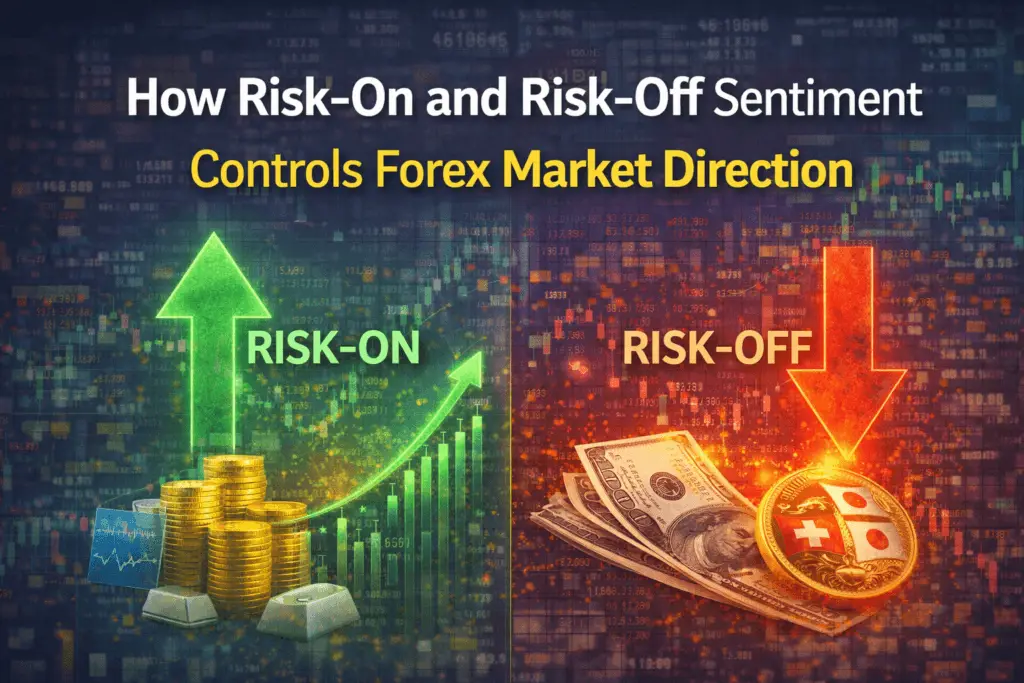
Forex markets often confuse traders because currencies move together even when their domestic economic data looks very different. A strong report from one country may fail to lift its currency, while another currency strengthens despite weak fundamentals. The explanation lies not in the data itself, but in risk sentiment. Understanding risk sentiment forex behavior is essential for identifying true market direction. Whether markets are in a risk-on or risk-off phase determines how capital flows across equities, bonds, commodities, and currencies. This article explains what risk-on and risk-off really mean, which currencies perform in each phase, and how yields and equities influence forex market direction. what risk-on and risk-off really mean Risk-on and risk-off describe investor behavior, not economic conditions. In a risk-on environment, investors feel confident about future growth and stability. They are willing to accept uncertainty in exchange for higher returns. In a risk-off environment, investors prioritize safety and liquidity, even if returns are lower. Forex markets respond quickly to these shifts because currencies represent capital movement between countries. When confidence rises, money flows toward growth-linked and higher-yielding currencies. When confidence falls, capital retreats toward safety. This behavioral shift explains why risk on risk off currencies often move together regardless of individual fundamentals. why risk sentiment matters more than economic data Economic data explains what has already happened. Risk sentiment reflects how investors feel about what might happen next. Forex markets are forward-looking, which is why sentiment often overrides data. A strong GDP or employment report may fail to lift a currency if markets are in risk-off mode. At the same time, weak data can be ignored during risk-on phases if investors believe conditions will improve. This is why forex market direction frequently remains unchanged despite frequent data releases. Sentiment sets the tone, while data adds short-term noise. how risk-on environments affect forex markets In risk-on phases, investors seek opportunity rather than protection. Capital flows into assets that benefit from global growth and stable financial conditions. Equities rise, credit spreads narrow, and volatility declines. In forex markets, this environment favors currencies associated with growth, trade, and higher yields. Capital leaves defensive currencies and moves toward instruments that offer better returns. Risk-on conditions often produce smooth, persistent trends because confidence supports follow-through. Pullbacks tend to be shallow, and volatility remains controlled. currencies that perform best during risk-on phases During risk-on environments, currencies linked to global trade and yield tend to outperform. These include commodity-linked currencies and those associated with expanding economies. At the same time, safe-haven currencies often weaken as demand for protection fades. This does not mean those economies are weak—it simply reflects shifting investor priorities. Understanding this relationship helps traders avoid fighting trends driven by sentiment rather than fundamentals. how risk-off sentiment shifts forex market direction Risk-off phases begin when uncertainty rises. This uncertainty can come from geopolitical tension, financial stress, tightening liquidity, or sudden changes in policy expectations. When confidence falls, investors reduce exposure to risk and prioritize liquidity. Capital flows out of equities, high-yield assets, and growth-sensitive currencies. Demand rises for assets perceived as stable and liquid. Forex markets react sharply because currency positions are often leveraged. As risk appetite declines, forced position reductions accelerate moves. currencies that benefit in risk-off conditions In risk-off environments, safe-haven currencies typically strengthen. These currencies benefit from capital preservation demand rather than growth expectations. This behavior explains why multiple currencies may strengthen simultaneously against risk-sensitive counterparts. The move is driven by global fear, not domestic strength. For traders, recognizing a shift to risk-off sentiment early is critical for protecting capital and aligning with market flow. the role of equities in risk sentiment forex analysis Equity markets are one of the clearest expressions of risk sentiment. Rising equities usually signal confidence, while falling equities often reflect caution. Forex markets frequently follow equity direction because both respond to the same capital flows. When equities trend higher, risk-on currencies tend to strengthen. When equities fall sharply, forex markets often shift into risk-off behavior. However, forex does not react to equity levels alone. The rate of change, volatility, and persistence of equity moves matter more than isolated declines or rallies. how bond yields influence risk-on and risk-off behavior Bond yields play a critical role in shaping risk sentiment. Rising yields can signal confidence in growth, but they can also tighten financial conditions. When yields rise gradually due to improving outlooks, risk-on sentiment often holds. When yields rise sharply or disorderly, markets may shift to risk-off as borrowing costs increase and liquidity tightens. Falling yields usually support risk-off sentiment when they reflect fear and demand for safety. In some cases, falling yields can also support risk-on if they ease financial conditions. Context matters. This interaction explains why risk sentiment forex analysis must include both equities and yields. why correlations increase during risk-off phases One of the most noticeable features of risk-off markets is rising correlation. Assets that normally move independently begin moving together. This happens because fear reduces differentiation. Investors focus on reducing exposure rather than selecting opportunities. As a result, currencies tied to risk often fall together, while safe-haven currencies rise together. These correlation spikes can surprise traders who believe they are diversified. In reality, they are exposed to the same underlying risk sentiment. why forex trends persist during strong sentiment phases Risk sentiment tends to shift slowly and persist once established. When confidence builds, it encourages continued participation. When fear takes hold, it discourages risk-taking. Because of this, forex market direction driven by sentiment can last weeks or months. Economic data may cause temporary pullbacks, but sentiment keeps the broader trend intact. This is why traders who fight sentiment often experience repeated stop-outs despite being “right” on data. how risk sentiment explains confusing price action Many confusing market behaviors become logical when viewed through sentiment. Strong data leading to currency weakness often occurs in risk-off phases where growth optimism is irrelevant. Weak data leading to strength can happen when it supports easier financial conditions in a risk-on environment. Risk sentiment provides the context
Why Forex Markets Often Ignore Economic Data Releases
One of the most frustrating experiences for forex traders is watching an important economic report hit the market—only to see price barely move, move sideways, or even move in the opposite direction. Inflation numbers, employment reports, GDP releases, and PMI data are all expected to drive currencies, yet in reality their impact often feels muted or illogical. This behavior leads many traders to ask a critical question: why does forex ignore data that seems so important?The answer lies in expectations, positioning, sentiment, and policy narratives. To understand true forex economic data reaction, traders must shift their focus away from headlines and toward how markets think ahead. forex markets are forward-looking by nature Forex markets do not wait for confirmation. They constantly price future outcomes based on probabilities, not facts. By the time an economic report is released, traders have already formed expectations using forecasts, trends, and central bank communication. Economic data describes what has already happened. The forex market trades what it believes will happen next. This forward-looking nature explains why many data releases fail to produce lasting movement. If a report confirms what the market already expected, price often does nothing—or reverses. expectations are priced in long before release Every major economic release comes with: These expectations are embedded in price well before the release date. When the data prints exactly as expected, there is no new information to trade. This is one of the main reasons why forex ignores data that looks significant on the surface. Markets react to surprises, not confirmations. when good data leads to bad price action Traders often assume strong data should strengthen a currency. In reality, strong data can trigger selling when it confirms expectations and encourages profit-taking. For example, if traders bought a currency in anticipation of strong data, the release becomes an exit opportunity. Once the data confirms expectations, there are no new buyers left—only sellers locking in gains. This dynamic explains many confusing forex economic data reaction patterns. market positioning matters more than the data itself Before major releases, markets are rarely neutral. Traders are already positioned based on expectations. If positioning is heavily skewed: Price reacts to how crowded the trade is, not just the number. This is why understanding market expectations forex is more important than memorizing economic calendars. sentiment shapes how data is interpreted Economic data does not exist in isolation. It is filtered through market sentiment. In optimistic environments, weak data may be ignored or spun positively. In cautious environments, strong data may fail to inspire confidence. Sentiment decides whether data is treated as supportive or irrelevant. This is why the same data can produce completely different reactions from one month to the next. policy narrative overrides individual reports Central banks set the dominant narrative. When policymakers communicate a clear direction, individual data releases lose influence. If central banks signal caution, strong data may not change policy expectations. If they signal tightening, weak data may be dismissed as temporary. Forex markets trade policy paths, not single data points. This is a key reason why forex ignores data during strong policy cycles. data must change expectations to move markets Economic data only matters when it forces traders to rethink future outcomes. If a report: then it moves markets. If it does none of these, price reaction is limited. This principle explains why markets sometimes react violently to modest surprises and barely react to dramatic-looking numbers. why sideways moves are common after data Sideways price action after data often reflects uncertainty resolution rather than direction. When expectations are met, traders pause. Liquidity returns, volatility fades, and price consolidates. This behavior is often mistaken for market indecision, but it is simply confirmation that nothing new has changed. Sideways movement is a signal that expectations remain intact. why opposite moves happen after data releases Opposite moves occur when data confirms what the market already priced in or contradicts positioning. For example: The market is not reacting to the data itself, but to how traders must adjust their positions. This adjustment process often looks illogical to beginners. algorithms amplify misleading reactions Modern forex markets are heavily influenced by algorithms. These systems react instantly to keywords and numbers, creating sharp initial moves. However, algorithmic reactions are mechanical, not contextual. Once human traders reassess expectations, price often reverses. This is why the first move after data is frequently unreliable. economic data has a short shelf life Most data releases influence price for minutes or hours, not days. Once the information is absorbed, the market refocuses on broader drivers such as sentiment, liquidity, and policy. Traders who chase data often enter just as its relevance fades. Understanding this timing helps avoid unnecessary losses. data vs broader market themes Markets operate within dominant themes: Economic data rarely overrides these themes unless it directly challenges them. This is why strong themes can persist despite mixed data. Themes control direction; data creates noise. why beginners struggle most with data trading Beginners often: Without understanding context, data trading becomes emotional and inconsistent. Learning market expectations forex dynamics reduces frustration and improves discipline. how professionals view economic releases Professional traders treat data as information, not signals. They ask: If the answer is no, they do nothing. This restraint is why professionals avoid overtrading around news. using economic data the right way Economic data should be used to: Data works best as a background filter, not a trigger. how traders can avoid data-related traps Smarter approaches include: Patience consistently outperforms prediction. when economic data really matters Data matters most when: In these moments, surprises carry more weight. Outside of them, data is often ignored. final conclusion: why forex ignores data so often Forex markets ignore economic data because they trade expectations, not history. By the time a report is released, the market has already decided how it feels about the future. This is why forex economic data reaction often feels muted, why traders ask why forex ignores data, and why understanding market expectations forex is essential. Data explains the
How Liquidity Conditions Shape Intraday and Long-Term Forex Trends
Liquidity is one of the most powerful forces in the forex market, yet it is also one of the least understood by retail traders. Many traders focus heavily on indicators, patterns, or economic data, but still struggle to understand why trends persist for weeks, why intraday moves suddenly accelerate, or why strong setups sometimes fail without warning. The missing piece in many cases is liquidity. Understanding forex liquidity provides clarity on how price truly moves. Liquidity determines whether trends flow smoothly or stall, whether volatility expands or contracts, and whether price respects structure or breaks it violently. This is why liquidity plays a central role in both intraday trading and long-term liquidity and currency trends. Liquidity in forex does not simply mean how easy it is to buy or sell a currency pair. In practical terms, liquidity refers to how much capital is available and willing to move through the market at any given time. When liquidity is abundant, price moves efficiently. When liquidity is scarce, price becomes unstable, erratic, and prone to sharp spikes. Forex markets respond directly to changes in liquidity because currencies are the foundation of global capital movement. Every trade, hedge, investment, or capital transfer flows through currency markets. As a result, liquidity conditions shape the very structure of the forex market. One of the most common misconceptions among traders is confusing liquidity with volatility. Volatility describes how fast price moves. Liquidity explains why it moves that way. High liquidity can actually reduce volatility by absorbing large orders smoothly. Low liquidity can increase volatility because even modest orders push price aggressively. This distinction is essential for understanding forex market structure. A market can be highly volatile due to low liquidity, not strong conviction. Likewise, a calm market does not necessarily lack interest—it may simply have sufficient liquidity to process flows efficiently. Central banks are the primary drivers of global liquidity conditions. Through interest rates, balance sheet operations, and policy communication, they influence how much capital flows through financial markets. When central banks provide accommodative conditions, liquidity expands. When they tighten financial conditions, liquidity contracts. These changes do not affect forex markets instantly. They gradually reshape capital behavior, leading to sustained trends or prolonged consolidations. This is why liquidity cycles often explain long-term forex trends better than individual economic releases. In high-liquidity environments, capital flows freely across markets. Risk appetite improves, participation increases, and trends develop smoothly. In these conditions, intraday price action tends to respect structure, pullbacks remain shallow, and momentum follows through more reliably. Traders often describe these markets as “clean” or “technical,” but what they are really experiencing is stable liquidity supporting orderly price discovery. When liquidity contracts, market behavior changes dramatically. Price becomes more sensitive, volatility increases, and false breakouts become common. Intraday moves may accelerate suddenly and then reverse just as quickly. Long-term trends may stall or transition into ranges. This environment is challenging for traders who rely only on indicators. Without understanding liquidity, these moves appear random. In reality, they reflect reduced participation and tighter capital conditions. Liquidity also explains why some trends last far longer than expected. When liquidity consistently supports capital flow in one direction, price continues moving even when economic data becomes mixed. Traders who fight these trends often get stopped repeatedly, believing price “should” reverse. As long as liquidity remains aligned, trends persist. Reversals usually begin only when liquidity conditions start to shift, not when indicators signal exhaustion. Intraday forex trends are also deeply influenced by liquidity timing. Liquidity is not constant throughout the trading day. It rises and falls based on market sessions, participation levels, and institutional activity. When liquidity is high, intraday trends develop more clearly. When liquidity thins, price becomes erratic and prone to stop-driven moves. Understanding this helps traders avoid forcing trades during unfavorable conditions. Liquidity also determines when trends accelerate. Acceleration occurs when new liquidity enters the market in the same direction as existing flow. This often happens after consolidation phases, policy shifts, or changes in risk sentiment. Without fresh liquidity, trends slow down. Price may continue moving, but momentum fades. This is why strong breakouts often fail when liquidity does not follow through. Many traders misinterpret volatility spikes as opportunity when they are actually warnings. Sudden volatility without supportive liquidity often leads to whipsaws rather than trends. These moves are driven by order imbalance, not conviction. Liquidity analysis helps traders distinguish between meaningful movement and noise. Retail traders often struggle with liquidity because it is not displayed directly on charts. However, its effects are visible through price behavior, follow-through, and structure respect. Markets with strong liquidity reward patience and trend-following. Markets with weak liquidity punish aggression. Understanding this changes how traders approach entries, exits, and risk management. Professional traders use liquidity as a framework, not a signal. They align trades with supportive liquidity environments and reduce exposure when liquidity deteriorates. This approach improves consistency and reduces emotional decision-making. Rather than predicting price, they observe how liquidity shapes behavior. Liquidity also explains why economic data sometimes appears irrelevant. If liquidity conditions dominate, data releases may cause only temporary volatility. If data alters liquidity expectations, reactions are stronger and more sustained. This is why liquidity often overrides short-term information. The most important lesson is that liquidity is not static. It expands and contracts over time, shaping both intraday moves and long-term trends. Traders who ignore liquidity often feel out of sync with the market. Traders who understand it gain context that indicators alone cannot provide. In conclusion, liquidity conditions shape forex markets at every level. They explain why trends persist, why volatility changes, and why price sometimes behaves unpredictably. Forex liquidity is the foundation of liquidity and currency trends, and understanding it provides deep insight into forex market structure. Traders who align with liquidity trade with the market. Traders who ignore it often trade against forces they cannot see. Visit our Social media pages:https://www.instagram.com/hadyjfx_official/https://www.youtube.com/@hadyjmentor7793https://www.facebook.com/profile.php?id=61562232239915 Join our free telegram channel:https://t.me/hadyjfx
Why USD Strength or Weakness Drives Correlation Across All Forex Pairs

In the forex market, no single currency influences price behavior more than the US dollar. Traders often analyze individual currency pairs in isolation, yet repeatedly find themselves confused when multiple pairs move in the same direction at the same time. This synchronized behavior is not random. It is driven by shifts in USD strength or weakness, which ripple across the entire forex market. Understanding the US dollar outlook is essential because the dollar sits at the center of global liquidity, trade, and capital flows. When the dollar moves, it reshapes risk sentiment, alters correlations, and drives broad market alignment. This is why the dollar impact on forex extends far beyond USD-based pairs and affects almost every currency combination. The US dollar dominates forex markets because it functions as the world’s primary reserve and funding currency. A large portion of global trade, debt issuance, and financial transactions are denominated in dollars. This structural role means that changes in USD demand influence how capital flows across borders, regardless of local economic conditions. When the dollar strengthens, global liquidity tightens. When the dollar weakens, liquidity expands. These shifts affect all currencies simultaneously, creating correlation across forex pairs that traders often misinterpret as coincidence. USD movement follows broad cycles rather than short-term randomness. These cycles are shaped by interest rate expectations, global liquidity conditions, and investor positioning. During periods of sustained dollar strength, capital concentrates into USD-denominated assets. During periods of sustained weakness, capital flows outward into foreign currencies, commodities, and risk-sensitive assets. These cycles explain why traders frequently see extended trends across EUR, GBP, JPY, and commodity currencies at the same time. Recognizing where the market stands within a dollar cycle provides essential context for USD strength analysis. One of the clearest frameworks for understanding dollar behavior is the concept of global risk sentiment. In risk-off environments, investors prioritize safety and liquidity. The US dollar benefits because it remains the most liquid currency in the world. During these phases, the dollar strengthens broadly, and most other currencies weaken together. In risk-on environments, investors seek yield and growth. Capital flows away from the dollar into equities, emerging markets, and higher-yielding currencies. This causes broad dollar weakness and synchronized strength across non-USD currencies. This dynamic is a key reason why risk sentiment and USD movement are inseparable. Many traders are confused when EUR, GBP, and JPY move together, despite differences in economic fundamentals. This behavior occurs because these currencies are responding to the same driver: the dollar. When USD weakens, capital flows into multiple currencies at once. When USD strengthens, capital retreats simultaneously. This is why analyzing currencies without considering the US dollar outlook often leads to tunnel vision. The dominant trend is not always country-specific—it is dollar-driven. USD positioning amplifies these movements. When markets become heavily positioned long or short the dollar, even small shifts in expectations can trigger rapid, synchronized moves across many pairs. Unwinding of positions creates momentum that feels sudden and aggressive. These positioning shifts are responsible for many correlation shocks, where assets that usually move independently suddenly align. Traders who believe they are diversified across multiple pairs often discover that they are exposed to the same underlying USD risk. Dollar strength or weakness also affects cross-currency pairs that do not include USD directly. Pairs like EUR/JPY or GBP/CHF are influenced indirectly because each currency’s performance is shaped by its relationship with the dollar. When USD moves aggressively, it distorts relative strength across the entire market. This indirect influence is why dollar impact on forex must be considered even when trading crosses. Economic data alone rarely explains these synchronized movements. Strong domestic data may fail to support a currency if the dollar is in a strong cycle. Weak data may not weaken a currency if USD weakness dominates global flows. Forex markets respond to relative capital movement, not absolute performance. The dollar acts as the reference point against which all currencies are measured. Professional traders treat USD analysis as a top-down process. They first assess whether the dollar is strengthening or weakening, then align individual pair trades with that broader trend. This approach reduces conflicting signals and improves consistency. Rather than trading every setup, they filter opportunities based on dollar direction and correlation risk. Retail traders often make the mistake of over-exposing themselves to correlated trades. Buying multiple non-USD currencies during dollar weakness may feel diversified, but it is effectively one large directional bet against the dollar. Understanding correlation helps traders manage risk more effectively and avoid unnecessary drawdowns. Dollar cycles tend to persist longer than traders expect. Once a trend is established, it continues until liquidity, policy expectations, or sentiment shifts meaningfully. Fighting these cycles usually results in repeated losses. Aligning with USD cycles allows traders to trade with institutional capital rather than against it. In conclusion, USD strength or weakness drives correlation across all forex pairs because the dollar sits at the center of global liquidity and capital flow. Changes in the US dollar outlook reshape risk sentiment, tighten or loosen financial conditions, and synchronize currency movement across markets. Understanding USD strength analysis and the dollar impact on forex helps traders avoid tunnel vision, manage correlation risk, and trade with greater clarity. The forex market is interconnected, and the US dollar is the anchor. Traders who respect this structure trade with confidence. Those who ignore it often trade against forces they cannot see. Visit our Social media pages:https://www.instagram.com/hadyjfx_official/https://www.youtube.com/@hadyjmentor7793https://www.facebook.com/profile.php?id=61562232239915 Join our free telegram channel:https://t.me/hadyjfx
How Market Positioning Explains Sudden Forex Reversals

One of the most frustrating experiences for forex traders is watching a strong trend suddenly reverse without any clear warning. Price moves smoothly for days or weeks, confidence builds, and then—often without major news—the market turns sharply, stopping out late entries and invalidating well-structured trades. These sudden reversals are rarely random. In most cases, they are driven by market positioning rather than new information. Understanding forex market positioning provides clarity on why currencies reverse abruptly, why trends exhaust faster than expected, and why sentiment shifts often occur before visible technical breakdowns. Positioning reveals how traders are already exposed, not how they plan to trade next—and that distinction is critical for effective currency reversal analysis. Forex markets do not move solely because of economic data or technical patterns. They move because participants enter, exit, and adjust positions. When too many traders are positioned in the same direction, the market becomes vulnerable to sharp moves once that positioning begins to unwind. This vulnerability explains why strong trends often fail suddenly. The issue is not a lack of buyers or sellers—it is an imbalance in exposure. Crowded trades are one of the most common causes of abrupt forex reversals. A trade becomes crowded when a large portion of the market shares the same directional bias. This often happens after extended trends, strong narratives, or repeated confirmation from indicators and news. When positioning becomes one-sided, there are fewer new participants left to push price further. At the same time, the risk of profit-taking increases. Once early participants begin exiting, price reacts quickly because there is limited opposing liquidity to absorb those orders. This is why crowded markets reverse faster and more aggressively than traders expect. Market sentiment plays a crucial role in this process. Forex sentiment reflects how confident traders feel about a particular direction. High confidence often coincides with late positioning, where traders enter after most of the move has already occurred. Ironically, the strongest sentiment readings often appear near market turning points. This does not mean sentiment causes reversals, but it highlights vulnerability. When sentiment is extreme, positioning is usually stretched. Profit-taking is another key driver behind sudden reversals. Institutional traders rarely exit positions all at once. They reduce exposure gradually as momentum slows or risk increases. This process can create subtle shifts in price behavior before any obvious breakdown appears. As profit-taking accelerates, price begins to lose follow-through. Breakouts fail more often. Pullbacks deepen. Volatility increases. These are early signs that positioning is changing beneath the surface. Traders who only watch price without understanding positioning often misinterpret these signals. Position unwinding occurs when traders are forced to exit positions due to risk limits, margin pressure, or changing expectations. This unwinding can happen even without negative news. Once price moves against crowded positions, stop-loss orders are triggered, adding momentum to the reversal. This chain reaction explains why reversals often feel sudden and violent. What appears to be a new trend is often just forced liquidation of existing exposure. One reason these reversals feel unpredictable is that positioning data is not always visible on charts. However, its effects are clear through price behavior. Failed continuations, sharp intraday swings, and strong countertrend moves often signal that positioning is being adjusted. Understanding forex market positioning helps traders interpret these movements as structural changes rather than emotional noise. Reversals are also influenced by how expectations evolve. When a trend is widely accepted, it becomes fragile. Any event—data, commentary, or risk shift—that challenges expectations can trigger rapid repositioning. This explains why markets sometimes reverse on seemingly insignificant catalysts. The trigger is not the cause; positioning is. Retail traders often assume reversals are caused by manipulation or hidden information. In reality, they are the natural outcome of imbalanced positioning. Markets do not need bad news to reverse—only a lack of new buyers or sellers. This perspective removes emotion and replaces confusion with structure. Professional traders monitor positioning indirectly through price reaction rather than trying to predict tops or bottoms. They watch how price behaves after good news, how it responds at key levels, and whether momentum expands or contracts. When strong narratives fail to push price further, professionals become cautious. When weak news fails to push price lower, they take notice. Using currency reversal analysis effectively means shifting focus from prediction to observation. Traders do not need to know who is positioned where. They need to recognize when positioning is likely stretched and vulnerable. This approach improves risk management and reduces the urge to chase late moves. Retail traders often make the mistake of entering trades when conviction feels strongest. Unfortunately, that is often when positioning is most crowded. Entering earlier with smaller size and exiting earlier with discipline produces better long-term results. Understanding sentiment and positioning helps traders avoid emotional entries. Market positioning also explains why reversals often overshoot. Once unwinding begins, price can move far beyond what fundamentals suggest. Forced exits accelerate momentum until new equilibrium is reached. These overshoots are not irrational—they are mechanical. In conclusion, sudden forex reversals are rarely mysterious. They are the visible result of invisible positioning dynamics. Crowded trades, profit-taking behavior, and position unwinding reshape price direction faster than most traders anticipate. Understanding forex market positioning, applying structured currency reversal analysis, and respecting forex sentiment allows traders to interpret reversals with clarity rather than frustration. Markets do not reverse to punish traders. They reverse to rebalance exposure. Traders who understand this trade with awareness. Those who ignore it continue to be surprised by moves they do not understand. Visit our Social media pages:https://www.instagram.com/hadyjfx_official/https://www.youtube.com/@hadyjmentor7793https://www.facebook.com/profile.php?id=61562232239915 Join our free telegram channel:https://t.me/hadyjfx
Why Silver Prices Fluctuate More Than Gold in Financial Markets
Silver often surprises traders with sudden and sharp price movements. While gold is generally seen as a stable store of value, silver can rise rapidly during optimism and fall just as quickly when confidence fades. This higher volatility leads many traders and investors to ask why silver behaves so differently, even though it belongs to the same precious metals category. The answer lies in silver’s structure. Silver is not only a monetary metal but also a critical industrial commodity. This dual role makes silver price movement far more sensitive to economic expectations, market sentiment, and liquidity conditions than gold. Understanding this difference is essential for accurate silver market analysis. silver’s dual role: industrial and investment demand Silver demand comes from two main sources. One is investment demand, where silver is held as a hedge or alternative asset. The other is industrial demand, where silver is used in manufacturing, technology, energy, and medical applications. Gold relies primarily on investment and reserve demand. Silver relies heavily on industrial consumption. Because industrial activity rises and falls with economic conditions, silver prices naturally fluctuate more as growth expectations change. This dual role is the foundation of why silver prices fluctuate more than gold. industrial demand amplifies silver volatility Industrial demand makes silver closely tied to the economic cycle. When global growth expectations improve, demand forecasts for silver rise, supporting higher prices. When slowdown fears emerge, those demand expectations weaken quickly. This creates larger price swings because markets constantly reassess future industrial usage. Gold does not face this pressure, as its value is not linked to production or manufacturing demand. As a result, silver price volatility increases whenever markets debate the strength or weakness of global growth. market size and liquidity effects Silver trades in a more compact market structure than gold. With fewer participants and lower overall depth, changes in buying or selling pressure can move prices more aggressively. When sentiment turns positive, silver can rally sharply as demand increases. When sentiment turns negative, selling pressure can cause rapid declines. Gold’s larger and deeper market tends to absorb these shifts more smoothly. This difference in market structure explains why silver reacts faster and with greater intensity than gold. silver versus gold behavior across market phases Silver and gold often move together, but their performance differs depending on the environment. During periods of economic expansion, silver frequently outperforms gold as industrial demand strengthens. During periods of uncertainty or slowdown, gold usually holds up better due to its defensive role. This shifting dynamic explains changes in silver vs gold behavior across cycles. Silver leads during optimism and lags during caution, while gold remains more stable. Understanding this relationship helps traders avoid misreading price action. impact of economic cycles on silver prices Silver prices are highly sensitive to where markets sit in the economic cycle. Early expansion phases often support strong silver rallies. Late-cycle uncertainty increases volatility. Slowdown phases tend to pressure silver as industrial demand expectations weaken. Gold, by contrast, often performs best when confidence declines. This divergence is why silver trends can reverse quickly during transitions between growth and slowdown. Economic cycles are one of the strongest drivers of silver price movement. sentiment changes affect silver more quickly Silver reacts strongly to changes in confidence. Optimism around growth, technology, or infrastructure spending can lift prices rapidly. Fear or caution tied to recession risk can trigger sharp pullbacks. Because sentiment shifts faster than fundamentals, silver prices can reverse suddenly even when conditions have not materially changed. This sensitivity makes silver market analysis highly dependent on expectations rather than confirmed outcomes. common mistakes traders make with silver Many traders treat silver exactly like gold. Others rely only on technical signals without considering economic context. Ignoring silver’s industrial exposure often leads to confusion when prices move against expectations. Treating silver as a pure safe-haven asset oversimplifies its behavior and increases trading errors. A balanced understanding improves consistency. using silver market analysis effectively Effective silver market analysis combines: Silver should be analyzed as a hybrid asset, reflecting both economic activity and investment behavior. final conclusion: why silver fluctuates more than gold Silver prices fluctuate more than gold because silver sits between industry and investment. Its dependence on economic growth, combined with a more compact market structure, leads to sharper reactions to changing expectations. This is why silver price volatility is higher, silver price movement is faster, and why silver prices fluctuate more frequently than gold. Silver amplifies optimism during expansion and exaggerates caution during slowdown. For traders and investors, understanding these dynamics transforms volatility from confusion into opportunity. Those who recognize silver’s unique role trade with clarity. Those who ignore it often mistake structure for unpredictability. Visit our Social media pages:https://www.instagram.com/hadyjfx_official/https://www.youtube.com/@hadyjmentor7793https://www.facebook.com/profile.php?id=61562232239915 Join our free telegram channel:https://t.me/hadyjfx
Why Gold Prices Rise and Fall During Market Uncertainty
Gold is often described as a safe asset, yet its price movement during uncertain times can confuse traders. In some situations, gold rises sharply as fear spreads. In others, it falls suddenly even when uncertainty remains high. This behavior leads many traders to ask why gold does not move in one consistent direction during crises. To understand gold price movement, it is necessary to look beyond headlines and focus on how fear, confidence, and capital flows interact. Gold does not react to uncertainty alone. It reacts to how investors feel about uncertainty and how they reposition capital in response. fear and confidence drive gold behavior Gold prices rise when fear dominates decision-making. During periods of heightened uncertainty, investors become more focused on preserving capital than generating returns. Gold benefits from this shift because it is viewed as a store of value that is independent of governments and financial systems. When confidence improves, even slightly, the need for protection declines. Investors begin reallocating funds toward assets linked to growth or yield. This change in mindset can cause gold prices to fall even if uncertainty has not fully disappeared. This balance between fear and confidence explains why gold prices can reverse quickly. gold versus risk sentiment Risk sentiment plays a central role in gold price volatility. In risk-off environments, investors reduce exposure to equities and higher-risk assets, increasing demand for gold. In risk-on environments, capital flows back into growth-oriented markets, often reducing demand for defensive assets. Gold does not rise simply because uncertainty exists. It rises when uncertainty causes investors to avoid risk. When uncertainty stabilizes or becomes familiar, risk appetite can return, and gold prices may decline. Understanding this relationship is key to interpreting why gold prices rise at some moments and fall at others. the role of global news in gold price movement Global news often acts as the trigger for sudden moves in gold. Geopolitical tensions, financial system stress, or policy uncertainty can rapidly change investor expectations. Markets react to the possibility of disruption, not just confirmed outcomes. This is why gold often moves immediately after global headlines, long before economic data reflects any impact. When news increases uncertainty unexpectedly, gold tends to rise. When news reduces perceived risk or confirms expectations, gold can fall just as quickly. how yields influence gold prices Gold does not generate income, so it competes with interest-bearing assets. Changes in yields influence how attractive gold appears relative to other options. When yields rise due to strong growth and confidence, gold may weaken as investors seek better returns elsewhere. When yields fall or rise because of instability or inflation concerns, gold can strengthen as confidence in financial assets declines. This is why gold sometimes falls during periods of rising yields and rises during others. The reason behind yield movement matters more than the direction itself. why gold sometimes reverses suddenly Sudden gold reversals often occur when expectations change faster than reality. Markets constantly adjust to new information, sentiment shifts, and positioning. If many traders are already positioned for higher gold prices, even neutral news can trigger profit-taking. This selling pressure can cause sharp pullbacks that feel unexpected. Gold price volatility increases when positioning becomes crowded, making reversals more frequent during uncertain periods. gold and short-term panic versus long-term uncertainty Short-term panic often pushes gold higher very quickly. However, once panic subsides, prices may stabilize or decline even if uncertainty remains. Long-term uncertainty supports gold more gradually. In these cases, gold trends tend to be steadier and less reactive to daily headlines. Recognizing whether markets are reacting to panic or longer-term concern helps traders interpret price behavior more accurately. common misconceptions about gold during uncertainty Many traders believe gold should always rise during crises. This assumption leads to frustration when prices move sideways or decline. Gold responds to changes in uncertainty, not uncertainty itself. When fear peaks and stops increasing, gold can fall even though conditions remain unstable. Understanding this distinction improves decision-making and reduces emotional trading. using gold price volatility effectively Gold price volatility should be viewed as information, not noise. Sharp moves often reflect shifts in sentiment or positioning rather than changes in fundamentals. Traders who combine gold market outlook analysis with sentiment and global context gain a clearer picture of why prices move the way they do. Gold works best as a context asset, helping traders understand broader market psychology. Final conclusion: why gold moves unpredictably during uncertainty Gold prices rise and fall during market uncertainty because gold reflects human behavior, not just economic conditions. Fear pushes prices higher, confidence pulls them lower, and expectations shift constantly in between. This is why gold price volatility is common during uncertain times and why gold price movement can feel unpredictable. Gold reacts to changes in sentiment, global news, and yield expectations long before data confirms outcomes. For traders building a realistic gold market outlook, the key lesson is simple: gold does not respond to uncertainty alone. It responds to how investors interpret and react to that uncertainty. Those who understand this trade gold with clarity. Those who ignore it trade emotion. Visit our Social media pages:https://www.instagram.com/hadyjfx_official/https://www.youtube.com/@hadyjmentor7793https://www.facebook.com/profile.php?id=61562232239915Join our free telegram channel:https://t.me/hadyjfx
How Worldwide News Drives Commodity and Currency Market Trends

Financial markets do not move only on scheduled economic data. Some of the strongest and most persistent price trends begin with global headlines—political developments, geopolitical tensions, policy shifts, or unexpected global events. Traders often notice commodities and currencies reacting sharply to worldwide news long before official confirmation appears in data releases. Understanding how worldwide market news influences price behavior is essential for interpreting modern markets. Global events reshape expectations, alter risk sentiment, and redirect capital flows. This article explains how global financial news impact drives commodities and currencies, why reactions differ between asset classes, and why markets often move ahead of confirmation. why global headlines move markets so quickly Worldwide news introduces uncertainty. Unlike economic data, which provides structured information, global events often arrive unexpectedly and evolve rapidly. Markets respond not to certainty, but to changes in perceived risk. When new information alters expectations about growth, stability, or policy direction, investors reposition immediately. This is why prices often move on headlines rather than waiting for data validation. Markets react to what could happen next, not just what has already happened. global political and economic developments Political decisions, international conflicts, trade negotiations, and policy shifts have global consequences. These developments influence supply chains, investment flows, and confidence across borders. For example, political instability can disrupt trade routes or investment planning, while economic policy changes can affect growth prospects worldwide. Commodities and currencies are especially sensitive because they reflect cross-border activity. This is why global financial news impact often shows up first in markets tied closely to international trade. risk sentiment as the transmission mechanism Risk sentiment connects worldwide news to market prices. When global headlines increase uncertainty, risk sentiment typically deteriorates. When confidence improves, risk appetite strengthens. In risk-off environments, investors reduce exposure to assets linked to growth and uncertainty. In risk-on environments, capital flows toward assets associated with expansion and opportunity. This shift in sentiment explains much of the immediate reaction seen in both commodities and currencies. how commodities respond to worldwide news Commodity prices react to worldwide news based on how events affect supply, demand, and confidence. Energy markets respond to geopolitical tension. Industrial metals react to growth expectations. Precious metals respond to uncertainty and confidence shifts. Because commodities are tied to real economic activity, commodity market reaction often reflects how global developments may influence production, trade, or consumption. Markets do not wait for confirmation of impact. Prices adjust as soon as expectations change. how currencies react to global developments Currencies respond to worldwide news through capital flows and relative safety perceptions. During periods of uncertainty, capital tends to move toward currencies viewed as stable or liquid. During periods of optimism, capital flows toward growth-linked currencies. This behavior shapes currency market trends across regions. Importantly, currencies often move together in response to global news rather than domestic data. This is why traders sometimes see synchronized moves across multiple currency pairs after major global headlines. commodities versus currencies: different reactions, same driver Although commodities and currencies respond differently, they are often driven by the same underlying force: global expectations. Commodities reflect physical demand and supply assumptions. Currencies reflect capital flow decisions and relative stability. Worldwide news alters both at the same time, but through different channels. Understanding this distinction helps traders interpret why assets may move in opposite directions while responding to the same event. why markets move before confirmation appears Markets are forward-looking by design. Waiting for confirmation means reacting late. As soon as expectations shift, prices adjust to reflect potential outcomes. Economic data often confirms what markets have already priced. By the time confirmation arrives, much of the move has already occurred. This is why worldwide market news frequently drives initial trends, while data explains them later. expectations matter more than outcomes Markets care less about the final outcome of events and more about how expectations change along the way. A situation that improves slightly from very negative expectations can support prices. A situation that disappoints optimistic expectations can pressure markets. This dynamic explains why markets sometimes rally on bad news or fall on good news. The reaction is about surprise relative to expectation, not absolute quality. how professional traders interpret worldwide news Professional traders focus on how global news alters the broader narrative. They assess whether developments change growth expectations, risk sentiment, or capital flow direction. Rather than reacting emotionally to headlines, they observe how price behaves after the initial reaction. This helps distinguish temporary noise from meaningful trend shifts. common mistakes traders make with global news Retail traders often chase headlines without context. Others assume news must align with economic logic to move markets. Ignoring sentiment, positioning, and expectations leads to frustration. Worldwide news does not move markets by itself—it changes how markets think about the future. using global news as market context Worldwide news should be used as context, not as a trigger. It helps explain why trends form and why volatility increases, but direction is confirmed by price behavior and broader market structure. Combining news awareness with technical and macro analysis improves consistency and reduces emotional decision-making. Final conclusion: why worldwide news shapes market trends Worldwide news drives commodity and currency market trends because it reshapes expectations before data can confirm change. Global developments influence confidence, risk perception, and capital allocation across markets. This is why global financial news impact often appears first in price action, why commodity market reaction can be swift, and why currency market trends shift together during periods of uncertainty. Markets move ahead of confirmation because they are designed to anticipate. Traders who understand this behavior trade with context and clarity. Those who wait for certainty often arrive after the move is already complete. Visit our Social media pages:https://www.instagram.com/hadyjfx_official/https://www.youtube.com/@hadyjmentor7793https://www.facebook.com/profile.php?id=61562232239915 Join our free telegram channel:https://t.me/hadyjfx
Why Copper Prices Signal Global Economic Strength or Weakness

Copper holds a special place in global financial markets because it is directly tied to real economic activity. Unlike precious metals that respond mainly to sentiment and risk perception, copper prices move with production, construction, and infrastructure demand. This is why traders and investors closely monitor copper when assessing the health of the global economy. Movements in copper prices often appear before economic slowdowns or recoveries are reflected in official data. For anyone following copper market analysis or forming a realistic copper price outlook, understanding copper’s role as a global growth indicator is essential. copper as a global economic indicator Copper is widely used across industries, including construction, power generation, electronics, transportation, and manufacturing. Because of this broad application, demand for copper rises and falls with economic expansion and contraction. When economic activity accelerates, copper consumption increases. When growth slows, demand weakens. This close link is why copper is often referred to as a practical measure of economic momentum rather than a speculative asset. The phrase global growth indicator copper reflects this role accurately—copper prices tend to reflect how strong or fragile global demand really is. copper and industrial activity Industrial production is one of the strongest drivers of copper demand. Factories, infrastructure projects, and energy systems all require copper as a core input. When industrial output rises, copper inventories tighten and prices tend to move higher. When production slows or investment declines, copper demand softens quickly. This makes copper especially sensitive to changes in manufacturing cycles, often reacting before official output data confirms the shift. For traders, copper price movement often provides early clues about changing industrial conditions. infrastructure and manufacturing demand Large-scale infrastructure projects are major sources of copper consumption. Power grids, renewable energy systems, housing development, and transportation networks all rely heavily on copper. When governments increase infrastructure spending to support growth, copper demand trends usually strengthen. When spending slows or projects are delayed, copper prices often weaken in response. Manufacturing demand works in a similar way. Expanding factories and rising production volumes support copper prices, while declining output places downward pressure on the market. why china matters so much for copper China plays a central role in global copper demand. As one of the world’s largest consumers of industrial metals, shifts in Chinese growth expectations have a direct impact on copper prices. When markets anticipate stronger growth in China, copper prices often rise even before official data confirms improvement. When concerns emerge about slowing construction or manufacturing activity, copper prices tend to weaken rapidly. Because of this relationship, copper is frequently used to gauge broader global growth trends, not just conditions in one country. why copper often leads economic trends Copper prices often move ahead of economic data because markets trade expectations, not confirmations. Investors and institutions adjust positions based on projected demand rather than waiting for official statistics. If copper prices begin to trend higher, it often signals rising confidence in future growth. If copper weakens persistently, it may indicate caution, slowing demand, or reduced investment activity ahead. This forward-looking behavior explains why copper is closely watched by macro traders and economists alike. copper demand trends and market sentiment Copper demand trends are influenced not only by physical consumption but also by sentiment about future growth. Optimism around global expansion tends to support copper prices, while uncertainty or caution reduces appetite. During periods of stable growth expectations, copper trends are often smooth and directional. During periods of uncertainty, prices can become volatile as markets reassess demand assumptions. Understanding sentiment helps place copper price movements into proper context. copper versus defensive assets Copper behaves differently from defensive assets such as gold. While gold may rise during periods of uncertainty, copper often weakens if growth expectations deteriorate. This contrast highlights copper’s role as a growth-linked asset rather than a safe-haven instrument. Comparing copper performance with defensive assets can provide valuable insight into market expectations about the global economy. why copper reacts faster than economic data Economic data is released with a delay and reflects past activity. Copper prices, on the other hand, adjust continuously as expectations change. When markets anticipate stronger or weaker growth, copper prices respond immediately. This is why copper often signals shifts in economic momentum before official indicators do. For traders, copper acts as an early warning system rather than a confirmation tool. common mistakes traders make with copper Many traders treat copper as just another commodity without considering its macro significance. Others focus only on technical patterns and ignore demand-side drivers. Misinterpreting copper as a short-term trading instrument without understanding its role in growth cycles often leads to poor timing and false signals. Recognizing copper’s connection to global demand improves interpretation and decision-making. using copper market analysis effectively Effective copper market analysis combines: Copper should be analyzed as part of a macro framework rather than in isolation. Final conclusion: why copper reflects global strength or weakness Copper prices signal global economic strength or weakness because copper is embedded in the real economy. Its demand rises with expansion and falls with contraction, making it a practical indicator of global growth trends. By tracking copper demand trends and forming a realistic copper price outlook, traders and investors gain insight into where the global economy may be heading next. Copper does not move randomly. It reflects production, investment, and confidence. Those who understand copper’s role gain an early view of economic shifts—often before the data confirms them. Visit our Social media pages:https://www.instagram.com/hadyjfx_official/https://www.youtube.com/@hadyjmentor7793https://www.facebook.com/profile.php?id=61562232239915 Join our free telegram channel:https://t.me/hadyjfx
How Silver Prices Track Economic Growth and Market Sentiment

Silver behaves differently from most assets in global financial markets. At times, it trades like a precious metal, responding to uncertainty and risk aversion. At other times, it behaves like an industrial commodity, moving in line with economic growth and manufacturing demand. This dual nature is what makes silver both attractive and confusing for traders and investors. Understanding silver price analysis requires looking beyond simple supply and demand. Silver prices reflect changes in global growth expectations, investor confidence, and overall market sentiment. This article explains how silver tracks economic cycles, how it differs from gold, and why silver market trend behavior often shifts quickly when sentiment changes. silver’s dual role in financial markets Silver occupies a unique position because it serves two distinct purposes. It is both a store of value and a key industrial input. Unlike gold, which is primarily held for protection and reserve purposes, silver is widely used in manufacturing, technology, and energy-related industries. Because of this, silver demand rises during periods of economic expansion and weakens when growth expectations decline. At the same time, silver can attract defensive flows during uncertainty, though usually to a lesser degree than gold. This dual role explains why silver can outperform gold during growth phases and underperform during periods of stress. industrial demand versus safe-haven demand A large portion of silver demand comes from industrial use. Electronics, renewable energy, medical equipment, and advanced manufacturing all rely on silver’s conductive and chemical properties. When global growth accelerates, industrial demand strengthens, supporting higher silver prices. When growth slows, that demand weakens, putting pressure on prices. Safe-haven demand exists for silver, but it is secondary. During major risk-off events, gold usually attracts capital first. Silver often follows later and with greater volatility. This balance between industrial demand and defensive demand drives much of the silver market trend. how silver reflects global economic growth Silver is highly sensitive to expectations about global production and trade. Manufacturing data, infrastructure investment, and industrial output trends all influence silver pricing. When markets anticipate expansion, silver prices often rise in advance, reflecting increased future demand. When recession risks grow, silver tends to weaken as industrial demand expectations decline. This sensitivity makes silver an informal indicator of economic momentum, especially during transitions between growth and slowdown phases. market sentiment and silver price behavior Market sentiment plays a crucial role in silver price movement. In optimistic environments, investors are more willing to allocate capital to assets tied to growth. Silver benefits from this behavior because it sits between precious metals and industrial commodities. In cautious or uncertain environments, sentiment shifts toward capital preservation. Gold usually outperforms silver in these phases, while silver may experience sharper swings due to reduced industrial confidence. This is why changes in sentiment can cause silver to move more aggressively than gold, both upward and downward. silver versus gold performance dynamics Comparing silver to gold highlights their structural differences. Gold is primarily a monetary and defensive asset. Silver is a hybrid asset. During strong growth cycles, silver often outperforms gold as industrial demand accelerates. During periods of economic stress, gold typically leads while silver lags or moves with greater volatility. This relationship is central to understanding silver vs gold movement and why their price trends sometimes diverge despite both being precious metals. why silver is more volatile than gold Silver trades in a more compact market structure, which allows shifts in sentiment or positioning to have a stronger and faster impact on price behavior than in gold. This means price movements can be amplified by changes in sentiment or positioning. When optimism increases, silver can rally sharply. When confidence fades, silver can decline quickly. This volatility reflects its dependence on growth expectations rather than pure capital protection. For traders, this volatility offers opportunity but also demands disciplined risk management. how silver reacts to economic data Silver does not respond uniformly to economic data releases. Strong growth-related data can support silver prices if it reinforces expansion expectations. Weak data can pressure silver if it signals reduced industrial demand. However, silver often reacts more to expectations than to the data itself. If growth optimism is already priced in, even strong data may produce little reaction. If sentiment is fragile, modest data surprises can lead to large moves. This behavior makes silver outlook today closely tied to narrative and confidence rather than individual reports. silver’s behavior during global transitions Silver is most reactive during periods of transition. When markets shift from expansion to slowdown, or from caution to recovery, silver often moves aggressively as expectations are recalibrated. These transitions explain why silver trends can change rapidly and why silver often leads other industrial commodities at turning points. Understanding these shifts helps traders avoid treating silver as a static asset. common mistakes traders make with silver Many traders assume silver behaves exactly like gold. Others trade silver solely on technical patterns without considering growth context. Ignoring silver’s industrial role leads to misinterpretation of price moves. Treating silver only as a safe haven or only as a commodity oversimplifies its behavior. Recognizing silver’s hybrid nature improves consistency and reduces frustration. using silver trend analysis effectively Effective silver price analysis combines: Silver should be analyzed as part of a macro framework, not in isolation. Final conclusion: why silver reflects growth and sentiment Silver prices track economic growth and market sentiment because silver sits at the intersection of industry and investment. Its price responds to manufacturing demand, global expansion expectations, and shifts in confidence. This is why silver market trend behavior often differs from gold and why silver vs gold movement changes across cycles. Silver strengthens when growth optimism rises and weakens when confidence fades. For traders and investors, understanding this relationship is essential for forming a realistic silver outlook today. Silver does not move randomly—it reflects how the world feels about growth, risk, and the future. Visit our Social media pages:https://www.instagram.com/hadyjfx_official/https://www.youtube.com/@hadyjmentor7793https://www.facebook.com/profile.php?id=61562232239915 Join our free telegram channel:https://t.me/hadyjfx