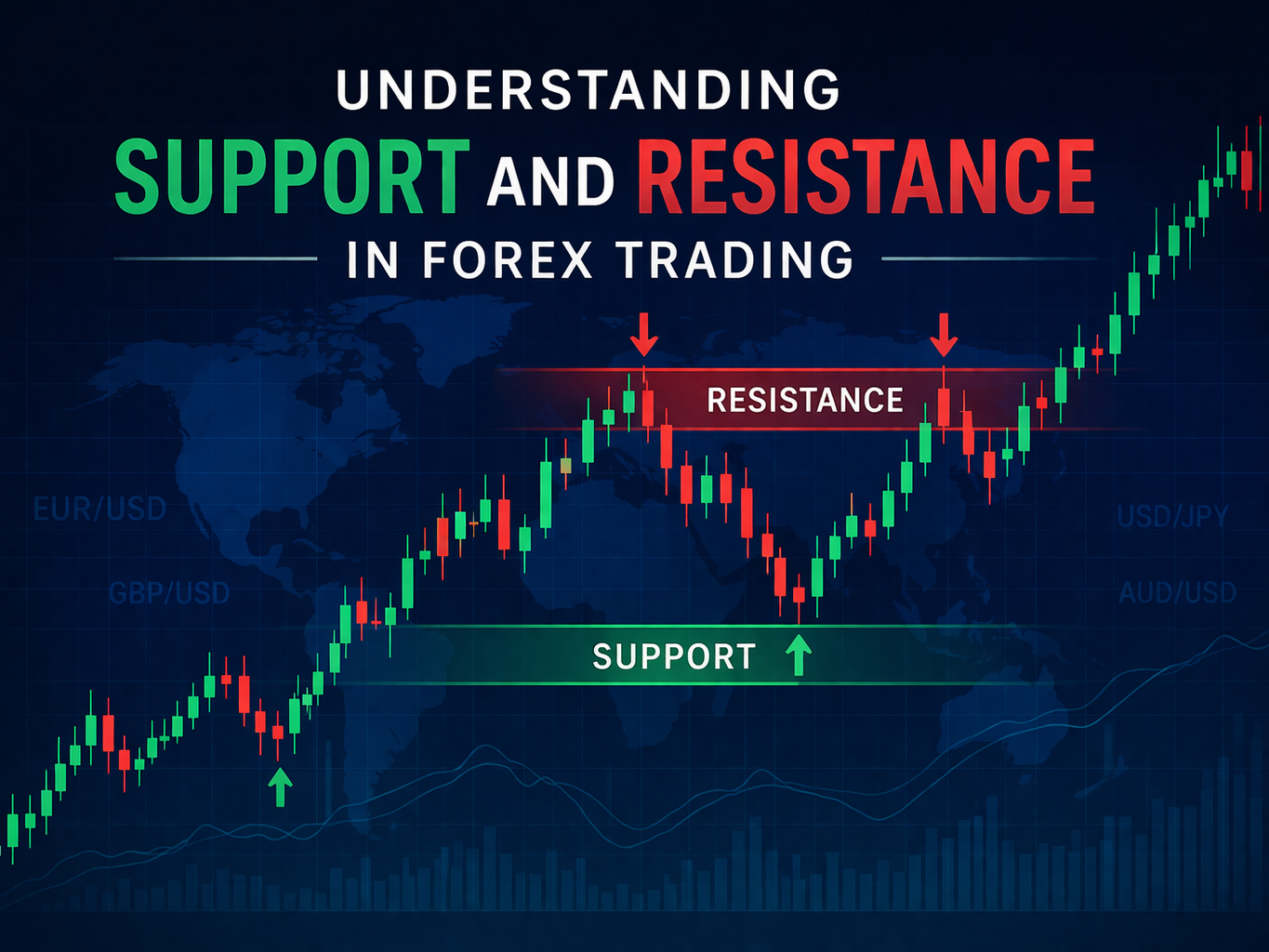
Forex trading is built on the idea of understanding price movement, and one of the most important concepts that every trader must learn is how price reacts at certain levels. These levels are not random; they are formed based on historical price behavior and market psychology. Traders across the world observe these areas closely because they often act as decision zones where the market either reverses or continues its trend. Learning how these levels work can significantly improve a trader’s ability to read charts and make informed trading decisions.
In simple terms, support and resistance represent areas on a chart where price tends to react repeatedly. These levels are formed due to the interaction between buyers and sellers in the market. When buyers dominate, price moves upward, and when sellers dominate, price moves downward. Over time, certain price zones develop where buying or selling pressure becomes strong enough to influence market direction. These zones become reference points for traders and are used to identify potential entry and exit opportunities.
Support is a price level where the market tends to stop falling and may start rising again. This happens because buyers enter the market at that level, creating demand. When price reaches support, traders often look for buying opportunities because there is a higher probability that the price may bounce upward. On the other hand, resistance is a level where price tends to stop rising and may start falling. This occurs because sellers step in, increasing supply. When price reaches resistance, traders look for selling opportunities.
Understanding this behavior is essential because markets do not move in straight lines. Instead, they move in waves, constantly reacting to areas where demand and supply change. These reactions are influenced by human psychology, as traders tend to remember previous price levels and make decisions based on them. This creates a pattern where price repeatedly reacts at similar levels, making support and resistance highly reliable tools.
At this stage, it becomes important to understand support and resistance forex trading as a core concept rather than just a basic idea. These levels are not exact lines but zones where price interaction occurs. Beginners often make the mistake of drawing precise lines, expecting the market to react perfectly at those points. In reality, price may slightly break above or below these levels before reversing. This is why experienced traders treat them as zones rather than fixed points.
Another important factor is how these levels are formed. Strong support or resistance levels are usually created after multiple price rejections. The more times price reacts at a level, the stronger it becomes. This is because more traders recognize that level and place their orders around it. As a result, when price returns to that zone, the reaction becomes more significant.
Market structure also plays a key role in understanding these levels. In an uptrend, support levels are more important because the market is moving upward, and traders look for buying opportunities at pullbacks. In a downtrend, resistance levels become more significant because traders look for selling opportunities when price retraces upward. Identifying the overall trend helps traders use support and resistance more effectively.
Another concept that traders should understand is the role reversal of levels. Sometimes, a support level can turn into resistance, and a resistance level can turn into support. This happens when price breaks through a level and then returns to test it again. For example, if price breaks above a resistance level, that level may act as support when price comes back down. This behavior provides strong trading opportunities and is widely used by experienced traders.
At a deeper level, traders begin to explore support resistance strategy in forex to refine their entries and exits. This involves combining these levels with other tools such as candlestick patterns, trend analysis, and price action. By doing so, traders can increase the probability of their trades and reduce risk. For example, waiting for confirmation signals at support or resistance levels can help avoid false entries.
Another important aspect is understanding false breakouts. Sometimes, price may appear to break a level but quickly reverse direction. This can trap traders who enter trades too early. Experienced traders wait for confirmation before making decisions. They observe how price behaves around the level and look for signs of strength or weakness before entering a trade.
Volume and market momentum also influence how price reacts at these levels. Strong momentum can cause price to break through support or resistance, while weak momentum may result in a reversal. Understanding these dynamics helps traders adapt their strategies based on market conditions.
Psychology plays a major role in how support and resistance levels function. These levels exist because traders collectively believe in them. When many traders place buy or sell orders at the same level, it creates a strong reaction in the market. This collective behavior is what makes these levels effective and widely used.
Another key factor is timeframes. Support and resistance zones appear across multiple timeframes, and their strength depends on the timeframe being used. Levels on higher timeframes such as daily or weekly charts are generally stronger than those on lower timeframes. Traders often use multiple timeframes to get a clearer picture of the market and improve their decision-making process.
At this point, understanding how support and resistance works in forex becomes essential for building a structured trading approach. It is not just about identifying levels but also about understanding how price interacts with them. Traders who develop this skill can better anticipate market movements and improve their overall performance.
Risk management is also closely connected to these levels. Traders often place stop losses beyond support or resistance zones to protect their capital. This ensures that if the market moves against their position, losses are limited. When traders combine strong risk control with precise level marking, their overall trading performance improves over time.
Patience is another important quality when trading using support and resistance. Many traders rush into trades without waiting for proper confirmation. This often leads to losses. Waiting for the right setup and following a disciplined approach can increase the chances of success.
Consistency is key in trading. Instead of trying to catch every move, successful traders focus on high-probability setups. By using support and resistance effectively, traders can filter out unnecessary trades and focus on quality opportunities.
Technology has made it easier for traders to identify these levels using charting tools and indicators. However, it is important to understand that these tools are only aids and should not replace proper analysis. Developing the ability to read price action is essential for long-term success.
Another important concept is combining support and resistance with trend analysis. When trend direction and key levels support each other, the chances of a high-quality trade setup become stronger. For example, buying at support in an uptrend or selling at resistance in a downtrend provides stronger setups.
Over time, traders develop their own methods of identifying and using these levels. Some prefer simple horizontal lines, while others use zones or dynamic levels such as moving averages. The key is to find a method that works consistently and stick to it.
In conclusion, support and resistance are fundamental concepts in forex trading that help traders understand market behavior and identify trading opportunities. These levels are formed based on price history and market psychology, making them reliable tools for analysis. By combining these levels with proper risk management, discipline, and continuous learning, traders can improve their performance and build a consistent trading approach.
Forex trading is not about predicting the market perfectly but about understanding how price behaves and reacting accordingly. Support and resistance provide a structured way to analyze the market and make informed decisions. With practice and experience, traders can use these concepts effectively to navigate the complexities of the forex market and work towards long-term success.
Visit our Social media pages:
https://www.instagram.com/hadyjfx_official
https://www.youtube.com/@hadyjmentor7793
https://www.facebook.com/profile.php?id=61562232239915
Join our free telegram channel:
https://t.me/hadyjfx