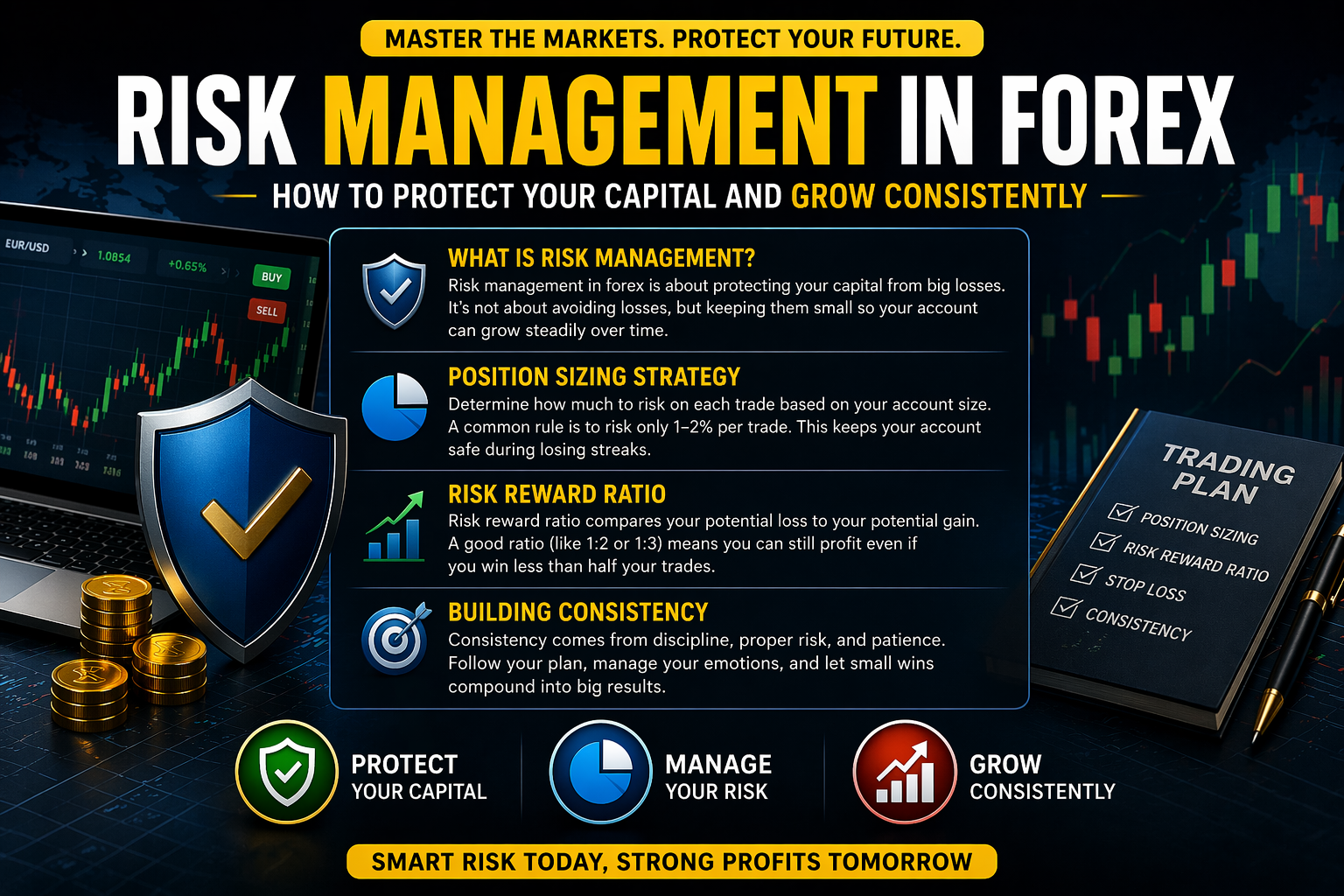
In the world of forex trading, most beginners focus only on finding the perfect strategy, entry point, or indicator. However, the truth is that even the best strategy will fail without proper risk management. Professional traders understand that protecting capital is more important than making profits. This is why risk management in forex, position sizing strategy, and risk reward ratio are considered the foundation of long-term success.
Many traders lose their accounts not because they lack knowledge, but because they ignore risk. A single bad trade with high risk can wipe out weeks or months of profits. On the other hand, traders who focus on managing risk can survive losing streaks and still grow their accounts steadily. This shift in mindset separates amateurs from professionals.
What is Risk Management in Forex
Risk management in forex refers to the process of controlling potential losses in trading. It involves setting rules that protect your trading capital from large drawdowns. Instead of focusing on how much you can make, risk management focuses on how much you can lose safely.
Every trade carries uncertainty. No strategy guarantees 100 percent accuracy. This is why traders must accept losses as part of the game. By applying risk management in forex, position sizing strategy, and risk reward ratio, traders can ensure that losses remain small while profits grow over time.
The goal is not to avoid losses but to control them. When losses are controlled and profits are allowed to run, overall account growth becomes consistent.
Why Risk Management is More Important Than Strategy
Many traders spend years searching for the perfect strategy but ignore risk management. This is a major mistake. Even a strategy with a low win rate can be profitable with proper risk management, while a high win rate strategy can fail without it.
For example, a trader winning 40 percent of trades can still make money if their risk reward ratio is strong. On the other hand, a trader winning 80 percent of trades can lose everything if they risk too much per trade.
This is why professional traders prioritize risk management in forex, position sizing strategy, and risk reward ratio over entry signals. Strategy gives you entries, but risk management keeps you in the game.
Understanding Position Sizing in Forex
Position sizing is the process of determining how much capital to risk on a single trade. It is one of the most powerful tools in trading but often overlooked by beginners.
Instead of randomly choosing lot sizes, professional traders calculate their position size based on account balance and risk percentage. This ensures that each trade carries a controlled level of risk. This concept is essential in risk management in forex, position sizing strategy, and risk reward ratio.
For example, if you have a trading account of 1000 dollars and risk 1 percent per trade, you are risking only 10 dollars. This means even after multiple losses, your account remains safe.
Position sizing allows traders to stay consistent and avoid emotional decision-making.
How to Calculate Position Size
Position size depends on three factors: account size, risk percentage, and stop loss distance. By combining these elements, traders can calculate the exact lot size for each trade.
If your stop loss is wide, your position size should be smaller. If your stop loss is tight, your position size can be larger. This balance ensures that risk remains constant across all trades.
This calculation is a core part of risk management in forex, position sizing strategy, and risk reward ratio. It helps traders maintain discipline and avoid overexposure.
Many trading platforms provide position size calculators, making this process easier for beginners.
Risk Per Trade: The Golden Rule
One of the most important rules in trading is limiting risk per trade. Most professional traders risk between 1 percent to 2 percent of their account on a single trade.
Risking more than this increases the chances of blowing the account during losing streaks. Even a small series of losses can become dangerous if risk is too high.
By following risk management in forex, position sizing strategy, and risk reward ratio, traders can survive losing streaks and continue trading confidently.
Consistency in risk leads to consistency in results.
Understanding Risk Reward Ratio
The risk reward ratio compares the potential loss of a trade with its expected profit. This balance plays a major role in determining whether a trading strategy can remain profitable over the long run.
For example, a 1:2 risk reward ratio means you risk 1 unit to gain 2 units. A trader does not need to win every trade to succeed. With a strong risk-to-reward setup, fewer winning trades can still generate overall profits.
This concept is essential in risk management in forex, position sizing strategy, and risk reward ratio. It shifts the focus from win rate to overall profitability.
Traders should always look for setups that offer favorable risk reward ratios. This improves long-term performance.
Why Risk Reward Ratio Matters
Many traders focus only on winning trades, but winning alone does not guarantee profit. What matters is how much you win compared to how much you lose.
A trader with a 50 percent win rate and a 1:2 risk reward ratio can grow their account consistently. On the other hand, a trader with a 70 percent win rate but a poor risk reward ratio may still lose money.
This is why risk management in forex, position sizing strategy, and risk reward ratio are interconnected. Together, they create a strong foundation for trading success.
Combining Position Sizing and RR Ratio
The real power of trading comes from combining position sizing with risk reward ratio. These two concepts work together to control risk and maximize returns.
Position sizing ensures that each trade carries a fixed level of risk, while risk reward ratio ensures that profits outweigh losses. This combination creates a positive expectancy.
By applying risk management in forex, position sizing strategy, and risk reward ratio, traders can achieve steady growth without taking unnecessary risks.
Common Risk Management Mistakes
Many traders make critical mistakes when it comes to risk management. One common mistake is risking too much on a single trade. This often leads to emotional trading and poor decisions.
Another mistake is moving stop losses. Traders often shift their stop loss to avoid taking a loss, which increases risk and leads to bigger losses.
Overtrading is also a major issue. Taking too many trades without proper setups reduces accuracy and increases exposure.
Ignoring risk management in forex, position sizing strategy, and risk reward ratio can quickly destroy a trading account.
How to Protect Your Capital
Protecting capital should always be the top priority. Without capital, trading is not possible. This is why traders must focus on survival before profits.
Using stop losses is essential. Every trade should have a predefined exit point. This prevents large losses and keeps risk under control.
Avoiding over-leverage is also important. High leverage can amplify both profits and losses. Traders should use leverage carefully.
By following risk management in forex, position sizing strategy, and risk reward ratio, traders can protect their capital and trade with confidence.
Building Consistency in Trading
Long-term success in forex trading comes from steady performance rather than chasing quick profits. Traders who focus on gradual growth and controlled risk are more likely to build sustainable results over time.
Traders who follow a disciplined approach and stick to their risk management rules are more likely to succeed. This includes maintaining consistent position sizes and risk reward ratios.
Risk management in forex, position sizing strategy, and risk reward ratio help traders stay consistent even during difficult market conditions.
Psychology and Risk Management
Trading psychology plays a major role in risk management. Fear and greed often lead to poor decisions.
Fear may cause traders to exit trades early, while greed may push them to risk more than they should. Both emotions can be harmful.
By following a structured approach to risk management in forex, position sizing strategy, and risk reward ratio, traders can reduce emotional influence and make rational decisions.
Discipline is more important than strategy.
Long-Term Growth Through Compounding
One of the most powerful concepts in trading is compounding. Small consistent gains can grow into significant profits over time.
By risking a small percentage per trade and maintaining a good risk reward ratio, traders can steadily increase their account size.
Compounding works best when combined with risk management in forex, position sizing strategy, and risk reward ratio. It allows traders to grow their accounts without taking excessive risks.
Conclusion
Risk management is the backbone of successful forex trading. Without it, even the best strategies will fail. By focusing on position sizing and risk reward ratio, traders can protect their capital and achieve consistent growth.
Understanding risk management in forex, position sizing strategy, and risk reward ratio changes the way traders approach the market. It shifts the focus from quick profits to long-term sustainability.
In the end, trading is not about how much you can make in one trade, but how well you can manage risk over hundreds of trades. Those who master this skill are the ones who succeed in the long run.
Instagram: https://www.instagram.com/hadyjfx_official
YouTube: https://www.youtube.com/@hadyjmentor7793
Facebook: https://www.facebook.com/profile.php?id=61562232239915
Join Telegram: https://t.me/hadyjfx