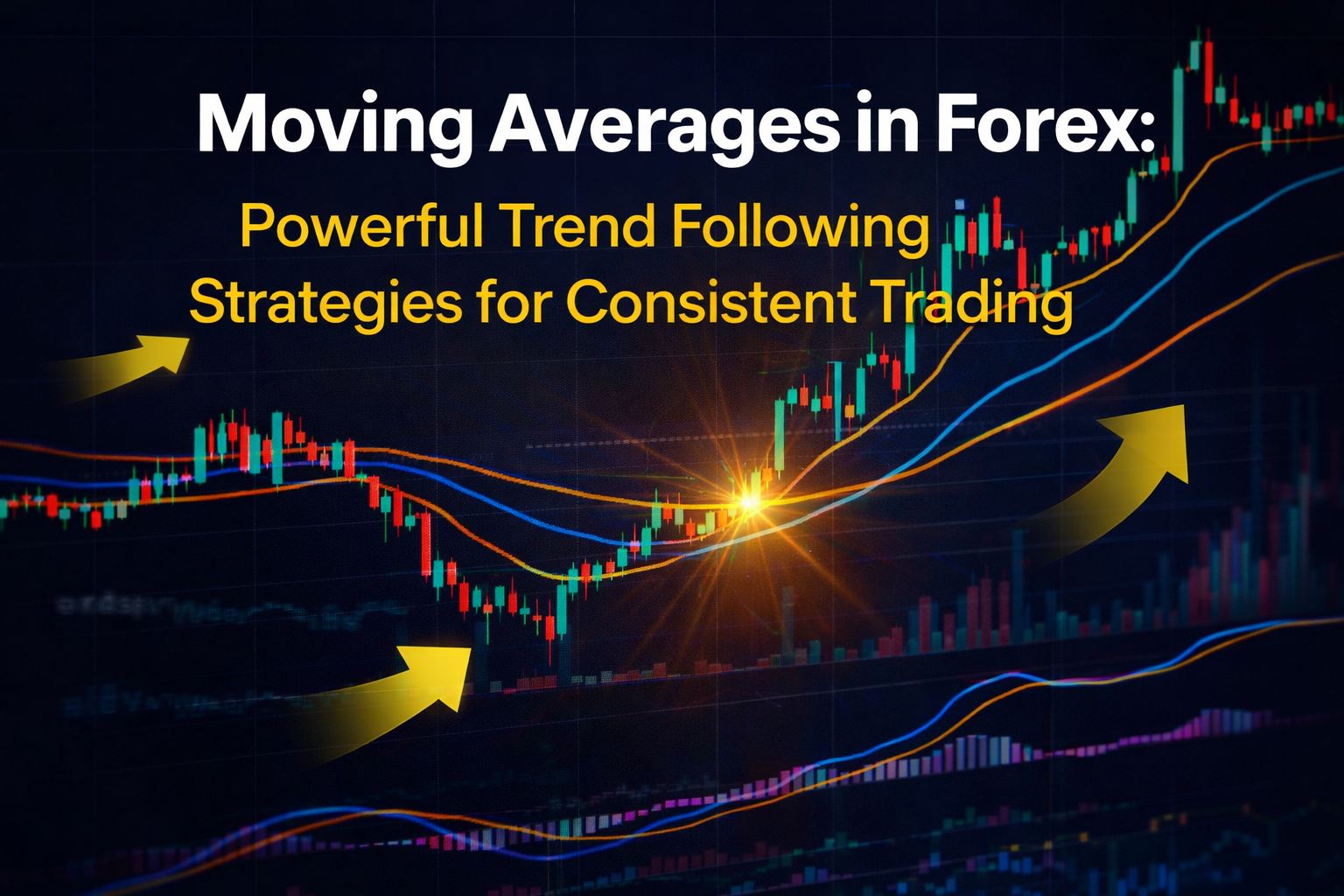
Forex trading mainly revolves around understanding market trends and making decisions based on price direction. One of the most effective and commonly used tools for identifying trends is the moving average. Traders around the world rely on moving averages to simplify price charts, reduce market noise, and find high-probability trading setups.
Whether you are just starting your trading journey or already have experience in the market, moving averages can serve as a strong foundation for building a consistent trading approach. They help you clearly understand the direction of the market and avoid confusion caused by short-term fluctuations.
What Are Moving Averages?
Moving averages are technical indicators that calculate the average price of an asset over a selected period. Instead of focusing on every small price movement, they smooth out the data and present a clearer picture of the overall trend.
There are multiple types of moving averages, but the two most commonly used are the Simple Moving Average (SMA) and the Exponential Moving Average (EMA). While both aim to identify trends, they differ in how they calculate price data.
The primary purpose of moving averages is to filter unnecessary noise and highlight the true direction of the market.
Types of Moving Averages in Forex
There are two major types of moving averages widely used by traders:
The Simple Moving Average (SMA) calculates the average price over a fixed number of periods, giving equal importance to all price points. Because of this, it reacts more slowly to recent price changes.
The Exponential Moving Average (EMA), on the other hand, gives more weight to recent price data. This makes it more responsive and suitable for traders who want quicker signals.
SMA is generally preferred for long-term analysis, while EMA is commonly used for short-term trading decisions.
How Moving Averages Work in Forex Trading
Moving averages appear as a line on the chart representing the average price over time. Their position relative to price helps traders understand market direction.
When price stays above the moving average, it usually indicates a bullish trend. When price moves below it, it suggests a bearish trend.
Additionally, the angle of the moving average is important. An upward slope shows strength in buying momentum, while a downward slope reflects selling pressure.
This simple visual representation allows traders to quickly identify trends without overcomplicating their analysis.
Why Moving Averages Are Important for Traders
Moving averages help traders stay aligned with the market trend. Many beginners lose money because they try to trade against the trend without proper confirmation.
By using moving averages, traders can filter weak signals and focus only on strong trading opportunities. They also act as dynamic support and resistance levels, which makes them even more valuable.
Another advantage is their simplicity. They can be used across all markets and timeframes, making them suitable for every type of trader.
Moving Average Trend Following Strategy
One of the most powerful ways to use moving averages is through trend-following strategies. Instead of predicting reversals, traders follow the direction of the existing trend.
If the price is trading above the moving average, traders look for buying opportunities. If the price is below it, they focus on selling setups.
This approach works best when the market is trending clearly, allowing traders to capture consistent moves.
EMA vs SMA: Which One Should You Use?
Both EMA and SMA have their own benefits. EMA reacts faster to price changes, making it ideal for short-term trading. SMA provides a smoother line, which is useful for identifying long-term trends.
There is no fixed rule about which one is better. Many traders combine both indicators to get a balanced understanding of the market.
For example, EMA can be used for precise entries, while SMA helps confirm the overall trend direction.
Moving Average Crossover Strategy
The crossover strategy is one of the most popular methods used by traders. It involves using two moving averages with different time periods.
A common setup includes a short-term moving average like 50 EMA and a long-term moving average like 200 EMA.
When the shorter moving average crosses above the longer one, it signals a bullish trend. When it crosses below, it indicates a bearish trend.
This method helps traders identify major trend shifts and enter trades at the right time.
Golden Cross and Death Cross
The Golden Cross and Death Cross are widely recognized signals in moving average trading.
A Golden Cross happens when a short-term moving average crosses above a long-term moving average, indicating strong upward momentum.
A Death Cross occurs when a short-term moving average crosses below a long-term moving average, signaling a potential downtrend.
These patterns are often used by long-term traders to identify major market movements.
Dynamic Support and Resistance Using Moving Averages
Moving averages can also act as dynamic support and resistance levels.
In an uptrend, price often pulls back to the moving average and then continues upward, treating it as support.
In a downtrend, price may reject from the moving average and move lower, treating it as resistance.
This behavior helps traders find better entry points and manage risk more effectively.
Best Moving Average Settings for Forex
The ideal moving average settings depend on your trading style.
Short-term traders often use 9 EMA, 20 EMA, or 50 EMA. Swing traders prefer 50 EMA or 100 EMA. Long-term traders commonly use 100 SMA or 200 SMA.
While there is no perfect setting, these levels are widely accepted and used by traders globally.
Combining Moving Averages with Other Indicators
Moving averages become more effective when used alongside other indicators.
For example, combining them with RSI helps identify overbought and oversold conditions. MACD can confirm momentum, while support and resistance improve entry accuracy.
Using multiple tools together reduces false signals and increases confidence in trades.
Common Mistakes When Using Moving Averages
Many traders misuse moving averages. One common mistake is relying on them without any confirmation.
Another mistake is adding too many moving averages, which creates confusion instead of clarity. Traders also tend to enter trades late because moving averages are lagging indicators.
Understanding these mistakes can significantly improve trading performance.
Best Timeframes for Moving Average Trading
Moving averages can be applied to any timeframe.
Scalpers usually trade on 5-minute or 15-minute charts. Swing traders prefer 1-hour or 4-hour charts. Long-term traders focus on daily or weekly charts.
The key is to choose a timeframe that matches your strategy and trading goals.
Advantages of Moving Averages
Moving averages are simple, reliable, and easy to understand. They clearly show trends and help reduce market noise.
They can be applied to all financial markets and work well with other indicators.
Because of their flexibility, they remain one of the most popular tools among traders.
Limitations of Moving Averages
Despite their benefits, moving averages have limitations. They are lagging indicators, meaning they react after the price has already moved.
They also perform poorly in sideways or ranging markets where there is no clear trend.
That’s why traders should combine them with other tools for better results.
How Beginners Should Start Using Moving Averages
Beginners should begin by understanding the basics and practicing on demo accounts.
They should focus on simple strategies like trend following and crossover setups before moving to advanced techniques.
Avoid overcomplicating charts and stick to a clear and simple approach.
Trading Psychology and Discipline
Emotions play a major role in trading success. Fear and greed often lead to poor decisions.
Traders should follow a structured plan and avoid impulsive actions. Maintaining discipline is essential for achieving consistent results over time.
Conclusion
Moving averages are one of the most powerful and reliable tools in forex trading. They help traders identify trends, confirm signals, and make better trading decisions.
By applying strategies like trend following, crossover systems, and dynamic support and resistance, traders can improve their overall performance.
Although moving averages are simple, mastering them requires patience, practice, and proper risk management. When used correctly, they can become a key part of a successful trading system.
Join Our Community
Instagram: https://www.instagram.com/hadyjfx_official
YouTube: https://www.youtube.com/@hadyjmentor7793
Facebook: https://www.facebook.com/profile.php?id=61562232239915
Join Telegram: https://t.me/hadyjfx