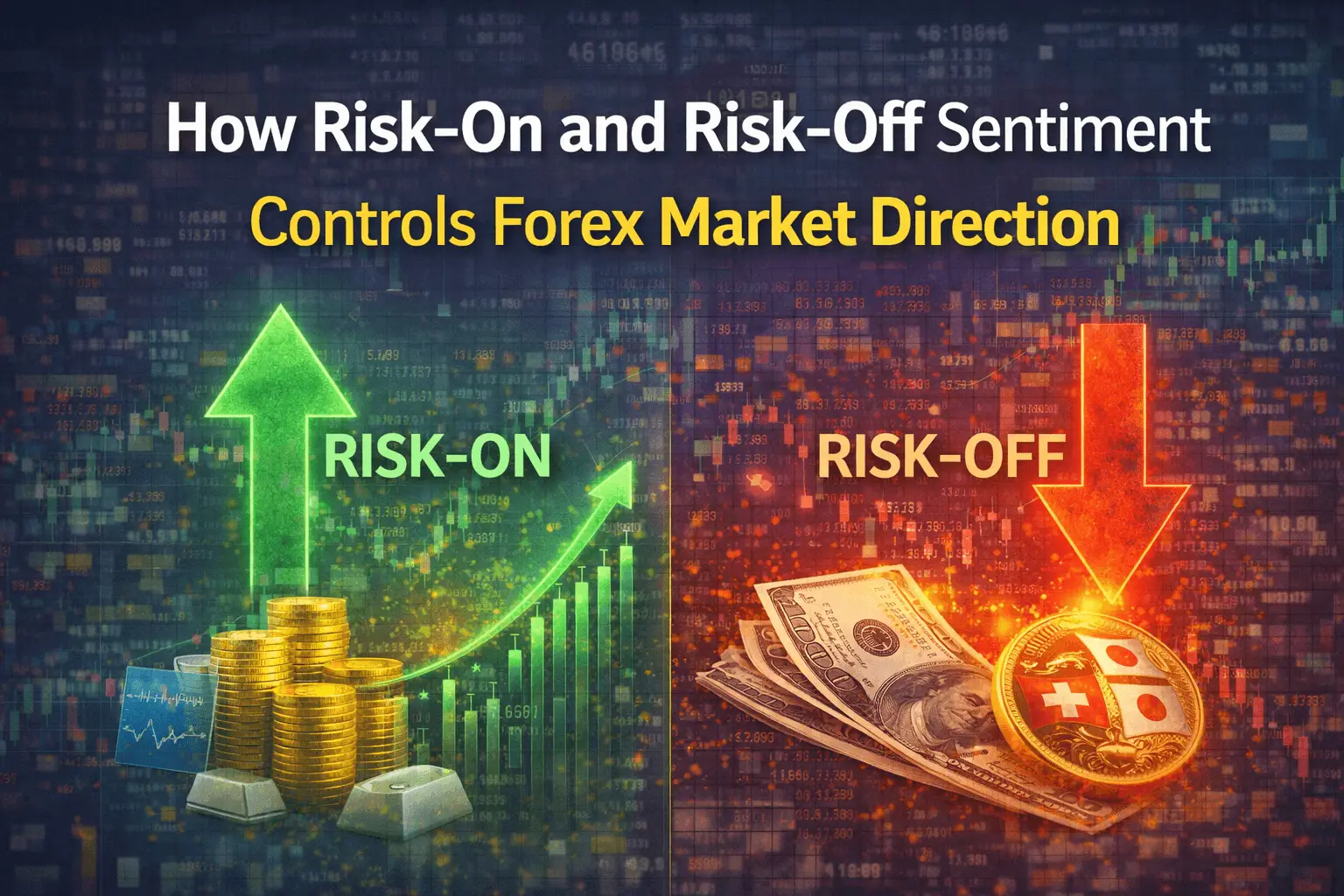
Forex markets often confuse traders because currencies move together even when their domestic economic data looks very different. A strong report from one country may fail to lift its currency, while another currency strengthens despite weak fundamentals. The explanation lies not in the data itself, but in risk sentiment.
Understanding risk sentiment forex behavior is essential for identifying true market direction. Whether markets are in a risk-on or risk-off phase determines how capital flows across equities, bonds, commodities, and currencies. This article explains what risk-on and risk-off really mean, which currencies perform in each phase, and how yields and equities influence forex market direction.
what risk-on and risk-off really mean
Risk-on and risk-off describe investor behavior, not economic conditions. In a risk-on environment, investors feel confident about future growth and stability. They are willing to accept uncertainty in exchange for higher returns. In a risk-off environment, investors prioritize safety and liquidity, even if returns are lower.
Forex markets respond quickly to these shifts because currencies represent capital movement between countries. When confidence rises, money flows toward growth-linked and higher-yielding currencies. When confidence falls, capital retreats toward safety.
This behavioral shift explains why risk on risk off currencies often move together regardless of individual fundamentals.
why risk sentiment matters more than economic data
Economic data explains what has already happened. Risk sentiment reflects how investors feel about what might happen next. Forex markets are forward-looking, which is why sentiment often overrides data.
A strong GDP or employment report may fail to lift a currency if markets are in risk-off mode. At the same time, weak data can be ignored during risk-on phases if investors believe conditions will improve.
This is why forex market direction frequently remains unchanged despite frequent data releases. Sentiment sets the tone, while data adds short-term noise.
how risk-on environments affect forex markets
In risk-on phases, investors seek opportunity rather than protection. Capital flows into assets that benefit from global growth and stable financial conditions. Equities rise, credit spreads narrow, and volatility declines.
In forex markets, this environment favors currencies associated with growth, trade, and higher yields. Capital leaves defensive currencies and moves toward instruments that offer better returns.
Risk-on conditions often produce smooth, persistent trends because confidence supports follow-through. Pullbacks tend to be shallow, and volatility remains controlled.
currencies that perform best during risk-on phases
During risk-on environments, currencies linked to global trade and yield tend to outperform. These include commodity-linked currencies and those associated with expanding economies.
At the same time, safe-haven currencies often weaken as demand for protection fades. This does not mean those economies are weak—it simply reflects shifting investor priorities.
Understanding this relationship helps traders avoid fighting trends driven by sentiment rather than fundamentals.
how risk-off sentiment shifts forex market direction
Risk-off phases begin when uncertainty rises. This uncertainty can come from geopolitical tension, financial stress, tightening liquidity, or sudden changes in policy expectations.
When confidence falls, investors reduce exposure to risk and prioritize liquidity. Capital flows out of equities, high-yield assets, and growth-sensitive currencies. Demand rises for assets perceived as stable and liquid.
Forex markets react sharply because currency positions are often leveraged. As risk appetite declines, forced position reductions accelerate moves.
currencies that benefit in risk-off conditions
In risk-off environments, safe-haven currencies typically strengthen. These currencies benefit from capital preservation demand rather than growth expectations.
This behavior explains why multiple currencies may strengthen simultaneously against risk-sensitive counterparts. The move is driven by global fear, not domestic strength.
For traders, recognizing a shift to risk-off sentiment early is critical for protecting capital and aligning with market flow.
the role of equities in risk sentiment forex analysis
Equity markets are one of the clearest expressions of risk sentiment. Rising equities usually signal confidence, while falling equities often reflect caution.
Forex markets frequently follow equity direction because both respond to the same capital flows. When equities trend higher, risk-on currencies tend to strengthen. When equities fall sharply, forex markets often shift into risk-off behavior.
However, forex does not react to equity levels alone. The rate of change, volatility, and persistence of equity moves matter more than isolated declines or rallies.
how bond yields influence risk-on and risk-off behavior
Bond yields play a critical role in shaping risk sentiment. Rising yields can signal confidence in growth, but they can also tighten financial conditions.
When yields rise gradually due to improving outlooks, risk-on sentiment often holds. When yields rise sharply or disorderly, markets may shift to risk-off as borrowing costs increase and liquidity tightens.
Falling yields usually support risk-off sentiment when they reflect fear and demand for safety. In some cases, falling yields can also support risk-on if they ease financial conditions. Context matters.
This interaction explains why risk sentiment forex analysis must include both equities and yields.
why correlations increase during risk-off phases
One of the most noticeable features of risk-off markets is rising correlation. Assets that normally move independently begin moving together.
This happens because fear reduces differentiation. Investors focus on reducing exposure rather than selecting opportunities. As a result, currencies tied to risk often fall together, while safe-haven currencies rise together.
These correlation spikes can surprise traders who believe they are diversified. In reality, they are exposed to the same underlying risk sentiment.
why forex trends persist during strong sentiment phases
Risk sentiment tends to shift slowly and persist once established. When confidence builds, it encourages continued participation. When fear takes hold, it discourages risk-taking.
Because of this, forex market direction driven by sentiment can last weeks or months. Economic data may cause temporary pullbacks, but sentiment keeps the broader trend intact.
This is why traders who fight sentiment often experience repeated stop-outs despite being “right” on data.
how risk sentiment explains confusing price action
Many confusing market behaviors become logical when viewed through sentiment.
Strong data leading to currency weakness often occurs in risk-off phases where growth optimism is irrelevant. Weak data leading to strength can happen when it supports easier financial conditions in a risk-on environment.
Risk sentiment provides the context that data alone cannot.
common mistakes traders make with risk-on risk-off analysis
Retail traders often label markets as risk-on or risk-off based on a single headline or short-term move. This leads to false conclusions.
Another common mistake is assuming sentiment flips instantly. In reality, sentiment shifts gradually and confirms itself through multiple markets.
Ignoring yield behavior or equity trends also weakens sentiment analysis. Forex does not operate in isolation.
how professional traders use risk sentiment
Professional traders use risk sentiment as a directional filter, not a timing tool. They align trades with prevailing sentiment and use technical structure to manage entries and exits.
Instead of predicting sentiment changes, they observe confirmation across markets. This reduces emotional decision-making and improves consistency.
Risk sentiment helps professionals decide what to trade, not when to trade.
using risk sentiment to improve forex trading decisions
Traders can apply risk-on risk-off analysis by:
Observing equity trend and volatility
Monitoring bond yield direction and pace
Watching correlation behavior across currencies
Aligning trades with dominant sentiment
This approach reduces conflict between indicators and clarifies market structure.
why sentiment always comes before data confirmation
Markets do not wait for confirmation. By the time economic damage appears in data, risk sentiment has already shifted.
Forex markets reflect this reality quickly because currency positions are sensitive to capital flows. This is why sentiment often leads, and data follows.
Understanding this sequence prevents traders from reacting late.
final conclusion: why risk sentiment controls forex market direction
Risk-on and risk-off sentiment controls forex market direction because it governs how capital flows across the global financial system. Currencies do not move solely on domestic data—they move based on confidence, fear, and liquidity preference.
By understanding risk sentiment forex behavior, recognizing risk on risk off currencies, and tracking how equities and yields interact, traders gain clarity that indicators alone cannot provide.
Forex markets reward alignment with sentiment, not stubborn analysis. Traders who understand sentiment trade with the market. Those who ignore it often trade against it.
Visit our Social media pages:
https://www.instagram.com/hadyjfx_official
/https://www.youtube.com/@hadyjmentor7793
https://www.facebook.com/profile.php?id=61562232239915
Join our free telegram channel:
https://t.me/hadyjfx