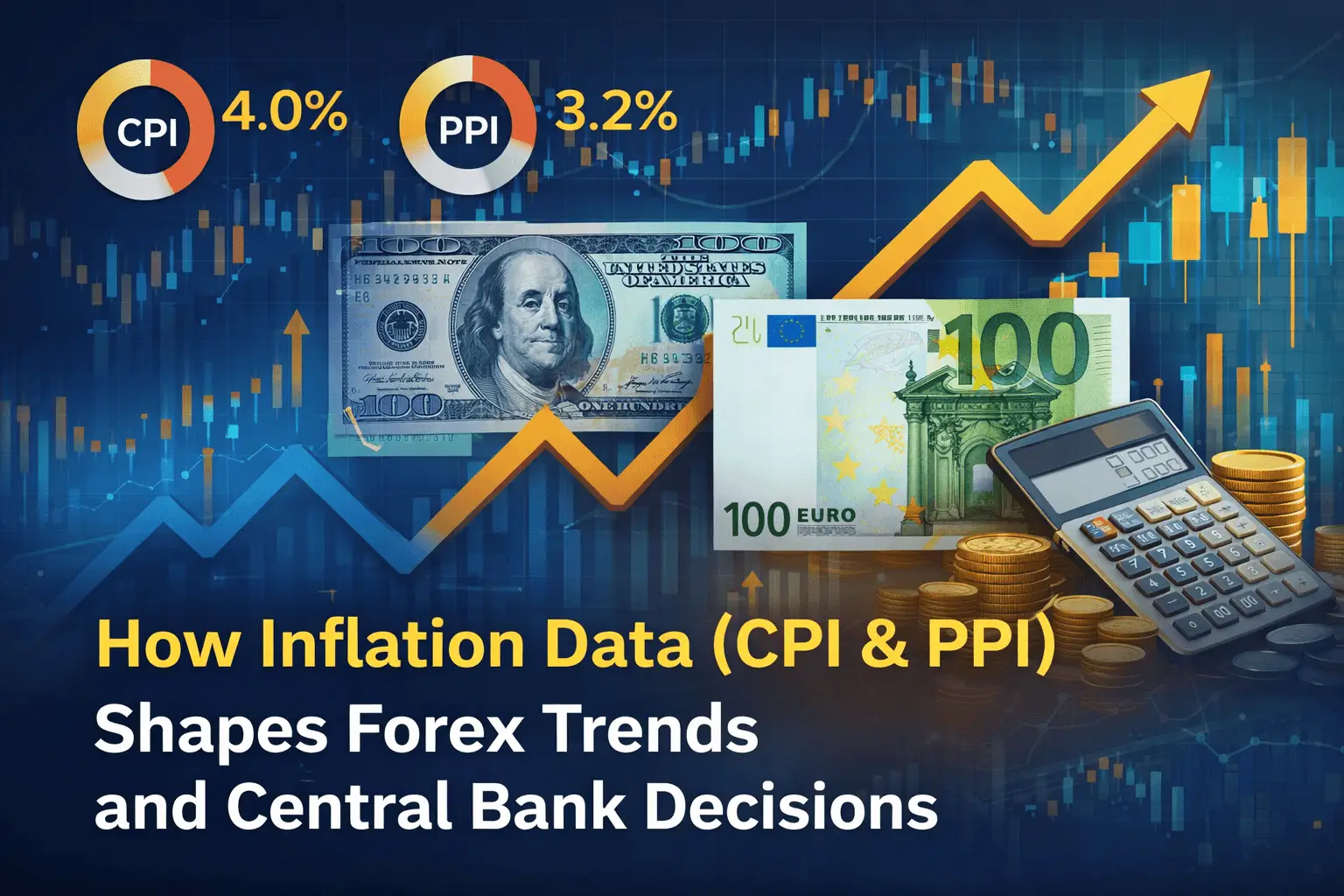
Inflation data plays a central role in how forex markets move, not because it explains the cost of living, but because it reshapes expectations about future monetary policy. Every CPI or PPI release forces traders to reassess how central banks may respond, and currencies react immediately to those changing expectations.
In the forex market, inflation is not treated as an academic concept—it is treated as a policy pressure signal. This article explains how CPI and PPI data influence currency trends, why markets sometimes ignore inflation numbers, and how inflation ultimately drives long-term forex direction through central bank decisions.
How Inflation Information Enters Financial Markets
Inflation data does not move currencies by itself. It moves markets only when it changes assumptions about interest rates, liquidity, and policy timing.
For traders, inflation answers one key question:
Does this data increase or reduce pressure on central banks to adjust policy?
When inflation runs higher than expected, policymakers face tighter constraints. When inflation cools, they gain flexibility. Forex markets respond to this shift in policy pressure, not to inflation theory.
This is why identical inflation readings can produce very different currency reactions depending on context.
CPI and PPI: Two Different Signals for Traders
Consumer Price Index (CPI)
CPI reflects price pressure at the consumer level. In forex markets, CPI matters because it directly influences inflation expectations, which feed into rate forecasts.
CPI matters when it:
- Alters expectations for future rate changes
- Conflicts with central bank guidance
- Signals a change in inflation trend
A CPI release only becomes market-moving if it forces traders to reprice interest rate paths.
Producer Price Index (PPI)
PPI tracks pricing pressure earlier in the economic chain. For traders, PPI is not about current prices—it is about future inflation risk.
Rising PPI suggests costs may pass through to consumers later. Falling PPI signals easing pressure ahead. While PPI rarely creates instant volatility, it quietly shapes medium-term policy expectations.
CPI vs PPI: Why Forex Markets Care About Both
CPI defines the present inflation environment. PPI shapes expectations for what may come next.
When both CPI and PPI rise together, inflation pressure appears entrenched. When PPI moves without CPI, markets assess whether price pressure is temporary or building.
Forex markets respond most aggressively when CPI surprises expectations, not when it simply confirms known conditions.
Headline vs Core Inflation: What Really Matters
Headline inflation includes volatile components that can distort short-term readings. Core inflation strips out these swings and reflects underlying price momentum.
Central banks rely more heavily on core inflation trends because they signal persistence. Forex markets follow this same logic.
A stable headline number with rising core inflation can still strengthen a currency if it limits policy flexibility.
Why CPI Releases Create Immediate Volatility
CPI releases generate volatility because:
- Expectations are already embedded in prices
- Liquidity is high at release time
- Algorithms react instantly to deviations
Even small surprises can trigger large moves because traders must reposition quickly when rate expectations shift.
Inflation Expectations vs Inflation Numbers
Markets do not trade inflation levels—they trade inflation surprises.
If inflation prints exactly as expected, reaction may be minimal. If inflation challenges existing assumptions, currencies reprice rapidly.
This explains why a “high” inflation number can sometimes produce no move, while a modest deviation causes sharp volatility.
Why Markets Sometimes Ignore Inflation Data
Inflation data may be ignored when:
- Central bank guidance already dominates
- The inflation move is viewed as temporary
- Markets are focused on risk sentiment
- Policy expectations remain unchanged
Forex markets only react when inflation alters the policy narrative.
Inflation as a Constraint on Central Bank Policy
Inflation limits how much freedom central banks have.
- Persistent inflation restricts easing
- Cooling inflation restores flexibility
- Unstable inflation increases uncertainty
Currencies trend when inflation consistently removes or restores policy options over time.
How Inflation Shapes Interest Rate Expectations
Interest rates are the transmission mechanism between inflation and currency value.
- Higher inflation → tighter policy expectations
- Lower inflation → easing expectations
Interest rate differentials attract or repel capital, shaping long-term currency trends.
Inflation and Long-Term Forex Trends
Sustained forex trends emerge when inflation:
- Moves consistently in one direction
- Forces policy adjustments
- Creates divergence between economies
Currencies strengthen where inflation keeps policy restrictive and weaken where inflation allows easing.
Inflation and Policy Divergence
Forex is a relative market. What matters is not inflation alone, but inflation differences.
If one economy faces persistent price pressure while another cools, capital flows toward the currency with higher expected returns. This divergence drives trends in major pairs.
Why Currencies Move Even Without Rate Changes
Currencies often move on inflation data even when rates remain unchanged because markets price future decisions, not current policy.
Shifts in timing expectations alone can drive repricing.
Inflation, Risk Sentiment, and Forex Behavior
Inflation interacts with risk sentiment:
- Persistent inflation tightens financial conditions
- Cooling inflation supports risk appetite
This affects high-yield, safe-haven, and emerging-market currencies simultaneously.
How Professional Traders Trade Inflation Data
Experienced traders:
- Focus on expectations, not headlines
- Compare inflation with central bank messaging
- Avoid trading first spikes
- Trade structure after volatility settles
Inflation is used as context, not a standalone signal.
Common Retail Mistakes with CPI & PPI
Retail traders often:
- Trade numbers without context
- Ignore core inflation
- Over-leverage during releases
- Chase volatility
Understanding inflation’s role in policy is more important than predicting figures.
Why PPI Deserves More Attention
PPI quietly shapes future inflation expectations. Central banks watch it closely even when markets do not. Over time, PPI trends influence policy direction and currency valuation.
Inflation, Wages, and Persistence
Inflation becomes more influential when supported by wage growth. Wage pressure can lock inflation in place, forcing prolonged restrictive policy and strengthening affected currencies.
Final Conclusion: Why Inflation Data Shapes Forex Markets
Inflation data shapes forex markets because it defines the limits of central bank action. CPI creates short-term volatility, PPI influences medium-term expectations, and core inflation determines policy persistence.
Markets ignore inflation when it changes nothing—and react violently when it changes everything.
For traders, inflation is not about prices. It is about policy pressure, rate paths, and capital flow direction.
Those who understand inflation in context trade with clarity. Those who trade inflation in isolation trade noise.
Visit our Social media pages:
https://www.instagram.com/hadyjfx_official/
https://www.youtube.com/@hadyjmentor7793
https://www.facebook.com/profile.php?id=61562232239915
Join our free telegram channel:
https://t.me/hadyjfx