Financial markets rarely move in isolation. Currencies, equities, bonds, and commodities constantly influence one another through shifts in global capital flow. Many traders struggle because they analyze a single forex pair without understanding the broader environment driving it.
This is where a structured Risk sentiment forex strategy becomes powerful. Instead of focusing only on technical patterns, this approach combines macro awareness with correlation analysis. It helps traders identify whether markets are in a risk-on or risk-off phase and position accordingly.
Understanding these phases reduces overexposure, improves trade selection, and aligns positions with institutional capital flow.
Understanding Risk-On and Risk-Off Behavior
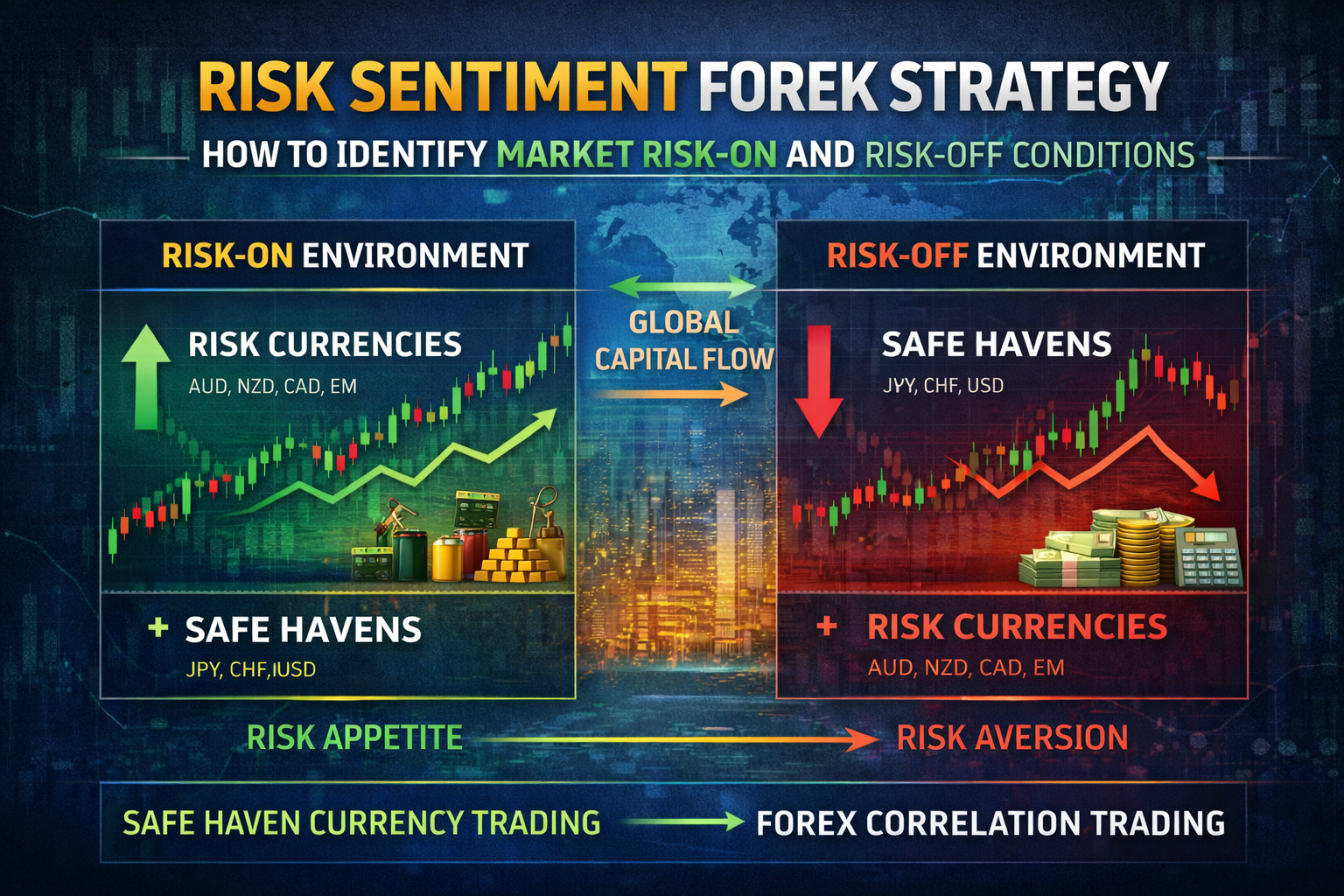
Risk-on describes an environment where investors are confident and willing to allocate capital toward higher-return assets. Risk-off describes periods of caution, where capital flows into defensive instruments.
In risk-on conditions:
Equities tend to rise.
Commodity-linked currencies strengthen.
Safe-haven currencies weaken.
In risk-off conditions:
Equities tend to decline.
Defensive assets gain demand.
High-yield currencies weaken.
Recognizing this shift early is the foundation of a successful Risk sentiment forex strategy.
Safe Haven vs Risk Currencies
Certain currencies consistently behave as safe havens. The Japanese yen and Swiss franc are commonly viewed as defensive because of their stability and liquidity. The US dollar can also act as a safe haven during global stress.
Risk-sensitive currencies include the Australian dollar, New Zealand dollar, Canadian dollar, and emerging-market currencies. These currencies often strengthen during global growth optimism and weaken during uncertainty.
Understanding this distinction allows traders to apply structured Safe haven currency trading principles rather than guessing direction based on local data alone.
Why Correlation Matters in Forex
Currencies rarely move independently. During strong risk-on or risk-off phases, multiple pairs move in synchronized patterns.
For example:
If global equities are rallying, AUD/USD and NZD/USD may rise together.
If global risk deteriorates, USD/JPY may fall while USD/CHF strengthens.
Ignoring correlation can lead to accidental overexposure. A trader holding long AUD/USD, long NZD/USD, and long GBP/USD may believe they are diversified — but in reality, they may be heavily exposed to the same risk sentiment shift.
This is why disciplined Forex correlation trading protects capital and reduces unintended concentration.
Equity Markets as Confirmation Tools
Equities provide a valuable confirmation layer for currency positioning. When stock indices trend strongly upward, risk appetite is generally healthy. When indices experience sharp declines, caution increases.
If a trader sees bullish structure forming in a risk currency pair while equities are rallying, alignment increases probability.
If technical signals suggest buying a risk currency while equities are falling sharply, caution is necessary.
A structured Risk sentiment forex strategy integrates cross-market observation rather than relying solely on candlestick patterns.
The Role of Bond Yields in Risk Assessment
Bond yields often reflect confidence in growth and monetary conditions. Rising yields driven by strong growth expectations may support risk-on environments. Falling yields during stress periods often signal defensive positioning.
When yields rise alongside equities, risk appetite is typically strong. When yields fall sharply during market stress, safe-haven demand increases.
Combining equity and yield observation strengthens decision-making within Safe haven currency trading setups.
How to Identify Risk-On Environments
Risk-on environments usually show several characteristics:
Equities trending higher with stable volatility.
Commodity prices firming.
Higher-yield currencies outperforming safe havens.
Credit markets stable.
During these phases, continuation trades in risk currencies often offer better probability than counter-trend setups.
A disciplined Forex correlation trading framework encourages aligning trades with this broader capital flow.
How to Identify Risk-Off Environments
Risk-off phases display different signals:
Sharp equity sell-offs.
Volatility increasing rapidly.
Flight into defensive assets.
Capital rotating into USD, JPY, or CHF.
In these conditions, safe-haven currencies strengthen while growth-linked currencies weaken.
Understanding this shift prevents traders from buying dip setups in risk currencies during broader capital retreat.
Correlation Filtering to Avoid Overexposure
Correlation filtering means reducing duplicate exposure across multiple pairs.
For example, if risk sentiment is positive and you hold long AUD/USD, opening long NZD/USD and long EUR/USD may multiply exposure to the same macro factor.
Instead, select one or two pairs that offer the clearest structure while maintaining balanced risk.
Professional traders think in portfolio terms, not isolated trades.
This mindset is essential for effective Forex correlation trading.
Combining Macro Bias With Technical Structure
Macro awareness alone is insufficient. Technical confirmation refines entries.
If risk-on conditions dominate and equities are rising, look for pullbacks in risk currencies to enter continuation trades. Avoid chasing expansion candles.
If risk-off conditions dominate, focus on retracements in safe-haven pairs for better risk-reward entries.
This balance between macro direction and technical precision defines a mature Risk sentiment forex strategy.
When Correlations Break Down
Correlations are not permanent. During transitional phases, markets may become choppy and inconsistent.
Central bank surprises, geopolitical events, or liquidity shifts can temporarily disrupt correlation patterns.
In these periods, position size should be reduced and patience increased.
Flexibility improves long-term consistency.
Psychological Benefits of Correlation Awareness
Many retail traders feel confused when multiple trades move against them simultaneously. This often happens because they unknowingly concentrated exposure.
Understanding correlation reduces emotional stress. Traders become aware of systemic risk rather than blaming individual setups.
Confidence increases when exposure is controlled.
Applying the Strategy in Real Conditions
Imagine global equities are trending upward and volatility remains contained. Yields are stable, and commodities are firming.
In this environment, continuation setups in AUD/USD or NZD/USD align with broader capital flow.
Alternatively, imagine equities are falling sharply with rising volatility. Safe-haven currencies strengthen.
In this case, long positions in USD/CHF or short positions in AUD/JPY may align with macro direction.
A structured Safe haven currency trading approach uses these signals as context rather than prediction.
Why This Strategy Reduces Overtrading
When traders understand whether the environment is risk-on or risk-off, they avoid forcing trades that contradict broader sentiment.
This naturally reduces frequency and increases quality.
A disciplined Risk sentiment forex strategy filters opportunities based on macro alignment, preventing random entries during uncertain transitions.
Common Mistakes to Avoid
Ignoring cross-market signals.
Overloading correlated pairs.
Trading against dominant sentiment.
Using correlation as a signal instead of confirmation.
Correlation is a filter, not a standalone entry trigger.
Final Thoughts
A structured Risk sentiment forex strategy integrates macro awareness, equity confirmation, yield observation, and disciplined Forex correlation trading principles.
Safe-haven and risk currencies behave predictably within broader capital flow cycles. Traders who understand these dynamics avoid overexposure, reduce emotional stress, and align with institutional movement.
Markets are interconnected. When traders treat them as isolated charts, confusion increases. When traders view them as a unified system driven by risk sentiment, clarity improves.
Successful trading is not just about identifying patterns. It is about understanding why capital moves.
Visit our Social media pages:
https://www.instagram.com/hadyjfx_official
/https://www.youtube.com/@hadyjmentor7793
https://www.facebook.com/profile.php?id=61562232239915
Join our free telegram channel:
https://t.me/hadyjfx