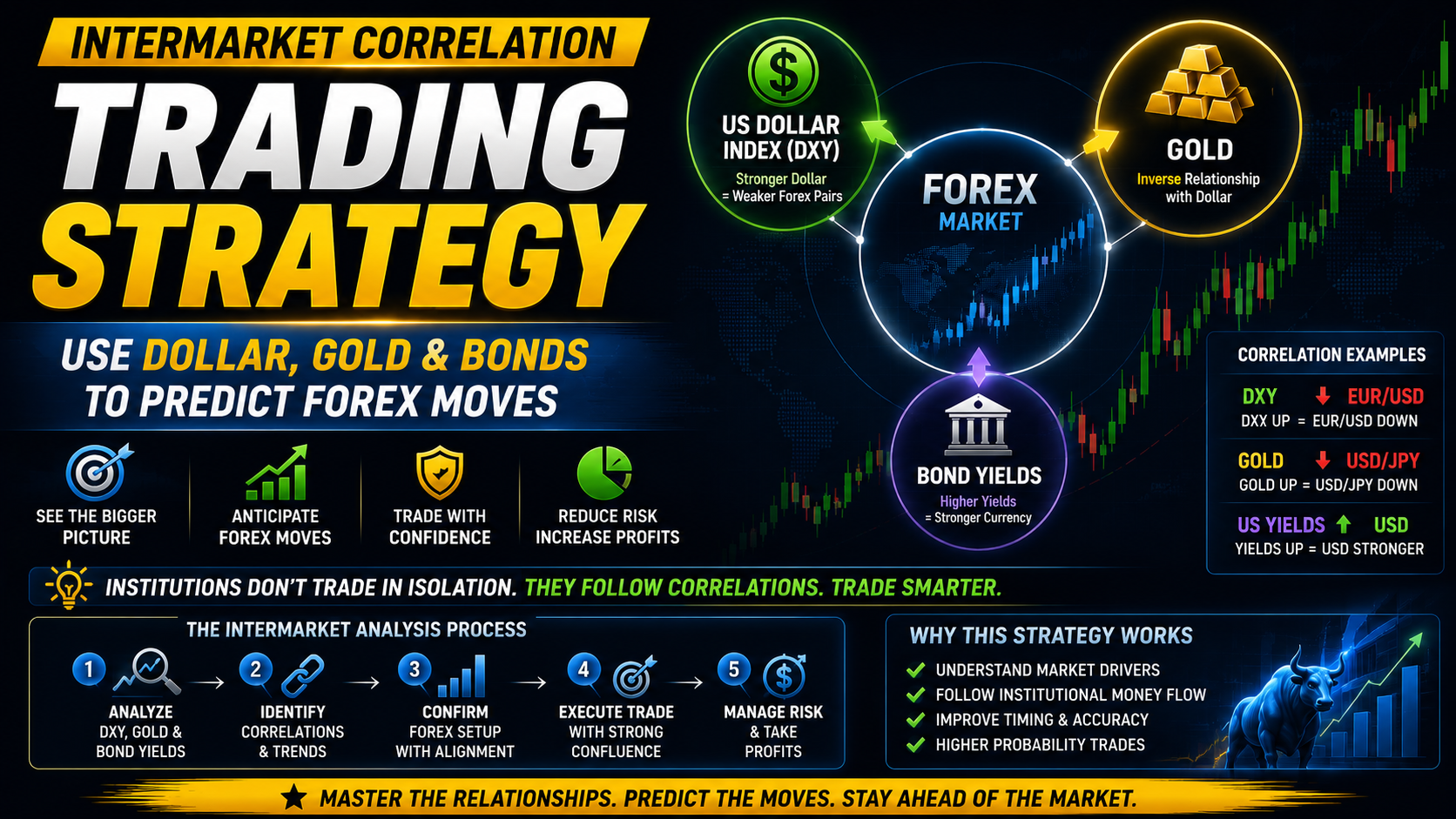
Forex trading is influenced by much more than chart patterns and indicators. Behind every major market move, there are relationships between different financial markets that help institutions predict future price direction. Professional traders do not analyze currency pairs in isolation. Instead, they study how assets like the US Dollar Index, gold, bonds, and stock markets interact with currencies. This approach is known as intermarket analysis. Understanding these relationships allows traders to anticipate market movement with greater confidence and precision. This is where intermarket correlation trading strategy, forex market correlation analysis, and dollar gold bond trading strategy become essential.
Most beginner traders focus only on a single chart without understanding the bigger financial picture. As a result, they often miss important clues that institutional traders use every day. For example, movements in the US dollar or bond yields can strongly influence EUR/USD and GBP/USD. Gold prices can reveal risk sentiment and inflation expectations. By mastering intermarket correlation trading strategy, forex market correlation analysis, and dollar gold bond trading strategy, traders can improve decision-making and align with institutional market behavior.
What is Intermarket Analysis
Intermarket analysis studies the relationship between different financial markets.
Instead of analyzing forex pairs alone, traders observe how currencies interact with commodities, bonds, indices, and interest rates.
These relationships help traders understand market sentiment, capital flow, and institutional positioning.
Understanding intermarket analysis is the foundation of intermarket correlation trading strategy, forex market correlation analysis, and dollar gold bond trading strategy.
Understanding Market Correlation
Correlation refers to the relationship between two financial assets.
A positive correlation means two assets move in the same direction.
A negative correlation means they move in opposite directions.
For example, the US dollar and gold often have a negative correlation. When the dollar strengthens, gold frequently weakens.
Understanding correlation is essential for intermarket correlation trading strategy, forex market correlation analysis, and dollar gold bond trading strategy.
Why Institutions Use Intermarket Analysis
Institutions trade based on macroeconomic conditions and capital flow.
They analyze multiple markets together to identify opportunities and manage risk.
A forex move rarely happens without influence from interest rates, bond yields, or economic sentiment.
Understanding this institutional approach improves intermarket correlation trading strategy, forex market correlation analysis, and dollar gold bond trading strategy.
The Role of the US Dollar Index (DXY)
The US Dollar Index, also known as DXY, measures the strength of the US dollar against major currencies.
When DXY rises, the US dollar generally strengthens.
When DXY falls, the dollar weakens.
Because EUR/USD has a large weight in DXY, the pair often moves inversely to the index.
Understanding DXY behavior is central to intermarket correlation trading strategy, forex market correlation analysis, and dollar gold bond trading strategy.
How DXY Influences Forex Pairs
Many forex pairs are directly affected by the dollar.
EUR/USD and GBP/USD usually move opposite to DXY.
USD/JPY often moves with dollar strength and bond yields.
Commodity currencies like AUD/USD are influenced by risk sentiment and dollar movement.
Understanding these relationships improves intermarket correlation trading strategy, forex market correlation analysis, and dollar gold bond trading strategy.
Gold and Forex Market Relationship
Gold is one of the most important correlated assets in forex trading.
Gold often has a negative correlation with the US dollar. When investors lose confidence in the dollar, gold prices tend to rise.
Gold also reacts to inflation expectations, interest rates, and economic uncertainty.
Understanding gold behavior strengthens intermarket correlation trading strategy, forex market correlation analysis, and dollar gold bond trading strategy.
Why Gold and Dollar Move Oppositely
Gold is priced in US dollars globally.
When the dollar strengthens, gold becomes more expensive for international buyers, reducing demand.
When the dollar weakens, gold becomes more attractive as a store of value.
This inverse relationship supports intermarket correlation trading strategy, forex market correlation analysis, and dollar gold bond trading strategy.
Understanding Bond Markets
Bonds are another major factor influencing forex markets.
Government bonds represent debt instruments issued by countries.
Bond yields reflect investor expectations regarding inflation, interest rates, and economic growth.
Institutions closely monitor bond yields to predict currency strength.
Understanding bonds is essential for intermarket correlation trading strategy, forex market correlation analysis, and dollar gold bond trading strategy.
Bond Yields and Currency Strength
Higher bond yields often strengthen a currency because investors seek better returns.
For example, rising US Treasury yields usually strengthen the US dollar.
Lower yields can weaken the currency because investors look for better opportunities elsewhere.
This relationship is a major component of intermarket correlation trading strategy, forex market correlation analysis, and dollar gold bond trading strategy.
Interest Rates and Market Correlation
Interest rates influence capital flow globally.
When central banks raise interest rates, foreign investors may move capital into that currency for better returns.
This strengthens the currency and affects correlated markets like gold and bonds.
Understanding interest rate relationships improves intermarket correlation trading strategy, forex market correlation analysis, and dollar gold bond trading strategy.
Risk-On and Risk-Off Market Behavior
Financial markets shift between risk-on and risk-off sentiment.
During risk-on conditions, investors prefer stocks and higher-yield currencies.
During risk-off conditions, investors move toward safe-haven assets like gold, bonds, and the US dollar.
Recognizing these shifts helps traders anticipate market direction.
This insight supports intermarket correlation trading strategy, forex market correlation analysis, and dollar gold bond trading strategy.
EUR/USD and DXY Correlation
EUR/USD is strongly negatively correlated with DXY.
If DXY shows strong bullish momentum, EUR/USD often weakens.
Institutional traders use DXY confirmation before entering EUR/USD trades.
Understanding this relationship strengthens intermarket correlation trading strategy, forex market correlation analysis, and dollar gold bond trading strategy.
GBP/USD and Market Sentiment
GBP/USD is heavily influenced by both the US dollar and market sentiment.
Strong dollar strength usually pressures GBP/USD downward.
Risk-on environments often support pound strength, while risk-off conditions favor the dollar.
Understanding these dynamics improves intermarket correlation trading strategy, forex market correlation analysis, and dollar gold bond trading strategy.
USD/JPY and Bond Yields
USD/JPY is closely connected to US bond yields.
When Treasury yields rise, USD/JPY often moves upward because higher yields attract investors into the dollar.
Falling yields can weaken USD/JPY.
This relationship is a major part of intermarket correlation trading strategy, forex market correlation analysis, and dollar gold bond trading strategy.
Gold and Inflation Expectations
Gold is considered a hedge against inflation.
When inflation rises, investors often buy gold to protect purchasing power.
However, aggressive interest rate hikes can strengthen the dollar and pressure gold downward.
Understanding this balance enhances intermarket correlation trading strategy, forex market correlation analysis, and dollar gold bond trading strategy.
Using Intermarket Analysis for Trade Confirmation
Intermarket analysis is powerful because it provides confirmation.
For example, if EUR/USD shows bullish price action while DXY weakens and gold strengthens, the bullish setup becomes stronger.
This confirmation reduces weak trades and improves accuracy.
It strengthens intermarket correlation trading strategy, forex market correlation analysis, and dollar gold bond trading strategy.
Step-by-Step Intermarket Trading Strategy
The first step is identifying the forex pair to trade.
Next, traders analyze correlated assets such as DXY, gold, and bond yields.
Then, they compare market direction across these assets.
If correlations align, traders look for technical confirmation before entering trades.
This structured approach defines intermarket correlation trading strategy, forex market correlation analysis, and dollar gold bond trading strategy.
Bullish EUR/USD Example
DXY is weakening while gold prices rise.
US bond yields begin falling, showing weaker dollar demand.
EUR/USD breaks bullish structure and confirms momentum.
Traders can enter buy trades with stronger confidence because multiple correlated markets support the move.
This setup reflects intermarket correlation trading strategy, forex market correlation analysis, and dollar gold bond trading strategy.
Bearish GBP/USD Example
DXY strengthens while bond yields rise sharply.
Gold prices weaken, confirming dollar strength.
GBP/USD shows bearish market structure and liquidity sweeps above highs.
Traders can enter sell trades with institutional confirmation.
This example demonstrates intermarket correlation trading strategy, forex market correlation analysis, and dollar gold bond trading strategy.
Importance of Higher Timeframe Analysis
Higher timeframes provide stronger correlation signals.
Daily and 4-hour charts reveal broader macro trends.
Lower timeframes provide precise entries.
Combining macro analysis with technical execution improves intermarket correlation trading strategy, forex market correlation analysis, and dollar gold bond trading strategy.
Risk Management in Intermarket Trading
Risk management remains essential.
Even strong correlations can temporarily fail.
Stop losses should be logical and position size should remain controlled.
Risk reward ratios should remain favorable.
This discipline supports intermarket correlation trading strategy, forex market correlation analysis, and dollar gold bond trading strategy.
Common Mistakes Traders Make
Many traders rely too heavily on one market without considering the broader picture.
Another mistake is assuming correlations remain fixed forever.
Ignoring economic news and central bank policy also reduces accuracy.
Avoiding these mistakes is important for mastering intermarket correlation trading strategy, forex market correlation analysis, and dollar gold bond trading strategy.
Psychology Behind Correlated Markets
Correlated markets reflect investor psychology.
Fear increases demand for safe-haven assets.
Optimism supports risk currencies and stocks.
Institutions monitor these emotional shifts to position themselves ahead of major moves.
Understanding this psychology improves intermarket correlation trading strategy, forex market correlation analysis, and dollar gold bond trading strategy.
Advantages of Intermarket Analysis
Intermarket analysis provides a broader understanding of market conditions.
It helps traders avoid weak setups and improves confidence.
It aligns trading decisions with institutional capital flow.
These benefits make intermarket correlation trading strategy, forex market correlation analysis, and dollar gold bond trading strategy highly effective.
Challenges of Intermarket Trading
Intermarket analysis requires patience and continuous learning.
Correlations can weaken temporarily during unusual market conditions.
Too much information can also confuse beginner traders.
Understanding these challenges helps traders apply intermarket correlation trading strategy, forex market correlation analysis, and dollar gold bond trading strategy effectively.
Building Consistency with Intermarket Analysis
Consistency comes from structured analysis and discipline.
Traders should focus on a few key correlated assets instead of monitoring everything.
Keeping a journal of correlated market behavior helps improve understanding over time.
This discipline supports long-term success in intermarket correlation trading strategy, forex market correlation analysis, and dollar gold bond trading strategy.
Why Intermarket Analysis Matters in 2026
Financial markets are becoming increasingly connected.
Global economic events now influence currencies, commodities, bonds, and indices simultaneously.
Institutional traders rely heavily on macroeconomic relationships and intermarket behavior.
Understanding these relationships gives traders a major advantage in modern markets.
This importance strengthens intermarket correlation trading strategy, forex market correlation analysis, and dollar gold bond trading strategy.
Final Thoughts on Intermarket Correlation Trading
Intermarket correlation trading is one of the most advanced and valuable concepts in forex trading. By understanding how the dollar, gold, bonds, and currencies interact, traders can gain deeper insight into market direction and institutional behavior.
Mastering intermarket correlation trading strategy, forex market correlation analysis, and dollar gold bond trading strategy requires patience, discipline, and continuous study.
In the end, successful trading is not about relying on a single chart or indicator. It is about understanding how global financial markets connect and learning to trade with institutional flow instead of against it.
For more information:-
Instagram: https://www.instagram.com/hadyjfx_official
YouTube: https://www.youtube.com/@hadyjmentor7793
Facebook: https://www.facebook.com/profile.php?id=61562232239915
Join Telegram: https://t.me/hadyjfx