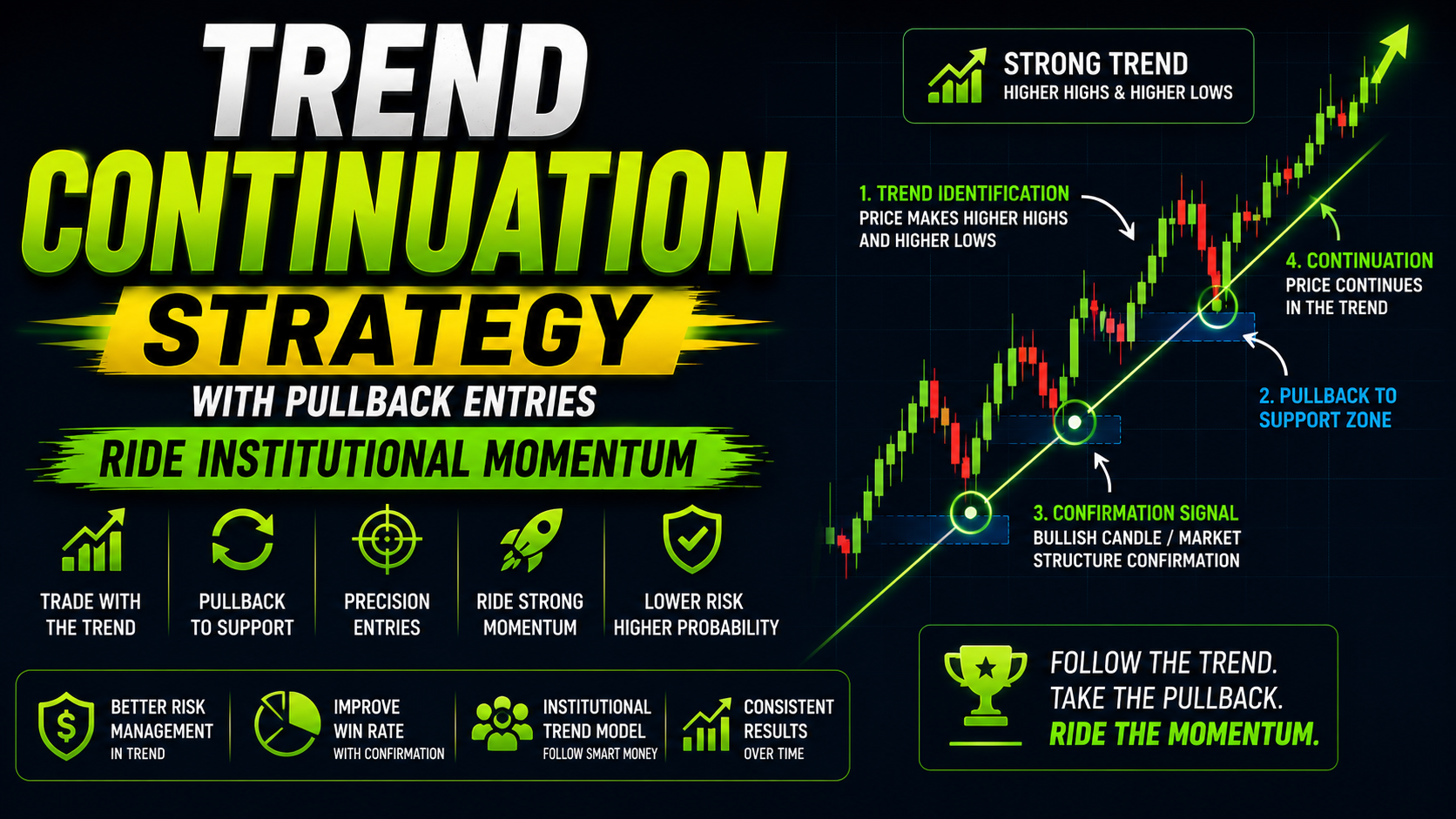
One of the biggest mistakes beginner traders make in forex trading is chasing price after a strong move has already happened. They enter trades late because of fear of missing out, only to watch the market retrace against them. Professional traders understand that the safest and most profitable entries usually come during pullbacks, not during impulsive moves. Institutions rarely enter trades after price has already expanded aggressively. Instead, they wait for retracements into important areas before continuing the trend. Understanding this concept can significantly improve trading accuracy and risk reward ratio. This is where trend continuation pullback strategy, institutional momentum trading, and forex pullback entry strategy become essential.
Trend continuation trading focuses on joining an existing trend after a temporary retracement. Instead of predicting reversals, traders align themselves with the dominant market direction. This approach reduces emotional trading and increases the probability of success. By mastering trend continuation pullback strategy, institutional momentum trading, and forex pullback entry strategy, traders can learn to trade with smart money instead of reacting emotionally to price movement.
Understanding Market Trends
A trend is the general direction in which the market moves over time.
An uptrend is formed by higher highs and higher lows.
A downtrend is formed by lower highs and lower lows.
A ranging market moves sideways without a clear direction.
Identifying the trend correctly is the first step in successful trading. This concept forms the foundation of trend continuation pullback strategy, institutional momentum trading, and forex pullback entry strategy.
Why Trends Continue
Markets often move in trends because of institutional order flow.
When institutions build positions, they usually do not enter all at once. They gradually add positions during pullbacks.
Economic fundamentals, market sentiment, and liquidity also support ongoing trends.
Understanding why trends continue helps traders apply trend continuation pullback strategy, institutional momentum trading, and forex pullback entry strategy more effectively.
What is a Pullback
A pullback is a temporary retracement against the main trend.
In an uptrend, price may move downward briefly before continuing higher.
In a downtrend, price may move upward temporarily before continuing lower.
Pullbacks are natural and healthy because markets cannot move in one direction continuously.
Understanding pullbacks is essential for trend continuation pullback strategy, institutional momentum trading, and forex pullback entry strategy.
Difference Between Pullback and Reversal
Many beginners confuse pullbacks with reversals.
A pullback is temporary and occurs within the existing trend. A reversal indicates a complete change in market direction.
Market structure helps traders identify the difference. If higher highs and higher lows remain intact, the trend is still bullish.
Recognizing this distinction strengthens trend continuation pullback strategy, institutional momentum trading, and forex pullback entry strategy.
Why Institutions Prefer Pullback Entries
Institutions avoid chasing price because it increases risk.
Instead, they wait for pullbacks into areas with better pricing and liquidity.
This allows them to enter trades with smaller stop losses and better risk reward opportunities.
Understanding institutional behavior improves trend continuation pullback strategy, institutional momentum trading, and forex pullback entry strategy.
Role of Market Structure in Continuation Trading
Market structure provides direction and confirmation.
In an uptrend, traders should focus on buying pullbacks.
In a downtrend, traders should focus on selling retracements.
Breaks of structure confirm trend continuation and help traders avoid countertrend setups.
This structure analysis supports trend continuation pullback strategy, institutional momentum trading, and forex pullback entry strategy.
Liquidity and Pullbacks
Pullbacks often occur because institutions seek liquidity before continuing the trend.
Price may sweep short-term highs or lows to trigger stop losses and pending orders.
Once liquidity is collected, the trend usually resumes.
Understanding liquidity behavior enhances trend continuation pullback strategy, institutional momentum trading, and forex pullback entry strategy.
Fair Value Gaps and Pullback Entries
Fair value gaps are important tools for continuation trading.
When price moves aggressively, imbalances are created in the market.
Price often retraces into these fair value gaps before continuing in the trend direction.
FVGs provide precise entry zones for pullback traders.
This concept strengthens trend continuation pullback strategy, institutional momentum trading, and forex pullback entry strategy.
Order Blocks in Trend Continuation
Order blocks represent institutional accumulation or distribution zones.
Bullish order blocks often act as support during uptrend pullbacks.
Bearish order blocks act as resistance during downtrend retracements.
Combining order blocks with pullback entries improves accuracy.
This combination supports trend continuation pullback strategy, institutional momentum trading, and forex pullback entry strategy.
Step-by-Step Trend Continuation Strategy
The first step is identifying the higher timeframe trend.
Next, traders wait for price to retrace into important areas such as fair value gaps, order blocks, or support resistance zones.
Then, they look for confirmation such as rejection candles or break of structure.
Once confirmation appears, traders enter in the direction of the trend.
This process defines trend continuation pullback strategy, institutional momentum trading, and forex pullback entry strategy.
Bullish Pullback Example
EUR/USD is in a strong uptrend with clear higher highs and higher lows.
Price retraces downward into a bullish order block and fair value gap.
A liquidity sweep occurs below short-term lows, followed by bullish rejection candles.
Price breaks structure upward, confirming continuation.
Traders can enter buy trades with stops below the pullback low.
This setup reflects trend continuation pullback strategy, institutional momentum trading, and forex pullback entry strategy.
Bearish Pullback Example
GBP/USD is moving downward in a strong trend.
Price retraces upward into a bearish order block.
A liquidity sweep occurs above short-term highs before price reverses downward.
A bearish break of structure confirms the continuation.
Traders can enter sell trades with proper risk management.
This example demonstrates trend continuation pullback strategy, institutional momentum trading, and forex pullback entry strategy.
Best Currency Pairs for Pullback Trading
Certain currency pairs are especially effective for trend continuation trading.
EUR/USD provides stable trends and reliable pullbacks.
GBP/USD offers stronger volatility and momentum.
XAU/USD creates powerful continuation setups during high liquidity sessions.
Choosing the right markets improves trend continuation pullback strategy, institutional momentum trading, and forex pullback entry strategy.
Best Timeframes for Continuation Trading
Higher timeframes provide stronger trend direction.
Lower timeframes provide precise entries.
Many traders use the 4-hour chart for trend analysis and the 5-minute or 15-minute charts for execution.
This multi-timeframe approach strengthens trend continuation pullback strategy, institutional momentum trading, and forex pullback entry strategy.
Importance of Trading Sessions
London and New York sessions provide the best continuation opportunities because institutional participation is highest.
Pullbacks often complete during low liquidity periods before continuation occurs during active sessions.
Understanding session timing improves trend continuation pullback strategy, institutional momentum trading, and forex pullback entry strategy.
Risk Management in Pullback Trading
Risk management is essential for long-term profitability.
Stop losses should be placed beyond logical swing points.
Position size should remain controlled.
Risk reward ratios should be favorable.
Pullback entries naturally improve risk reward because traders enter closer to institutional zones.
This discipline supports trend continuation pullback strategy, institutional momentum trading, and forex pullback entry strategy.
Common Mistakes Traders Make
Many traders enter trades too early before confirmation.
Another mistake is confusing reversals with pullbacks.
Chasing price after impulsive moves also reduces profitability.
Ignoring higher timeframe direction often leads to poor entries.
Avoiding these mistakes is important for mastering trend continuation pullback strategy, institutional momentum trading, and forex pullback entry strategy.
Psychology Behind Pullback Trading
Pullbacks create emotional reactions among traders.
Fear causes traders to exit winning positions during retracements.
Greed causes traders to chase momentum instead of waiting patiently.
Institutions use these emotional reactions to collect liquidity.
Understanding trader psychology improves trend continuation pullback strategy, institutional momentum trading, and forex pullback entry strategy.
Advantages of Pullback Entries
Pullback entries provide better risk reward opportunities.
They reduce emotional trading and improve precision.
They also allow traders to align with institutional momentum instead of reacting late.
These benefits make trend continuation pullback strategy, institutional momentum trading, and forex pullback entry strategy highly effective.
Challenges of Continuation Trading
Despite its strengths, continuation trading requires patience.
Not every pullback leads to continuation.
Market conditions and news events can change momentum quickly.
Understanding these challenges helps traders apply trend continuation pullback strategy, institutional momentum trading, and forex pullback entry strategy effectively.
Combining Pullbacks with Smart Money Concepts
Trend continuation becomes more powerful when combined with smart money concepts.
Liquidity sweeps reveal manipulation.
Fair value gaps provide entry precision.
Order blocks show institutional zones.
Break of structure confirms continuation.
This combination creates highly accurate trading opportunities.
It strengthens trend continuation pullback strategy, institutional momentum trading, and forex pullback entry strategy.
How Institutions Build Momentum
Institutions rarely move price in a straight line.
They create pullbacks to attract liquidity and shake out weak traders.
These retracements allow institutions to continue building positions before the next impulsive move.
Understanding this behavior is key to trend continuation pullback strategy, institutional momentum trading, and forex pullback entry strategy.
Importance of Patience in Pullback Trading
Patience is one of the most important skills for continuation traders.
The best trades often come after waiting for confirmation at key levels.
Entering impulsively usually increases risk and reduces profitability.
Patient traders have a higher probability of success with trend continuation pullback strategy, institutional momentum trading, and forex pullback entry strategy.
Building Consistency with Continuation Trading
Consistency comes from discipline and repetition.
Traders should focus on mastering one strategy instead of constantly changing systems.
Keeping a trading journal helps identify strengths and weaknesses over time.
This discipline supports long-term success in trend continuation pullback strategy, institutional momentum trading, and forex pullback entry strategy.
Final Thoughts on Trend Continuation Pullbacks
Trend continuation trading with pullback entries is one of the safest and most effective strategies in forex trading. By entering during retracements instead of chasing momentum, traders can improve timing, reduce risk, and align with institutional behavior.
Mastering trend continuation pullback strategy, institutional momentum trading, and forex pullback entry strategy requires patience, discipline, and continuous learning.
In the end, successful trading is not about predicting every market move. It is about understanding market structure, waiting for high-quality pullbacks, and trading with institutional momentum instead of emotional reactions.
For more information:-
Instagram: https://www.instagram.com/hadyjfx_official
YouTube: https://www.youtube.com/@hadyjmentor7793
Facebook: https://www.facebook.com/profile.php?id=61562232239915
Join Telegram: https://t.me/hadyjfx