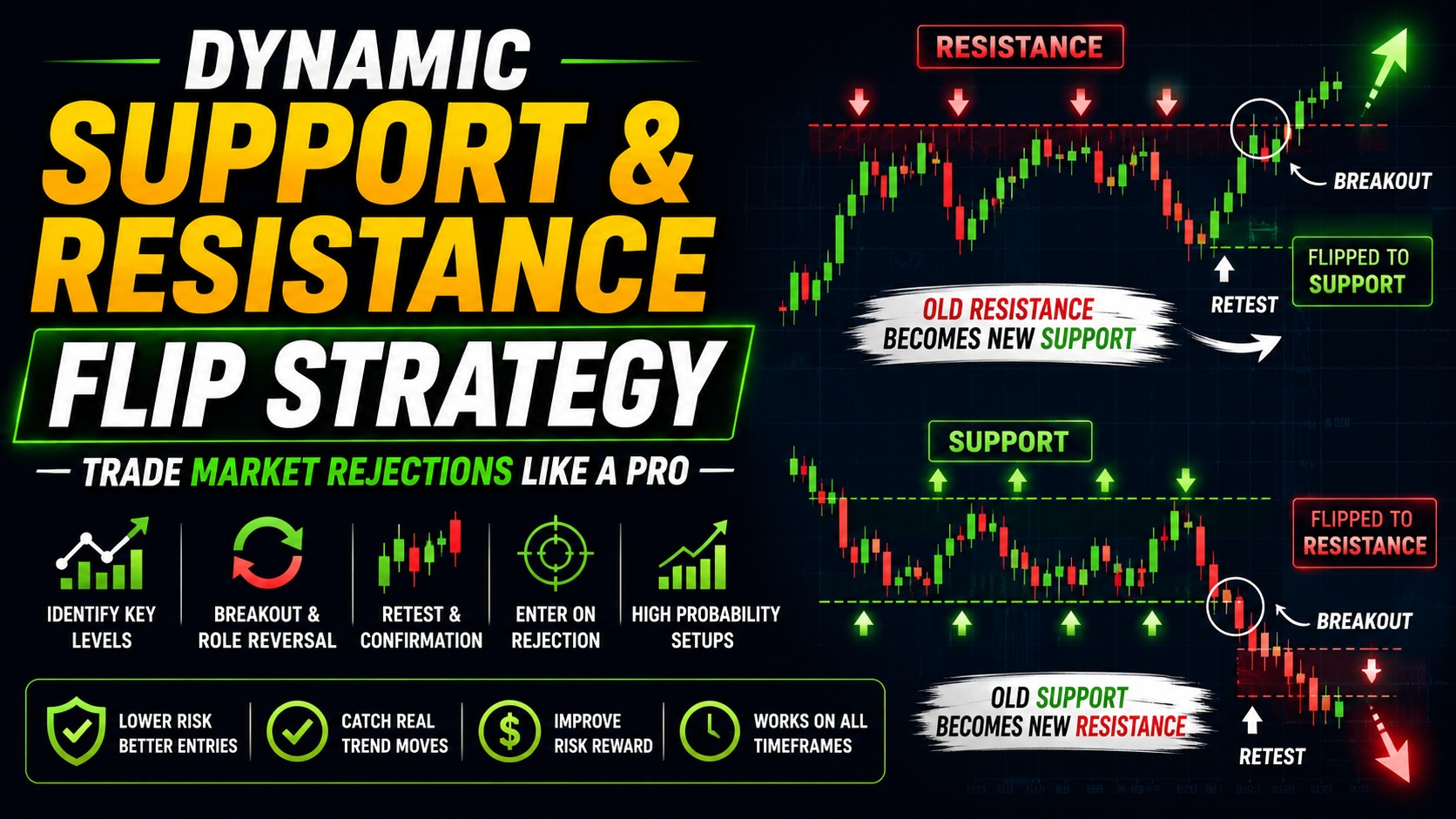
Support and resistance are among the most important concepts in forex trading. Almost every trader has heard about these levels, but very few truly understand how they work in live market conditions. Most beginner traders treat support and resistance as fixed lines, while professional traders understand that these levels are dynamic and constantly changing. One of the most powerful concepts in price action trading is the support and resistance flip. This happens when a broken resistance becomes support or when broken support turns into resistance. Understanding this behavior can significantly improve trading accuracy and timing. This is where dynamic support resistance strategy, breakout retest trading, and market rejection forex trading become essential.
Many traders make the mistake of entering trades immediately after a breakout. However, professional traders often wait for price to retest the broken level before entering. This retest provides confirmation that the market accepts the new direction. By mastering dynamic support resistance strategy, breakout retest trading, and market rejection forex trading, traders can avoid false breakouts and improve consistency.
Understanding Support and Resistance
Support is a price level where buying pressure is strong enough to stop price from falling further. Resistance is a level where selling pressure prevents price from rising higher.
These levels are formed because traders react emotionally around certain prices. Buyers often enter near support, while sellers enter near resistance.
Support and resistance levels are not exact lines. They are zones where price reactions are likely to occur.
Understanding these basics is essential for dynamic support resistance strategy, breakout retest trading, and market rejection forex trading.
Why Support and Resistance Matter
Support and resistance levels represent important decision areas in the market.
Institutions often place large orders around these zones. Retail traders also focus on them because they are easy to identify.
As a result, price frequently reacts strongly at these levels.
These reactions create trading opportunities that form the basis of dynamic support resistance strategy, breakout retest trading, and market rejection forex trading.
What is a Support Resistance Flip
A support resistance flip occurs when a broken level changes its role.
When price breaks above resistance, that resistance may later act as support.
When price breaks below support, that support may later become resistance.
This role reversal happens because market participants change their behavior after the breakout.
Understanding this concept is central to dynamic support resistance strategy, breakout retest trading, and market rejection forex trading.
Why Role Reversal Happens
Role reversal is driven by market psychology and order flow.
For example, traders who missed a breakout may wait for a retest to enter trades. Traders who were trapped on the wrong side may also exit positions during the retest.
This creates buying or selling pressure around the flipped level.
Institutions use these reactions to continue market momentum.
This behavior supports dynamic support resistance strategy, breakout retest trading, and market rejection forex trading.
Difference Between Static and Dynamic Levels
Static support and resistance are fixed horizontal levels.
Dynamic support and resistance change over time and can include trendlines, moving averages, and evolving market zones.
Professional traders focus more on dynamic market behavior rather than fixed lines.
Understanding this difference improves dynamic support resistance strategy, breakout retest trading, and market rejection forex trading.
How to Identify Strong Levels
Not every support and resistance zone carries the same value in the forex market.
Some levels become highly important because price reacts there repeatedly over time. When the market respects a level multiple times, traders and institutions begin paying closer attention to it.
Higher timeframe levels usually have stronger influence because they reflect broader market participation and institutional order flow. These zones often attract liquidity and become key decision areas for smart money activity.
A well-respected level can create powerful breakout and retest opportunities once price finally moves beyond it.
Understanding how to identify these major zones helps traders improve dynamic support resistance strategy, breakout retest trading, and market rejection forex trading.
Breakout Trading Explained
A breakout happens when price moves beyond a key support or resistance level.
This usually indicates strong momentum and increased market participation.
However, not every breakout is genuine. Some breakouts fail and reverse quickly.
Understanding breakout behavior is important for dynamic support resistance strategy, breakout retest trading, and market rejection forex trading.
The Importance of Retests
Professional traders often avoid entering immediately after a breakout.
Instead, they wait for price to return and retest the broken level.
A successful retest confirms that the market accepts the new direction.
This approach reduces risk and improves entry accuracy.
It is a core principle of dynamic support resistance strategy, breakout retest trading, and market rejection forex trading.
How to Trade a Bullish Support Flip
Price breaks above a major resistance level with strong momentum.
Instead of buying immediately, traders wait for price to return to the broken resistance.
If price rejects the level and starts moving upward again, the level has flipped into support.
Traders can enter buy positions after confirmation.
This setup reflects dynamic support resistance strategy, breakout retest trading, and market rejection forex trading.
How to Trade a Bearish Resistance Flip
Price breaks below a strong support level.
After the breakout, price retraces upward to retest the broken support.
If the market rejects the level and moves downward, the level has flipped into resistance.
Traders can enter sell trades with proper risk management.
This example demonstrates dynamic support resistance strategy, breakout retest trading, and market rejection forex trading.
Market Rejection Candles Explained
Rejection candles are powerful signals around support and resistance flips.
Long wicks show that the market attempted to move in one direction but failed.
Bullish rejection candles often appear at support. Bearish rejection candles appear near resistance.
These candles provide confirmation for entries.
They strengthen dynamic support resistance strategy, breakout retest trading, and market rejection forex trading.
Break of Structure Confirmation
Break of structure confirms that the market direction has changed.
For example, after a bullish retest, price breaking a previous high confirms strength.
Similarly, after a bearish retest, breaking a previous low confirms weakness.
Using structure analysis improves dynamic support resistance strategy, breakout retest trading, and market rejection forex trading.
Role of Liquidity in Support Resistance Flips
Liquidity plays a major role in market behavior.
Institutions often sweep liquidity above resistance or below support before the real move begins.
These liquidity grabs trap retail traders and create better opportunities for smart money.
Understanding liquidity improves dynamic support resistance strategy, breakout retest trading, and market rejection forex trading.
Multi-Timeframe Analysis
Using multiple timeframes improves trading accuracy.
Higher timeframes identify major support and resistance zones.
Lower timeframes provide precise entry opportunities.
For example, traders may identify a resistance flip on the 4-hour chart and enter on the 5-minute chart.
This approach enhances dynamic support resistance strategy, breakout retest trading, and market rejection forex trading.
Best Market Conditions for This Strategy
This strategy works best in trending markets.
Strong momentum increases the probability of successful flips.
London and New York sessions often provide the best breakout opportunities because liquidity is high.
Choosing the right conditions improves dynamic support resistance strategy, breakout retest trading, and market rejection forex trading.
Risk Management in Retest Trading
Risk management is essential for long-term success.
Stop losses should be placed beyond the flipped zone.
Position size should remain controlled.
Risk reward ratio should be favorable.
Proper risk control strengthens dynamic support resistance strategy, breakout retest trading, and market rejection forex trading.
Common Mistakes Traders Make
Many traders chase breakouts without waiting for retests.
Another mistake is trading weak levels without confirmation.
Overtrading and ignoring market structure also lead to losses.
Avoiding these mistakes is important for mastering dynamic support resistance strategy, breakout retest trading, and market rejection forex trading.
Psychology Behind Breakout Retests
Breakout retests are driven by trader emotions.
Fear of missing out causes traders to enter too early.
Fear of loss causes weak hands to exit during retests.
Institutions use these emotions to create liquidity.
Understanding market psychology helps traders remain disciplined.
This mindset supports dynamic support resistance strategy, breakout retest trading, and market rejection forex trading.
Advantages of Support Resistance Flip Strategy
This strategy provides clear entry and exit points.
It improves trade timing and reduces false breakout entries.
It works across different currency pairs and timeframes.
These benefits make dynamic support resistance strategy, breakout retest trading, and market rejection forex trading highly effective.
Challenges of This Strategy
Despite its advantages, this strategy requires patience.
Not every breakout retest will succeed.
Market conditions and news events can affect performance.
Understanding these challenges helps traders apply dynamic support resistance strategy, breakout retest trading, and market rejection forex trading effectively.
Combining This Strategy with Smart Money Concepts
Support resistance flips become even stronger when combined with smart money concepts.
Order blocks provide institutional zones.
Fair value gaps confirm imbalance.
Liquidity sweeps reveal manipulation.
This combination creates high-probability setups.
It strengthens dynamic support resistance strategy, breakout retest trading, and market rejection forex trading.
Building Consistency with Retest Trading
Consistency comes from discipline and structured analysis.
Traders should focus on quality setups instead of taking random trades.
Maintaining a trading journal helps improve performance over time.
This discipline supports long-term success in dynamic support resistance strategy, breakout retest trading, and market rejection forex trading.
Using This Strategy on Different Markets
Although commonly used in forex, this strategy also works in gold, indices, and cryptocurrency markets.
The principles of breakout and retest are universal because they are based on human behavior and liquidity.
This flexibility makes dynamic support resistance strategy, breakout retest trading, and market rejection forex trading highly versatile.
Final Thoughts on Support Resistance Flip Trading
The support and resistance flip strategy is one of the most practical and beginner-friendly trading concepts. It helps traders understand how markets transition from one phase to another and how institutions use breakout retests to continue momentum.
Mastering dynamic support resistance strategy, breakout retest trading, and market rejection forex trading requires patience, discipline, and continuous learning.
In the end, successful trading is not about predicting every move. It is about understanding how price reacts around important levels and learning to trade with market structure instead of emotions.
For more information:-
Instagram: https://www.instagram.com/hadyjfx_official
YouTube: https://www.youtube.com/@hadyjmentor7793
Facebook: https://www.facebook.com/profile.php?id=61562232239915
Join Telegram: https://t.me/hadyjfx