In forex trading, one of the most misunderstood concepts is why strong support or resistance zones suddenly fail. Traders often enter trades based on order blocks or key levels, only to see price break through and move aggressively in the opposite direction. This is not random behavior—it is a result of smart money manipulation. Institutions often create traps by invalidating key zones to capture liquidity. This phenomenon leads to the formation of breaker blocks. Understanding this concept can give traders a significant edge. This is where breaker block trading strategy, smart money trap reversal, and failed order block concept become essential.
Most retail traders assume that every order block will hold. However, professional traders know that when a strong level fails, it often creates an even stronger opportunity in the opposite direction. By mastering breaker block trading strategy, smart money trap reversal, and failed order block concept, traders can turn losing setups into high-probability trades.
What is a Breaker Block
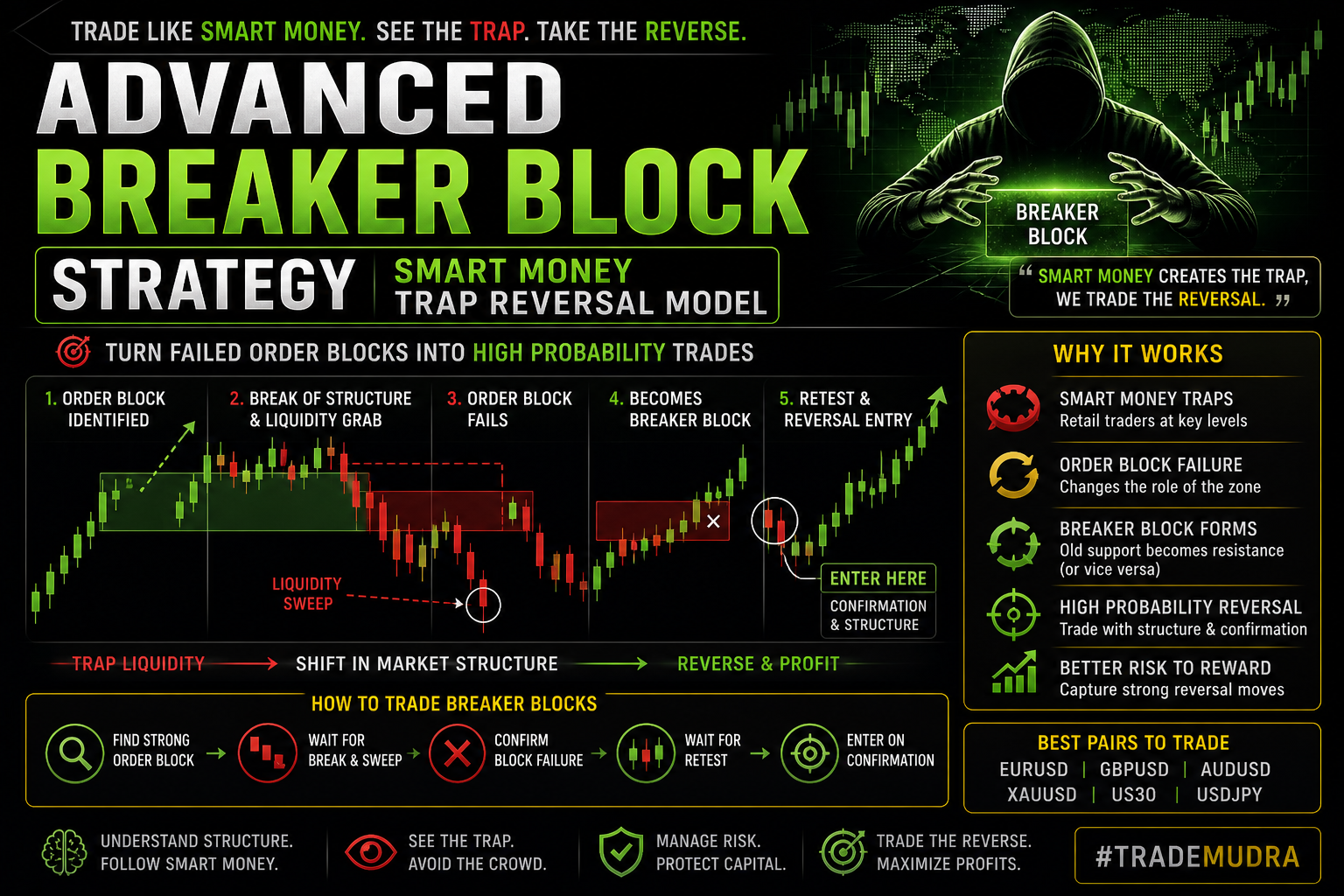
A breaker block is formed when an order block fails and price breaks through it with strong momentum. Instead of acting as support or resistance, the broken zone flips its role.
For example, a bullish order block that fails can become resistance. A bearish order block that fails can become support.
This shift happens because traders who entered positions at the original zone are trapped. Their stop losses and exits create liquidity for the new move. This concept is the foundation of breaker block trading strategy, smart money trap reversal, and failed order block concept.
Why Breaker Blocks Work
Breaker blocks work because they represent trapped traders.
When price breaks an order block, traders who expected it to hold are forced to exit their positions. This creates additional momentum in the direction of the breakout.
Institutions use this liquidity to push price further. As a result, the broken level becomes a strong zone for future reactions.
Understanding this behavior is key to breaker block trading strategy, smart money trap reversal, and failed order block concept.
Difference Between Order Block and Breaker Block
Order blocks are zones where institutions enter positions, expecting price to react.
Breaker blocks, on the other hand, are formed when these zones fail.
While order blocks are used for continuation trades, breaker blocks are used for reversal trades.
Recognizing the transition from order block to breaker block is essential for applying breaker block trading strategy, smart money trap reversal, and failed order block concept effectively.
How Breaker Blocks Are Formed
Breaker blocks form through a specific sequence.
First, price creates a strong order block.
Next, traders enter positions expecting a reaction.
Then, price breaks through the zone, triggering stop losses.
Finally, price returns to the broken zone, which now acts as a new support or resistance.
This sequence is central to breaker block trading strategy, smart money trap reversal, and failed order block concept.
Market Structure and Breaker Blocks
Market structure plays an important role in identifying breaker blocks.
A break of structure often confirms the failure of an order block.
A change of character may signal the beginning of a reversal.
By combining these concepts, traders can identify high-probability setups.
This integration strengthens breaker block trading strategy, smart money trap reversal, and failed order block concept.
Step-by-Step Breaker Block Strategy
The first step is identifying a strong order block.
Next, observe whether price respects or breaks the zone.
If the zone fails with strong momentum, mark it as a potential breaker block.
Wait for price to return to this zone. Look for confirmation before entering trades.
This structured approach defines breaker block trading strategy, smart money trap reversal, and failed order block concept.
Entry Confirmation Techniques
Confirmation is essential to avoid false signals.
Traders should look for rejection candles showing strong reaction.
Break of structure confirms the new direction.
Liquidity sweeps provide additional confirmation.
These signals improve accuracy in breaker block trading strategy, smart money trap reversal, and failed order block concept.
Bullish Breaker Block Example
Price is in a downtrend and forms a bearish order block.
Traders expect price to drop from this zone. However, price breaks above the order block with strong momentum.
This creates a bullish breaker block. When price returns to this zone, it acts as support.
Traders can enter buy trades with stops below the zone. This setup reflects breaker block trading strategy, smart money trap reversal, and failed order block concept.
Bearish Breaker Block Example
Price is in an uptrend and forms a bullish order block.
Traders expect price to rise, but it breaks below the zone.
This creates a bearish breaker block. When price returns to the zone, it acts as resistance.
Traders can enter sell trades with proper risk management.
This example demonstrates breaker block trading strategy, smart money trap reversal, and failed order block concept.
Risk Management in Breaker Block Trading
Risk management is essential for success.
Stop losses should be placed beyond the breaker block zone.
Position size should be controlled to manage risk.
Risk reward ratio should be favorable.
These principles support breaker block trading strategy, smart money trap reversal, and failed order block concept.
Multi-Timeframe Analysis
Using multiple timeframes improves accuracy.
Higher timeframes help identify major order blocks and structure.
Lower timeframes provide precise entry points.
This approach enhances breaker block trading strategy, smart money trap reversal, and failed order block concept.
Combining Breaker Blocks with Other Concepts
Breaker blocks become more powerful when combined with other smart money concepts.
Liquidity sweeps confirm market intent.
Fair value gaps provide additional entry zones.
Trend analysis ensures alignment with market direction.
This combination strengthens breaker block trading strategy, smart money trap reversal, and failed order block concept.
Common Mistakes Traders Make
Many traders assume every broken level is a breaker block.
Another mistake is entering trades without confirmation.
Ignoring market structure and overtrading also lead to losses.
Avoiding these mistakes is crucial for mastering breaker block trading strategy, smart money trap reversal, and failed order block concept.
Psychology Behind Breaker Blocks
Breaker blocks reflect trader psychology.
When a level fails, traders experience fear and confusion.
Some exit trades in panic, while others try to hold losing positions.
Institutions use these reactions to create liquidity and drive price.
Understanding this psychology helps traders stay disciplined.
This insight supports breaker block trading strategy, smart money trap reversal, and failed order block concept.
Advantages of Breaker Block Strategy
This strategy helps traders trade with smart money rather than against it.
It provides high-probability reversal setups.
It improves risk reward ratio and entry precision.
These advantages make breaker block trading strategy, smart money trap reversal, and failed order block concept highly effective.
Limitations of the Strategy
Despite its strengths, this strategy requires practice.
Not all failed zones become valid breaker blocks.
Market conditions can affect performance.
Understanding these limitations helps traders apply breaker block trading strategy, smart money trap reversal, and failed order block concept effectively.
Building Consistency with Breaker Blocks
Consistency comes from discipline and structured analysis.
Traders should follow clear rules and avoid emotional decisions.
Keeping a trading journal helps improve performance over time.
This discipline supports long-term success in breaker block trading strategy, smart money trap reversal, and failed order block concept.
Conclusion
The breaker block strategy is a powerful tool for understanding market reversals. By identifying failed order blocks, traders can turn traps into opportunities.
Mastering breaker block trading strategy, smart money trap reversal, and failed order block concept requires patience, discipline, and practice.
In the end, successful trading is about understanding how the market truly works. Those who learn to recognize smart money traps gain a significant edge in the forex market.
For more information:-
Instagram: https://www.instagram.com/hadyjfx_official
YouTube: https://www.youtube.com/@hadyjmentor7793
Facebook: https://www.facebook.com/profile.php?id=61562232239915
Join Telegram: https://t.me/hadyjfx