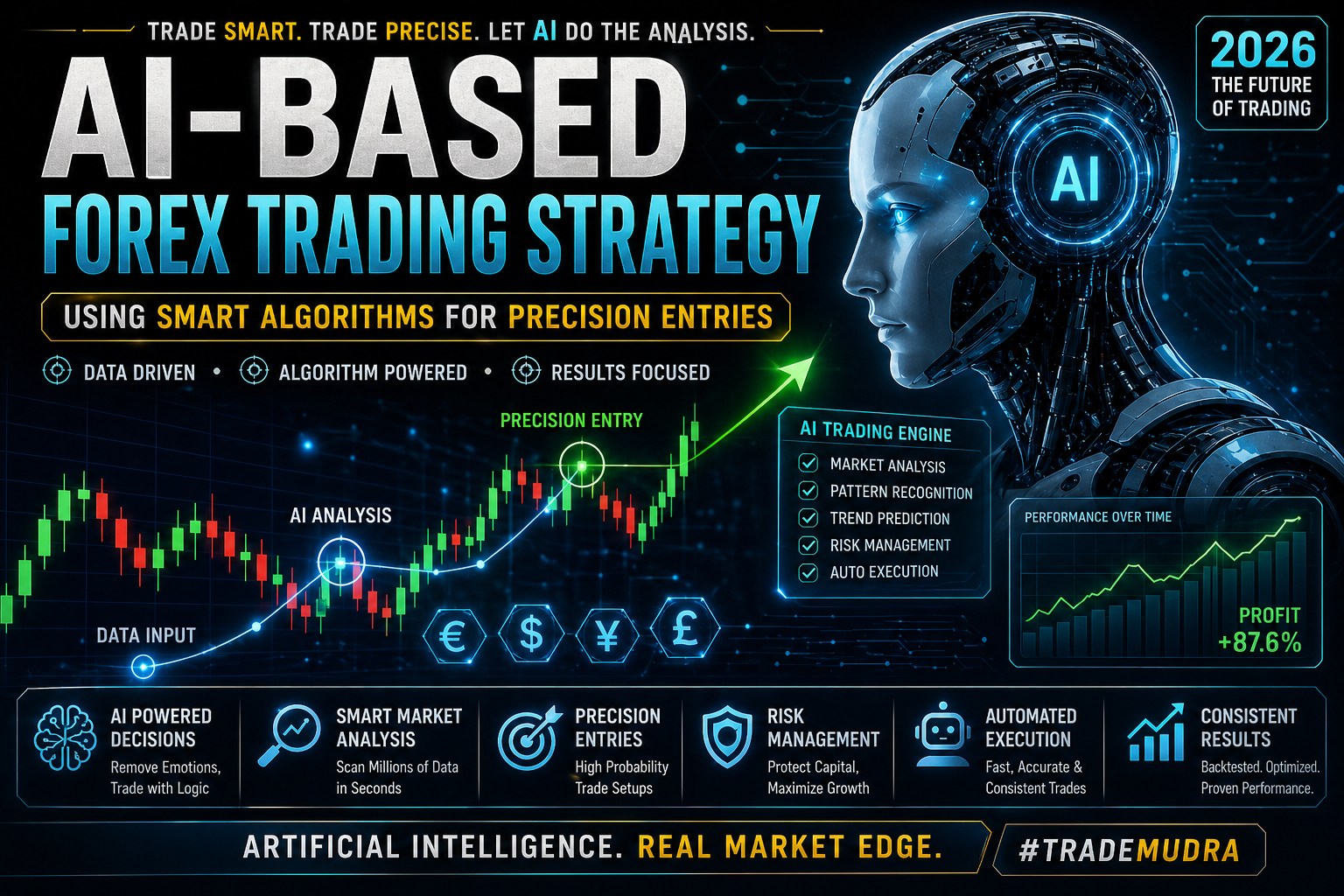
The forex market is evolving rapidly, and traditional trading methods are no longer enough to stay competitive. In 2026, artificial intelligence is transforming the way traders analyze markets, execute trades, and manage risk. Instead of relying solely on manual analysis, traders are now leveraging smart algorithms to make faster and more accurate decisions. This shift is creating a new era of trading where data, automation, and machine learning play a central role. This is where AI forex trading strategy, algorithmic trading systems, and data-driven trading models become essential.
Artificial intelligence allows traders to process massive amounts of data in seconds. It can identify patterns, predict market behavior, and execute trades with precision. Unlike human traders, AI systems are not affected by emotions such as fear or greed. This makes them highly effective in maintaining discipline and consistency. Understanding AI forex trading strategy, algorithmic trading systems, and data-driven trading models can give traders a significant edge in modern markets.
What is AI-Based Forex Trading
AI-based forex trading refers to the use of artificial intelligence and machine learning algorithms to analyze market data and execute trades. These systems are designed to learn from historical data and adapt to changing market conditions.
Unlike traditional strategies, AI does not rely on fixed rules. Instead, it evolves based on new data and market behavior. This makes it more flexible and efficient.
AI systems can analyze price action, volume, news, and even sentiment data from social media. This multi-dimensional analysis improves accuracy and decision-making. This concept forms the foundation of AI forex trading strategy, algorithmic trading systems, and data-driven trading models.
How Smart Algorithms Work in Forex
Smart algorithms follow a structured process to generate trading signals.
First, they collect large amounts of historical and real-time data. This includes price movements, economic indicators, and market sentiment.
Next, they analyze this data using mathematical models and machine learning techniques. These models identify patterns that are not visible to the human eye.
Finally, the system generates trade signals and executes them automatically or with minimal human intervention. This process defines AI forex trading strategy, algorithmic trading systems, and data-driven trading models.
Types of AI Trading Strategies
There are several types of AI-based strategies used in forex trading.
Trend-following algorithms identify strong market trends and trade in the same direction.
Mean reversion models look for overbought or oversold conditions and trade reversals.
Arbitrage systems exploit price differences across different markets.
Sentiment analysis models use news and social media data to predict market direction.
Each type offers unique advantages and contributes to AI forex trading strategy, algorithmic trading systems, and data-driven trading models.
Advantages of AI in Forex Trading
AI provides several advantages over traditional trading methods.
It eliminates emotional decision-making, ensuring consistent execution.
It processes data faster than humans, allowing quick responses to market changes.
It can operate 24/7 without fatigue, making it ideal for forex markets.
It improves accuracy by analyzing multiple factors simultaneously.
These benefits make AI forex trading strategy, algorithmic trading systems, and data-driven trading models highly effective in modern trading.
Role of Machine Learning in Trading
Machine learning is a key component of AI trading systems.
It allows algorithms to learn from past data and improve over time. As the system processes more data, its predictions become more accurate.
Machine learning models can adapt to different market conditions, making them more reliable than static strategies.
This adaptability is essential for AI forex trading strategy, algorithmic trading systems, and data-driven trading models.
Data Sources Used in AI Trading
AI systems rely on multiple data sources to make decisions.
Price data is the most basic input, including open, high, low, and close values.
Economic data such as interest rates and inflation provide macro insights.
News and sentiment data help predict market reactions.
Volume and liquidity data reveal institutional activity.
Combining these sources enhances AI forex trading strategy, algorithmic trading systems, and data-driven trading models.
Building an AI Trading Strategy
Creating an AI-based trading strategy involves several steps.
First, define the trading objective, such as trend-following or reversal trading.
Next, collect and clean historical data for analysis.
Then, choose a suitable machine learning model.
Train the model using historical data and test its performance.
Finally, deploy the system in live markets with proper risk controls.
This structured approach is essential for AI forex trading strategy, algorithmic trading systems, and data-driven trading models.
Backtesting and Optimization
Backtesting is crucial for evaluating an AI trading strategy.
It involves testing the strategy on historical data to measure its performance. This helps identify strengths and weaknesses.
Optimization improves the strategy by adjusting parameters for better results. However, over-optimization should be avoided as it can reduce real-world performance.
Proper testing supports AI forex trading strategy, algorithmic trading systems, and data-driven trading models.
Risk Management in AI Trading
Risk management remains essential even with advanced technology.
Stop losses should be integrated into the algorithm to limit losses.
Position sizing should be controlled based on account size.
Diversification can reduce overall risk.
AI systems can automate risk management, ensuring consistent application. This strengthens AI forex trading strategy, algorithmic trading systems, and data-driven trading models.
Multi-Timeframe Analysis with AI
AI systems can analyze multiple timeframes simultaneously.
Higher timeframes provide the overall trend, while lower timeframes offer precise entries.
This multi-layered analysis improves accuracy and reduces false signals.
It is an important aspect of AI forex trading strategy, algorithmic trading systems, and data-driven trading models.
Combining AI with Smart Money Concepts
AI can be combined with smart money concepts for better results.
Algorithms can identify liquidity zones, order blocks, and fair value gaps.
They can detect stop hunts and market manipulation patterns.
This combination enhances precision and aligns trading with institutional behavior.
It represents the future of AI forex trading strategy, algorithmic trading systems, and data-driven trading models.
Common Mistakes in AI Trading
Many traders make mistakes when using AI.
Relying completely on automation without understanding the system can be risky.
Using poor-quality data can lead to inaccurate predictions.
Over-optimizing strategies can reduce real-world performance.
Avoiding these mistakes is crucial for successful AI forex trading strategy, algorithmic trading systems, and data-driven trading models.
Psychology in AI Trading
Even though AI removes emotional decision-making, trader psychology still matters.
Traders must trust the system and avoid interfering unnecessarily.
Discipline is required to follow the strategy consistently.
Understanding this balance improves AI forex trading strategy, algorithmic trading systems, and data-driven trading models.
Future of AI in Forex Trading
The future of forex trading is closely linked to artificial intelligence.
AI systems will become more advanced, incorporating deep learning and real-time data analysis.
Integration with big data and cloud computing will improve performance.
Retail traders will have access to more powerful tools.
These developments will further strengthen AI forex trading strategy, algorithmic trading systems, and data-driven trading models.
Advantages vs Limitations
AI trading offers high accuracy, speed, and consistency. However, it also has limitations.
It requires technical knowledge and reliable data.
Market conditions can change, affecting performance.
Technical failures can disrupt trading.
Understanding both sides helps traders use AI forex trading strategy, algorithmic trading systems, and data-driven trading models effectively.
Conclusion
AI-based forex trading is transforming the financial markets. By using smart algorithms and data-driven models, traders can achieve higher accuracy and consistency.
Mastering AI forex trading strategy, algorithmic trading systems, and data-driven trading models requires knowledge, practice, and discipline.
In the end, the goal is not to replace human traders but to enhance their capabilities. Those who adapt to this new technology will have a significant advantage in the forex market of 2026 and beyond.
For more information:-
Instagram: https://www.instagram.com/hadyjfx_official
YouTube: https://www.youtube.com/@hadyjmentor7793
Facebook: https://www.facebook.com/profile.php?id=61562232239915
Join Telegram: https://t.me/hadyjfx