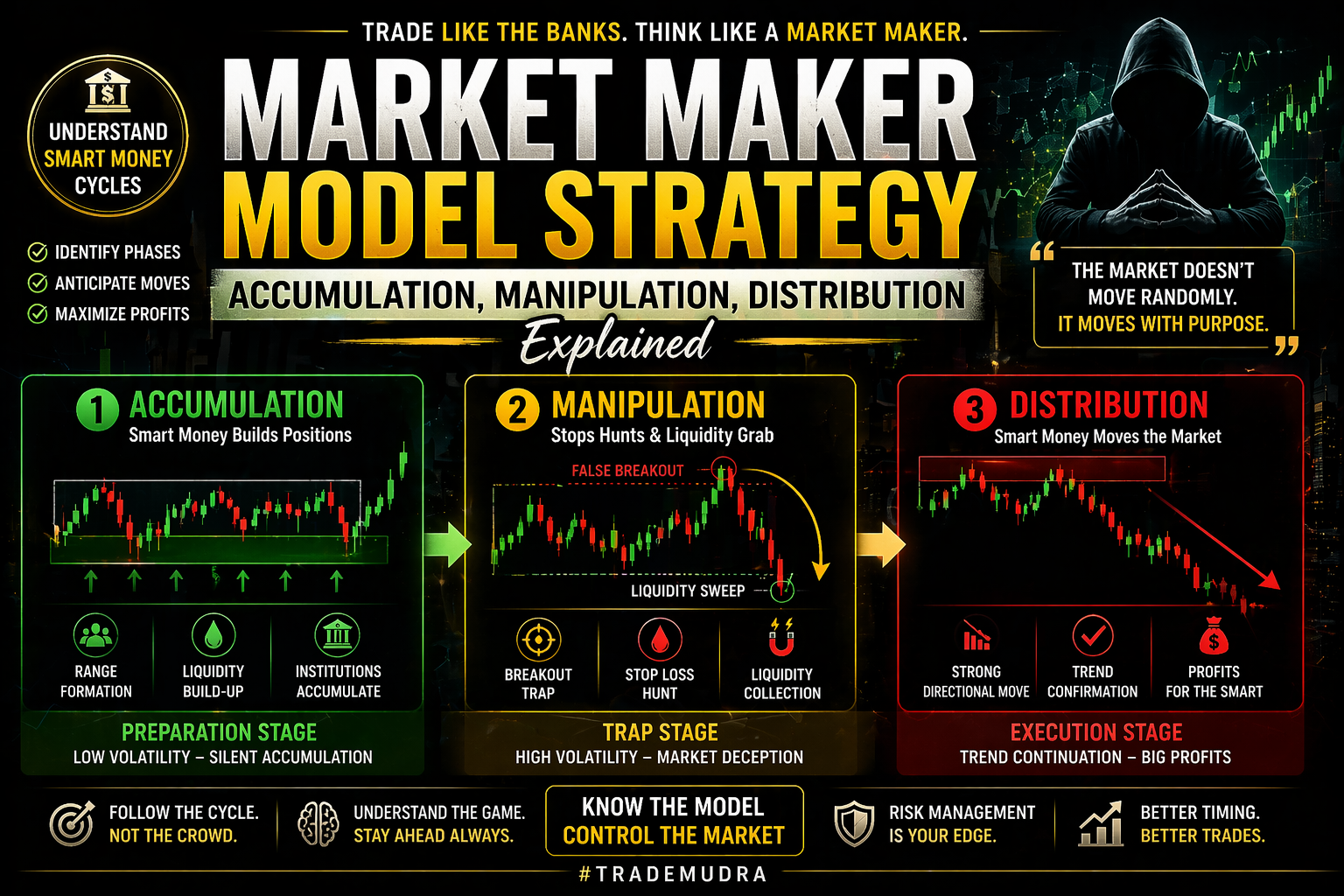
In the forex market, price does not move randomly. Behind every strong move lies a structured process driven by institutions and market makers. Retail traders often enter trades without understanding this process, which leads to losses and confusion. Professional traders, however, study how smart money builds positions and moves the market in phases. One of the most powerful frameworks to understand this behavior is the Market Maker Model. This model explains how price cycles through accumulation, manipulation, and distribution before making significant moves. This is where market maker model strategy, smart money trading cycle, and accumulation manipulation distribution become essential.
Understanding this model gives traders a clear roadmap of market behavior. Instead of reacting to price, traders can anticipate moves by identifying where the market is in its cycle. This shift in perspective allows traders to align with institutional flow rather than being trapped by it.
What is the Market Maker Model
The Market Maker Model is a structured approach that explains how institutions control price movement. It is based on the idea that markets move in cycles, driven by liquidity and order flow.
The model consists of three main phases: accumulation, manipulation, and distribution. Each phase has a specific purpose and plays a role in the overall movement of price.
By understanding these phases, traders can identify high-probability setups and avoid common traps. This concept forms the foundation of market maker model strategy, smart money trading cycle, and accumulation manipulation distribution.
Phase 1: Accumulation Explained
Accumulation is the first phase of the cycle. During this phase, institutions quietly build positions without causing major price movements.
Price typically moves in a range during accumulation. This range creates a sense of uncertainty among retail traders, leading to indecision.
Institutions use this phase to collect liquidity and prepare for the next move. Since they cannot enter large positions at once, they accumulate orders over time.
Recognizing accumulation is crucial in market maker model strategy, smart money trading cycle, and accumulation manipulation distribution.
Characteristics of Accumulation Phase
The accumulation phase has specific characteristics that traders can identify.
Price moves sideways within a defined range. Volatility is relatively low compared to trending markets.
There are multiple false breakouts within the range, which trap retail traders.
Liquidity builds above the highs and below the lows of the range. These areas become targets for the next phase.
Understanding these traits helps traders apply market maker model strategy, smart money trading cycle, and accumulation manipulation distribution effectively.
Phase 2: Manipulation Explained
Manipulation is the most deceptive phase of the cycle. During this phase, price moves outside the accumulation range to trigger stop losses and trap traders.
This move is often mistaken for a breakout. Retail traders enter trades expecting continuation, but the move quickly reverses.
The purpose of manipulation is to collect liquidity. By triggering stop losses and breakout orders, institutions gather the volume needed to execute large trades.
This phase is a key component of market maker model strategy, smart money trading cycle, and accumulation manipulation distribution.
Types of Manipulation Moves
Manipulation can occur in both directions.
In a bullish scenario, price may drop below the range to trigger sell stops before moving upward.
In a bearish scenario, price may rise above the range to trigger buy stops before dropping.
These moves are often fast and sharp, creating confusion in the market.
Recognizing these patterns is essential for mastering market maker model strategy, smart money trading cycle, and accumulation manipulation distribution.
Phase 3: Distribution Explained
Distribution is the final phase where the real move happens. After collecting liquidity during manipulation, institutions drive the market in the intended direction.
This phase is characterized by strong momentum and clear trends. Price moves away from the accumulation range with conviction.
Retail traders who entered during manipulation are often trapped, which fuels the trend further.
Understanding distribution helps traders capture large moves using market maker model strategy, smart money trading cycle, and accumulation manipulation distribution.
How to Identify Each Phase on Charts
Identifying the phases requires careful observation of price behavior.
Look for consolidation ranges to identify accumulation. Watch for false breakouts to spot manipulation.
Strong directional moves indicate distribution.
Using these signals, traders can determine where the market is in its cycle. This is a practical application of market maker model strategy, smart money trading cycle, and accumulation manipulation distribution.
Entry Strategy Using Market Maker Model
The best entries occur after the manipulation phase.
Instead of chasing breakouts, traders should wait for liquidity sweeps and confirmation.
Once manipulation is complete and price shows rejection, traders can enter in the direction of distribution.
This approach aligns with market maker model strategy, smart money trading cycle, and accumulation manipulation distribution.
Combining Market Structure with the Model
Market structure enhances the effectiveness of the model.
During distribution, traders should look for break of structure in the direction of the move.
Change of character may signal the transition from accumulation to distribution.
Combining these concepts improves accuracy and supports market maker model strategy, smart money trading cycle, and accumulation manipulation distribution.
Multi-Timeframe Analysis for Better Accuracy
Using multiple timeframes helps identify phases more clearly.
Higher timeframes show accumulation ranges and major trends. Lower timeframes reveal manipulation and entry points.
This approach increases precision and reduces risk.
Multi-timeframe analysis is an important part of market maker model strategy, smart money trading cycle, and accumulation manipulation distribution.
Risk Management in Market Maker Trading
Risk management is essential when trading this model.
Stop losses should be placed beyond manipulation zones to avoid being triggered.
Position sizing should be controlled to manage risk effectively.
Maintaining a proper risk reward ratio ensures long-term profitability.
These principles complement market maker model strategy, smart money trading cycle, and accumulation manipulation distribution.
Common Mistakes Traders Make
Many traders misinterpret manipulation as a breakout.
Another mistake is entering trades during accumulation without confirmation.
Overtrading and ignoring market context also lead to losses.
Avoiding these mistakes is crucial for mastering market maker model strategy, smart money trading cycle, and accumulation manipulation distribution.
Psychology Behind Market Maker Model
The model is deeply connected to trader psychology.
Accumulation creates confusion, manipulation creates fear and excitement, and distribution creates momentum.
Institutions use these emotions to their advantage.
Understanding this psychology helps traders stay disciplined and focused.
This insight supports market maker model strategy, smart money trading cycle, and accumulation manipulation distribution.
Advantages of Market Maker Model Strategy
This strategy provides a clear understanding of market behavior.
It helps traders anticipate moves rather than react to them.
It also aligns traders with institutional flow, improving accuracy and consistency.
These advantages make market maker model strategy, smart money trading cycle, and accumulation manipulation distribution highly effective.
Limitations of the Strategy
Despite its strengths, the model requires practice and experience.
Beginners may struggle to identify phases correctly.
Market conditions can also vary, affecting the clarity of signals.
Understanding these limitations helps traders apply market maker model strategy, smart money trading cycle, and accumulation manipulation distribution effectively.
Conclusion
The Market Maker Model provides a powerful framework for understanding how the forex market operates. By recognizing accumulation, manipulation, and distribution phases, traders can anticipate price movements and avoid common traps.
Mastering market maker model strategy, smart money trading cycle, and accumulation manipulation distribution requires patience, discipline, and practice.
In the end, successful trading is not about predicting the market but understanding its behavior. Those who learn to follow smart money cycles gain a significant edge in the forex market.
For more information:-
Instagram: https://www.instagram.com/hadyjfx_official
YouTube: https://www.youtube.com/@hadyjmentor7793
Facebook: https://www.facebook.com/profile.php?id=61562232239915
Join Telegram: https://t.me/hadyjfx