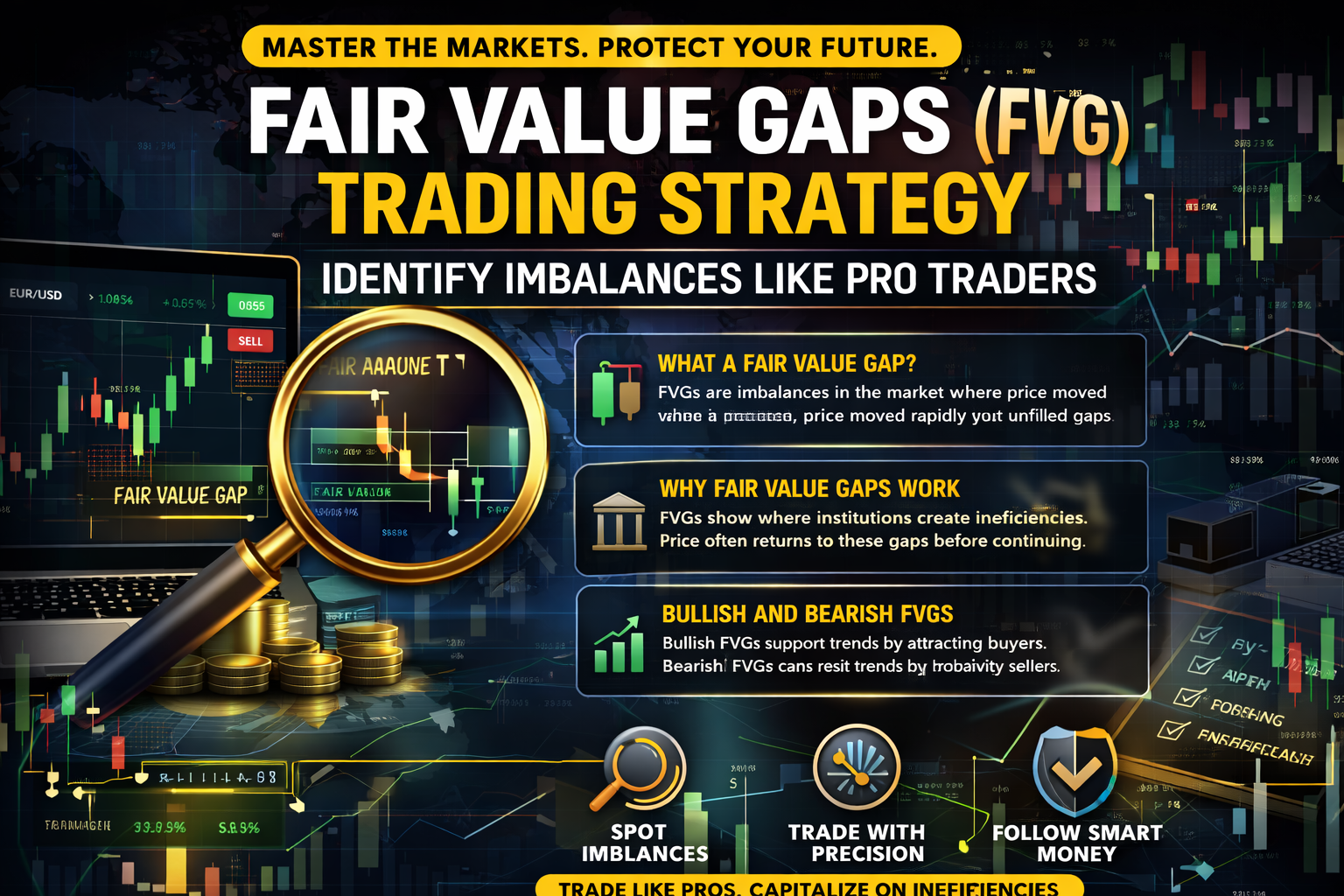
In the forex market, price does not move randomly. Every movement is driven by imbalance between buyers and sellers. When institutions enter the market with large orders, they create inefficiencies in price delivery. These inefficiencies are known as Fair Value Gaps (FVG). Understanding how to identify and trade these gaps can significantly improve your trading performance. This is where fair value gap trading strategy, smart money concept, and price imbalance trading become essential.
Retail traders often focus on indicators, but professional traders pay attention to price inefficiencies. Fair Value Gaps reveal where the market has moved too quickly, leaving behind areas that price may revisit. These zones act like magnets, attracting price back before continuing the trend. By mastering fair value gap trading strategy, smart money concept, and price imbalance trading, traders can align themselves with institutional behavior.
What is a Fair Value Gap (FVG)
A Fair Value Gap is a three-candle pattern that represents an imbalance in the market. It occurs when the price moves so aggressively that it leaves a gap between candles.
In simple terms, an FVG forms when the high of the first candle and the low of the third candle do not overlap with the middle candle. This creates a gap or inefficiency in price.
This gap indicates that the market did not trade efficiently in that area. Institutions often revisit these zones to rebalance price before continuing in the intended direction. This concept is a core part of fair value gap trading strategy, smart money concept, and price imbalance trading.
Why Fair Value Gaps Work
Fair Value Gaps work because they represent areas of strong institutional activity. When large players enter the market, they create rapid price movements that leave behind imbalances.
Price tends to return to these imbalances because the market seeks efficiency. This process is known as rebalancing. Once the gap is filled, price often continues in the original direction.
This behavior makes FVGs powerful tools for identifying high-probability trade setups. It is one of the key principles of fair value gap trading strategy, smart money concept, and price imbalance trading.
Types of Fair Value Gaps
Fair Value Gaps are generally classified into two categories: bullish gaps and bearish gaps.
A bullish FVG forms during an upward move and acts as a potential support zone. Traders look for buying opportunities when price returns to this gap.
A bearish FVG forms during a downward move and acts as a resistance zone. Traders look for selling opportunities when price revisits the gap.
Understanding these types is important for applying fair value gap trading strategy, smart money concept, and price imbalance trading effectively.
How to Identify a Valid FVG
Not every gap is a high-quality setup. Traders must learn to identify valid Fair Value Gaps.
A strong FVG is usually created by a large impulsive move. It often breaks market structure, indicating institutional involvement. It also aligns with higher timeframe trends.
Fresh FVGs that have not been revisited tend to be more reliable. The cleaner the gap, the higher the probability of price reacting to it.
These criteria are essential for mastering fair value gap trading strategy, smart money concept, and price imbalance trading.
FVG and Market Structure Connection
Fair Value Gaps become significantly more effective when they are used alongside overall market structure. During an upward trend, bullish FVG zones offer better opportunities, while in a downward trend, bearish gaps tend to perform more effectively.
Market structure helps determine the overall direction, while FVGs provide precise entry zones. This combination increases the probability of successful trades.
Break of structure and change of character also play a role in confirming trends and reversals. These concepts are closely linked with fair value gap trading strategy, smart money concept, and price imbalance trading.
Entry Strategy Using FVG
A proper entry strategy is essential for trading FVGs. Traders should not enter trades immediately when price reaches the gap.
First, identify the trend using higher timeframe analysis. Then, mark key FVG zones on the chart.
Wait for price to return to the gap and observe price action. Look for confirmation such as rejection candles, liquidity sweeps, or structure shifts.
Once confirmation is seen, enter the trade with proper risk management. This approach aligns with fair value gap trading strategy, smart money concept, and price imbalance trading.
FVG with Liquidity and Stop Hunting
Fair Value Gaps often work in combination with liquidity zones. Before entering an FVG, price may sweep liquidity by taking out previous highs or lows.
This liquidity grab provides the necessary orders for institutions to enter trades. After collecting liquidity, price moves into the FVG and reacts.
Understanding this relationship enhances the effectiveness of fair value gap trading strategy, smart money concept, and price imbalance trading.
Multi-Timeframe Analysis for FVG
Using multiple timeframes improves accuracy in FVG trading. Larger timeframes help traders understand the main market direction and important zones, whereas smaller timeframes are used to fine-tune entries with better accuracy.
For example, a trader may identify a bullish FVG on the 4-hour chart and then look for entry confirmation on the 5-minute chart.
This approach increases precision and reduces risk. Multi-timeframe analysis is a key component of fair value gap trading strategy, smart money concept, and price imbalance trading.
Stop Loss and Take Profit Strategy
Proper risk management is essential when trading FVGs. Stop losses should be placed beyond the gap to avoid being triggered by minor price movements.
Take profit levels can be set at previous highs or lows, liquidity zones, or key support and resistance levels.
Maintaining a good risk reward ratio ensures long-term profitability. This is an important aspect of fair value gap trading strategy, smart money concept, and price imbalance trading.
Common Mistakes in FVG Trading
Many traders make mistakes when trading Fair Value Gaps. One common mistake is trading every gap without confirmation.
Another mistake is ignoring market structure. Trading against the trend reduces accuracy and increases risk.
Overtrading and poor risk management are also common issues. Traders must be selective and disciplined.
Avoiding these mistakes is crucial for mastering fair value gap trading strategy, smart money concept, and price imbalance trading.
Advanced Concepts: Partial Fills and Inverse FVG
Sometimes price does not fully fill the gap but reacts from a partial fill. This indicates strong momentum and can still provide trading opportunities.
Inverse FVGs occur when a gap fails and price moves in the opposite direction. These zones can act as support or resistance.
Understanding these advanced concepts helps traders refine their strategy. These ideas are part of fair value gap trading strategy, smart money concept, and price imbalance trading.
Psychology Behind Price Imbalance
Price imbalance reflects the psychology of the market. When institutions enter aggressively, they create fear and excitement among retail traders.
This leads to impulsive decisions, which institutions use to their advantage. By understanding this psychology, traders can remain calm and make rational decisions.
This psychological aspect is deeply connected with fair value gap trading strategy, smart money concept, and price imbalance trading.
Benefits of FVG Trading Strategy
FVG trading offers several advantages. It provides clear entry zones, improves risk reward ratio, and aligns traders with institutional flow.
It also simplifies trading by focusing on price action instead of indicators. This makes it suitable for both beginners and experienced traders.
These benefits make fair value gap trading strategy, smart money concept, and price imbalance trading highly effective.
Limitations of FVG Trading
Despite its advantages, FVG trading requires practice and experience. Beginners may struggle to identify valid gaps.
Market conditions can also affect performance. In ranging markets, FVGs may not work as effectively as in trending markets.
Understanding these limitations helps traders apply fair value gap trading strategy, smart money concept, and price imbalance trading more effectively.
Conclusion
Fair Value Gaps provide a powerful way to understand market inefficiencies and institutional behavior. By identifying imbalances and waiting for price to rebalance, traders can find high-probability setups.
Mastering fair value gap trading strategy, smart money concept, and price imbalance trading requires patience, discipline, and practice. It is not about predicting the market but understanding how it moves.
In the long run, traders who learn to trade FVGs effectively can achieve consistent results and align themselves with smart money.
For more information:-
Instagram: https://www.instagram.com/hadyjfx_official
YouTube: https://www.youtube.com/@hadyjmentor7793
Facebook: https://www.facebook.com/profile.php?id=61562232239915
Join Telegram: https://t.me/hadyjfx