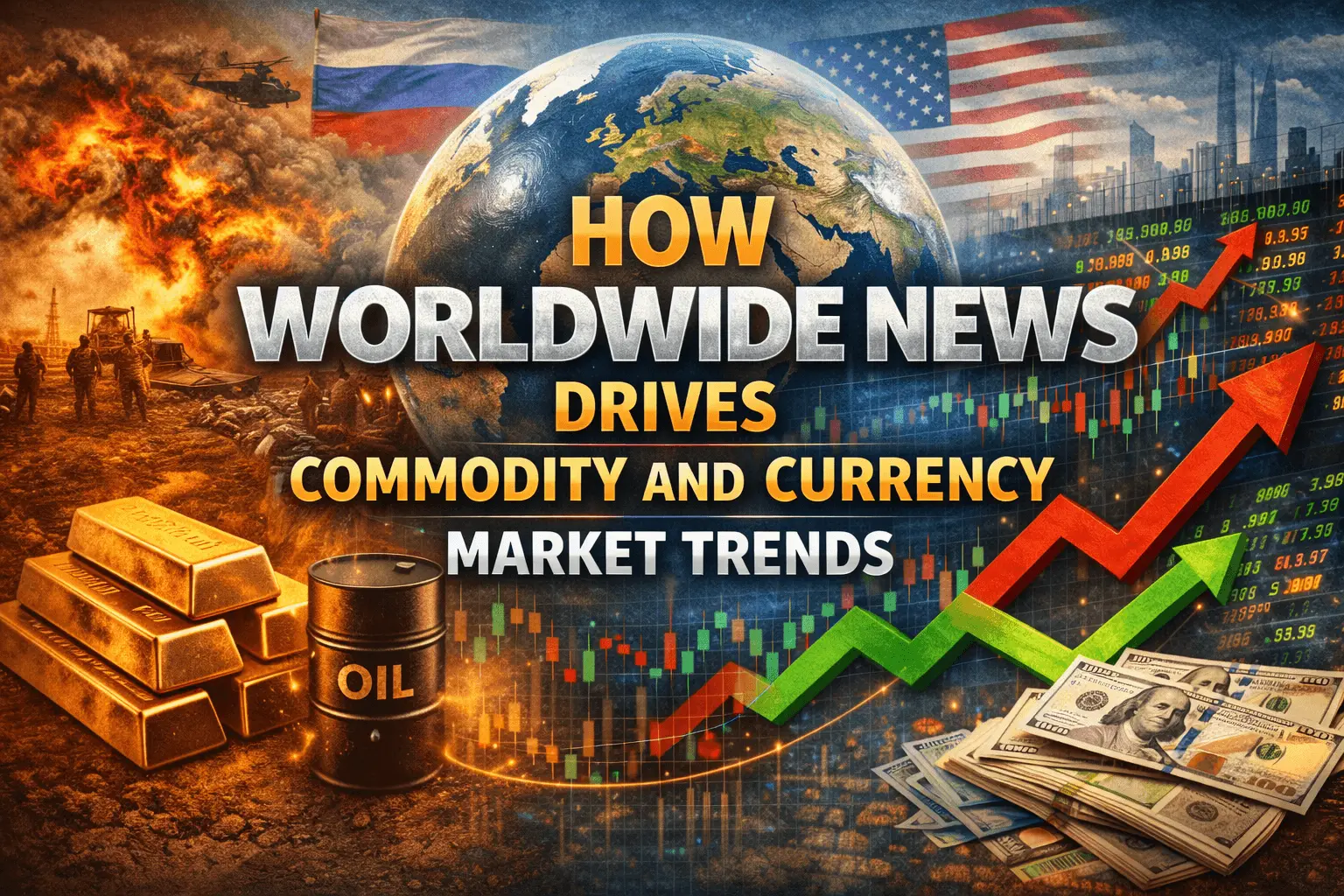
Financial markets do not move only on scheduled economic data. Some of the strongest and most persistent price trends begin with global headlines—political developments, geopolitical tensions, policy shifts, or unexpected global events. Traders often notice commodities and currencies reacting sharply to worldwide news long before official confirmation appears in data releases.
Understanding how worldwide market news influences price behavior is essential for interpreting modern markets. Global events reshape expectations, alter risk sentiment, and redirect capital flows. This article explains how global financial news impact drives commodities and currencies, why reactions differ between asset classes, and why markets often move ahead of confirmation.
why global headlines move markets so quickly
Worldwide news introduces uncertainty. Unlike economic data, which provides structured information, global events often arrive unexpectedly and evolve rapidly. Markets respond not to certainty, but to changes in perceived risk.
When new information alters expectations about growth, stability, or policy direction, investors reposition immediately. This is why prices often move on headlines rather than waiting for data validation.
Markets react to what could happen next, not just what has already happened.
global political and economic developments
Political decisions, international conflicts, trade negotiations, and policy shifts have global consequences. These developments influence supply chains, investment flows, and confidence across borders.
For example, political instability can disrupt trade routes or investment planning, while economic policy changes can affect growth prospects worldwide. Commodities and currencies are especially sensitive because they reflect cross-border activity.
This is why global financial news impact often shows up first in markets tied closely to international trade.
risk sentiment as the transmission mechanism
Risk sentiment connects worldwide news to market prices. When global headlines increase uncertainty, risk sentiment typically deteriorates. When confidence improves, risk appetite strengthens.
In risk-off environments, investors reduce exposure to assets linked to growth and uncertainty. In risk-on environments, capital flows toward assets associated with expansion and opportunity.
This shift in sentiment explains much of the immediate reaction seen in both commodities and currencies.
how commodities respond to worldwide news
Commodity prices react to worldwide news based on how events affect supply, demand, and confidence. Energy markets respond to geopolitical tension. Industrial metals react to growth expectations. Precious metals respond to uncertainty and confidence shifts.
Because commodities are tied to real economic activity, commodity market reaction often reflects how global developments may influence production, trade, or consumption.
Markets do not wait for confirmation of impact. Prices adjust as soon as expectations change.
how currencies react to global developments
Currencies respond to worldwide news through capital flows and relative safety perceptions. During periods of uncertainty, capital tends to move toward currencies viewed as stable or liquid. During periods of optimism, capital flows toward growth-linked currencies.
This behavior shapes currency market trends across regions. Importantly, currencies often move together in response to global news rather than domestic data.
This is why traders sometimes see synchronized moves across multiple currency pairs after major global headlines.
commodities versus currencies: different reactions, same driver
Although commodities and currencies respond differently, they are often driven by the same underlying force: global expectations.
Commodities reflect physical demand and supply assumptions. Currencies reflect capital flow decisions and relative stability. Worldwide news alters both at the same time, but through different channels.
Understanding this distinction helps traders interpret why assets may move in opposite directions while responding to the same event.
why markets move before confirmation appears
Markets are forward-looking by design. Waiting for confirmation means reacting late. As soon as expectations shift, prices adjust to reflect potential outcomes.
Economic data often confirms what markets have already priced. By the time confirmation arrives, much of the move has already occurred.
This is why worldwide market news frequently drives initial trends, while data explains them later.
expectations matter more than outcomes
Markets care less about the final outcome of events and more about how expectations change along the way. A situation that improves slightly from very negative expectations can support prices. A situation that disappoints optimistic expectations can pressure markets.
This dynamic explains why markets sometimes rally on bad news or fall on good news. The reaction is about surprise relative to expectation, not absolute quality.
how professional traders interpret worldwide news
Professional traders focus on how global news alters the broader narrative. They assess whether developments change growth expectations, risk sentiment, or capital flow direction.
Rather than reacting emotionally to headlines, they observe how price behaves after the initial reaction. This helps distinguish temporary noise from meaningful trend shifts.
common mistakes traders make with global news
Retail traders often chase headlines without context. Others assume news must align with economic logic to move markets.
Ignoring sentiment, positioning, and expectations leads to frustration. Worldwide news does not move markets by itself—it changes how markets think about the future.
using global news as market context
Worldwide news should be used as context, not as a trigger. It helps explain why trends form and why volatility increases, but direction is confirmed by price behavior and broader market structure.
Combining news awareness with technical and macro analysis improves consistency and reduces emotional decision-making.
Final conclusion: why worldwide news shapes market trends
Worldwide news drives commodity and currency market trends because it reshapes expectations before data can confirm change. Global developments influence confidence, risk perception, and capital allocation across markets.
This is why global financial news impact often appears first in price action, why commodity market reaction can be swift, and why currency market trends shift together during periods of uncertainty.
Markets move ahead of confirmation because they are designed to anticipate. Traders who understand this behavior trade with context and clarity. Those who wait for certainty often arrive after the move is already complete.
Visit our Social media pages:
https://www.instagram.com/hadyjfx_official
/https://www.youtube.com/@hadyjmentor7793
https://www.facebook.com/profile.php?id=61562232239915
Join our free telegram channel:
https://t.me/hadyjfx