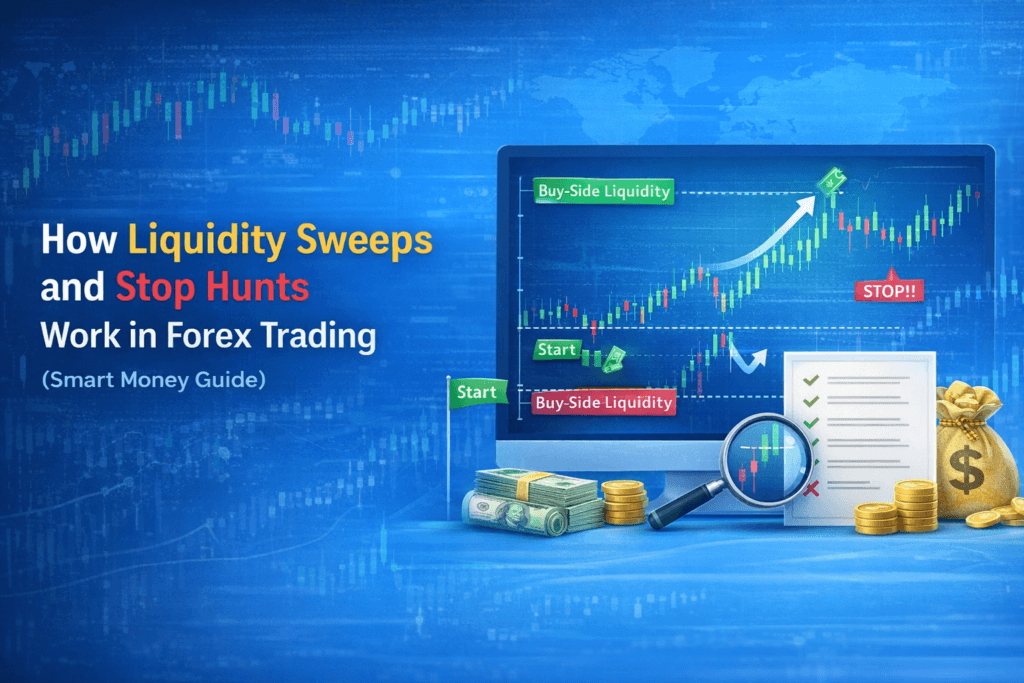
The forex market often behaves in ways that confuse traders, especially beginners. Many traders experience situations where price hits their stop loss and then immediately moves in the direction they originally expected. Others see breakouts fail again and again, or price reverse sharply from obvious levels. These events are not random and they are not caused by bad luck. They are closely linked to how liquidity works in the forex market.
Understanding liquidity sweeps and stop hunts allows traders to see the logic behind price movements. Instead of feeling targeted by the market, traders begin to understand that price is simply moving toward areas where orders exist.
What Liquidity Means in Forex
Liquidity refers to the presence of buy and sell orders in the market. For any trade to be executed, there must be an opposing order available. Retail traders naturally place orders in predictable locations, which creates clusters of liquidity.
Common places where liquidity builds include:
- Above recent highs
- Below recent lows
- Near support and resistance zones
- Around trendlines
- At equal highs and equal lows
These areas become important targets for large market participants.
Why Institutions Focus on Liquidity
Banks, hedge funds, and large financial institutions trade with very large position sizes. They cannot enter or exit trades randomly without affecting price. To execute efficiently, they need zones where many orders already exist.
Price often moves toward obvious levels because:
- Stop losses are placed there
- Pending breakout orders sit there
- Liquidity is guaranteed
Once this liquidity is collected, price can move freely in the intended direction.
What Is a Stop Hunt
A stop hunt occurs when price moves into an area filled with stop losses. When those stops are triggered, they turn into market orders, providing the liquidity institutions need.
Important points about stop hunts:
- They are not personal attacks on traders
- They are a natural part of market mechanics
- They often happen near obvious technical levels
- They frequently occur before major price reversals
After stops are cleared, price often changes direction quickly.
What Is a Liquidity Sweep
A liquidity sweep happens when price briefly breaks a high or low, absorbs the orders resting there, and then reverses or shifts direction.
Liquidity sweeps commonly occur at:
- Previous day highs and lows
- Session highs and lows
- Equal highs or equal lows
- Range boundaries
A liquidity sweep is often the beginning of a real move, not the end.
Liquidity Sweep vs Breakout (Why Traders Get Trapped)
Many traders confuse liquidity sweeps with true breakouts. This misunderstanding causes repeated losses.
Typical breakout behavior:
- Price breaks a level
- Traders enter immediately
- Price reverses
- Stops get hit
Liquidity-based behavior:
- Price breaks a level
- Liquidity is collected
- Strong rejection appears
- Directional move follows
Waiting for reaction instead of entering instantly makes a huge difference.
How Liquidity Sweeps Appear on Charts
On charts, liquidity sweeps usually show clear visual signs, such as:
- Strong push into a high or low
- Long rejection wicks
- Sharp opposite candles
- Sudden change in market structure
These signs indicate that liquidity has been taken and institutions are positioning for the next move.
Buy-Side and Sell-Side Liquidity (ICT Concept)
In Smart Money and ICT trading concepts, liquidity is divided into two sides.
- Buy-side liquidity exists above highs, where buy stops and breakout buys are placed
- Sell-side liquidity exists below lows, where sell stops and breakout sells accumulate
Price frequently moves from one liquidity pool to another. This explains why markets often sweep one side before moving strongly in the opposite direction.
Liquidity and Trading Sessions
Liquidity behavior becomes much clearer during major trading sessions.
During the London session:
- Price often sweeps Asian session highs or lows
- Daily direction is frequently established
During the New York session:
- Price may sweep London session liquidity
- Strong reversals or continuations often occur
Most high-quality liquidity setups happen during these active periods.
Why Retail Traders Lose Around Liquidity Zones
Retail traders often lose money because their behavior is predictable.
Common retail mistakes include:
- Placing stop losses at obvious levels
- Entering breakouts without confirmation
- Trading during low-liquidity hours
- Overtrading after losses
Institutions rely on this predictability to find liquidity.
How Beginners Can Trade Liquidity Safely
Beginners should focus on observation rather than prediction.
Simple beginner approach:
- Mark recent highs and lows
- Wait for price to sweep those levels
- Avoid entering during the sweep
- Watch for strong rejection or structure change
Patience is more important than precision at this stage.
Advanced Smart Money / ICT Trading Approach
Advanced traders wait for confirmation after the liquidity sweep.
This confirmation may include:
- Clear market structure shift
- Strong displacement candle
- Formation of imbalance or fair value gap
- Entry on retracement after the sweep
This approach reduces risk and increases trade quality.
Liquidity vs Indicator-Based Trading
Indicators react to price after the move has already happened. Liquidity analysis focuses on the cause of the move instead of the effect.
This is why:
- Indicators fail during stop hunts
- Liquidity-based traders stay calm
- Price action starts to make sense
Liquidity explains why indicators often give late or false signals.
Risk Management in Liquidity Trading
Liquidity trading does not remove risk. It improves probability, not certainty.
Best practices include:
- Risking small amounts per trade
- Using stops beyond structure
- Trading only high-quality setups
- Avoiding emotional revenge trades
Risk control is what keeps traders in the game long-term.
Common Mistakes to Avoid
Even with liquidity knowledge, traders still make mistakes such as:
- Entering too early during the sweep
- Assuming every sweep will reverse
- Ignoring higher timeframe context
- Trading without confirmation
Discipline and patience are essential.
Why Understanding Liquidity Changes Everything
Once traders understand liquidity:
- Losses become logical
- Fake breakouts become opportunities
- Confidence improves
- Emotional trading reduces
Instead of feeling hunted, traders feel aligned with the market.
Conclusion
Liquidity sweeps and stop hunts are not tricks or manipulation. They are a natural result of how large orders are executed in the forex market. Price moves toward liquidity, collects it, and then moves away. Traders who understand this stop fighting the market and begin trading with structure and logic.
Whether you are a beginner learning to avoid traps or an advanced trader refining Smart Money strategies, liquidity understanding provides a powerful edge. When combined with patience and proper risk management, it transforms the way you view and trade the forex market.
Visit our Social media pages:
https://www.instagram.com/hadyjfx_official/
https://www.youtube.com/@hadyjmentor7793
https://www.facebook.com/profile.php?id=61562232239915
Join our free telegram channel:
https://t.me/hadyjfx