Introduction
Many new traders believe that success in trading means winning most of the time. They focus only on how many trades they can win and feel frustrated when losses appear. In reality, professional traders think very differently. They understand that controlling losses and allowing profits to grow matters far more than being right on every trade.
This idea is known as risk-to-reward planning. It explains how traders with average accuracy can still grow their accounts steadily by managing risk wisely. Small losses combined with larger gains can create strong results over time.
This article explains risk-to-reward planning in a simple and practical way. You will learn how different risk-to-reward models work, how win rate and reward size balance each other, how expectancy shapes long-term results, and why small wins can lead to big profits.
What Risk-to-Reward Means in Trading
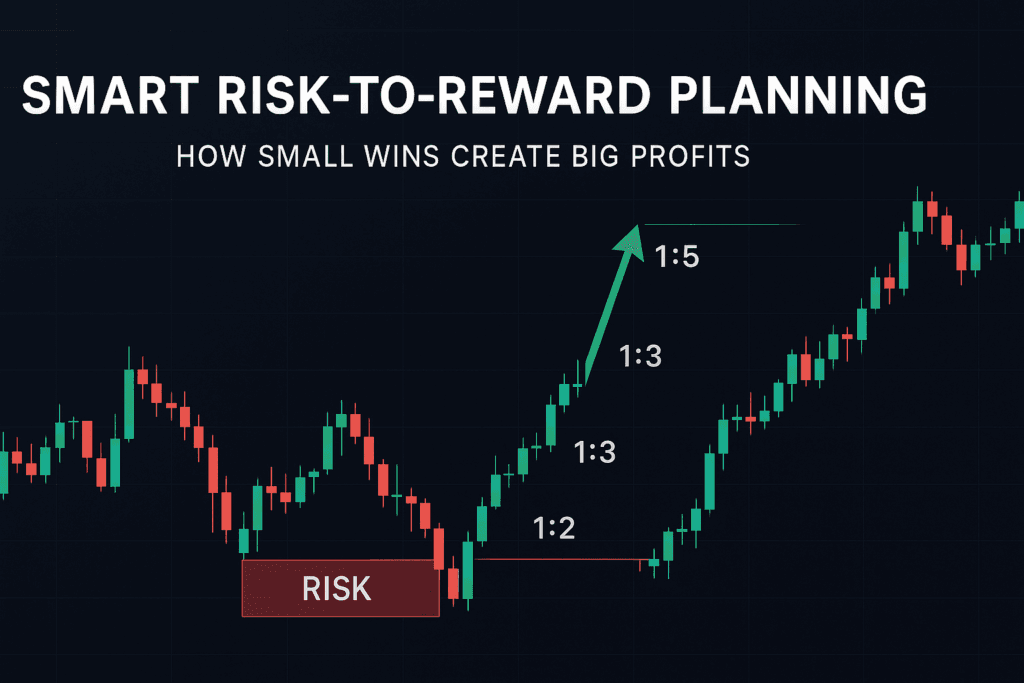
Risk-to-reward describes the relationship between how much you are willing to lose on a trade and how much you aim to gain if the trade succeeds.
For example:
- Risking ₹100 to make ₹200 follows a 1:2 model
- Risking ₹100 to make ₹300 follows a 1:3 model
The first number represents risk. The second represents potential reward.
Professional traders decide this ratio before entering a trade. Beginners often enter trades first and think about exits later, which leads to poor decisions.
Why Risk-to-Reward Is More Important Than Win Rate
Many traders believe that winning more trades automatically leads to profits. This is not always true.
A trader can:
- Win many trades with small profits and still lose money
- Lose several trades and still end up profitable
The difference lies in how losses and wins are managed.
Traders who risk too much for small gains need very high accuracy to survive. Traders who risk less and aim for larger rewards can remain profitable even with fewer winning trades.
Understanding the 1:2 Risk-to-Reward Model
The 1:2 model means the potential reward is twice the size of the risk.
Example:
- Risk: ₹100
- Target: ₹200
If one trade wins and one trade loses:
- Loss = ₹100
- Gain = ₹200
- Net result = +₹100
This model allows traders to be profitable even if they do not win every trade.
The 1:2 approach is suitable for beginners because it balances realism with steady growth.
Understanding the 1:3 Risk-to-Reward Model
The 1:3 model increases the reward while keeping risk fixed.
Example:
- Risk: ₹100
- Target: ₹300
If two trades lose and one trade wins:
- Loss = ₹200
- Gain = ₹300
- Net result = +₹100
This model reduces the need for high accuracy but requires patience and discipline.
Traders using this approach must accept that losses may occur more frequently, but winners compensate for them.
Understanding the 1:5 Risk-to-Reward Model
The 1:5 model focuses on large gains compared to small losses.
Example:
- Risk: ₹100
- Target: ₹500
Even after several losing trades, a single successful trade can recover losses and still generate profit.
This model suits experienced traders who can handle long losing streaks without emotional reactions.
Comparing 1:2, 1:3, and 1:5 Models
Each model has advantages and challenges.
1:2 provides:
- Higher winning frequency
- Faster trade completion
- Smaller profit per trade
1:3 provides:
- Balanced growth
- Moderate win rate
- Better long-term stability
1:5 provides:
- Fewer winning trades
- Larger gains
- Higher emotional demands
There is no perfect model. The best choice depends on personality, patience, and trading style.
How Win Rate and Risk-to-Reward Work Together
Win rate and risk-to-reward cannot be judged separately.
A high win rate with poor reward sizing can still fail.
A lower win rate with strong reward sizing can grow an account.
Professional traders focus on balance, not accuracy alone.
They accept losses calmly because they know their profitable trades outweigh their losing ones.
Why High Win Rate Strategies Often Collapse
Many beginners chase strategies that promise high accuracy.
The problem is:
- Stop losses are wide
- Profit targets are small
- One large loss can erase many gains
This creates stress and unstable performance.
Professional traders prefer small controlled losses over frequent small wins.
Understanding Trade Expectancy (Simple Explanation)
Trade expectancy describes how a trading approach performs when results are viewed over many trades, not just one.
It helps traders understand whether repeating the same behavior over time leads to growth or decline.
Expectancy depends on:
- How often trades succeed
- How large winning trades are
- How small losing trades are
A strategy with positive expectancy grows accounts slowly but consistently.
Why Expectancy Matters More Than Individual Trades
No single trade defines success or failure.
Professional traders think in groups of trades, not individual outcomes.
Losses are normal. Wins are normal. What matters is the overall result after many trades.
This mindset removes emotional pressure and improves discipline.
How Risk-to-Reward Supports Long-Term Growth
Long-term growth depends on survival.
Smart traders:
- Risk small amounts per trade
- Avoid emotional decisions
- Protect capital during difficult periods
Large drawdowns damage confidence and decision-making.
Slow and steady growth builds skill and consistency.
Why Small Wins Can Create Big Profits Over Time
Small profits may seem insignificant at first, but they compound.
When traders:
- Control risk
- Maintain positive expectancy
- Stay disciplined
Their accounts grow naturally over time.
This is how professional traders remain profitable year after year.
Choosing the Right Risk Per Trade
Risk-to-reward works best when combined with limited risk exposure.
Many professionals risk:
- 0.5% to 2% of account per trade
This keeps losses manageable and emotions under control.
Large risk destroys even good strategies.
Common Risk-to-Reward Mistakes Beginners Make
Beginners often:
- Move stop losses emotionally
- Reduce targets too early
- Increase risk after losses
- Change rules frequently
These behaviors break expectancy and consistency.
Discipline matters more than prediction.
How to Build a Simple Risk-to-Reward Plan
To start:
- Choose one model (1:2 or 1:3)
- Fix your risk amount
- Keep the same rules for every trade
Do not change targets based on fear or greed.
Consistency creates confidence.
How Professionals View Losses
Professional traders see losses as part of the process.
A loss is:
- A business expense
- A planned outcome
- A cost of participation
This mindset removes fear and allows clear execution.
Why Risk-to-Reward Builds Trading Confidence
When you know:
- Your maximum loss
- Your potential gain
- Your long-term edge
Trading becomes calm and structured.
Confidence comes from preparation, not prediction.
Conclusion
Smart risk-to-reward planning is the foundation of profitable trading. It explains how traders with average accuracy can outperform traders who win more often but manage risk poorly.
By understanding different reward models, balancing win rate with reward size, focusing on expectancy, and thinking long-term, traders build accounts safely and steadily.
Small wins, when combined with discipline and patience, create big profits over time.
Trading success is not about being right frequently. It is about managing risk intelligently and letting probability work in your favor.
Visit our Social media pages:
https://www.instagram.com/hadyjfx_official/
https://www.youtube.com/@hadyjmentor7793
https://www.facebook.com/profile.php?id=61562232239915
Join our free telegram channel:
https://t.me/hadyjfx