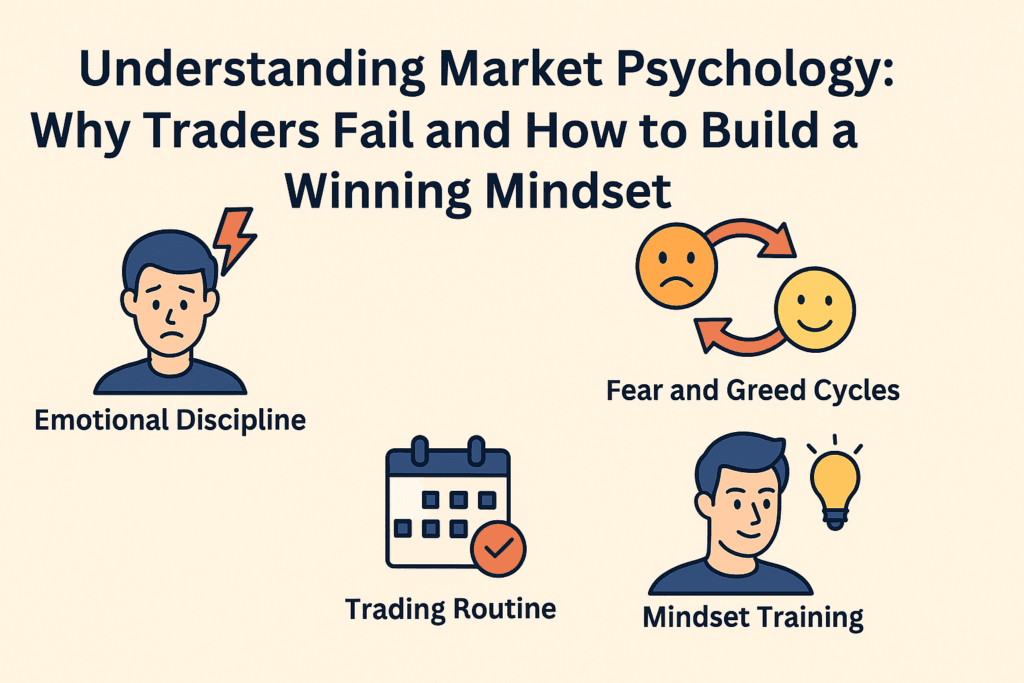
Covers emotional discipline, fear & greed cycles, trading routines, and mindset training.
Introduction
Most traders believe that their success depends on strategy, indicators, or winning signals. But in reality, the forex market rewards traders who have control over their mindset, not their charts. Market psychology—your emotions, habits, discipline, and decision-making under stress—plays a bigger role in profitability than any technical skill.
Many traders lose money even when they have a good strategy simply because they cannot control fear, greed, or impulsive behavior. This article explains why traders fail emotionally and how you can build a strong, winning mindset that supports long-term success.
1. Why Market Psychology Determines Trading Success
Trading is not just analyzing the market—it is managing yourself. Your reactions to loss, uncertainty, risk, and pressure determine whether you stay consistent or spiral into emotional mistakes.
Market psychology affects your trading results because it influences:
- How you handle losing trades
- Whether you follow your rules or break them
- Your ability to wait for high-quality setups
- Your patience, confidence, and discipline
- Your risk-taking behaviour
You might know exactly what to do, but your mind often stops you from doing it.
2. The Fear & Greed Cycle: The Emotional Trap Most Traders Fall Into
Fear and greed are the two main emotional drivers behind market movement—and trader behavior.
Fear: The Emotion That Leads to Hesitation and Panic
Common fear-based mistakes:
- Closing trades too early
- Being afraid to enter even when the setup is perfect
- Reducing lot size after small losses
- Missing opportunities due to hesitation
Fear is triggered by uncertainty, past losses, and lack of confidence.
Greed: The Emotion That Causes Overtrading and Overrisking
Common greed-based mistakes:
- Holding winners too long
- Increasing lot size after a winning streak
- Taking unnecessary trades
- Ignoring your stop loss
Greed pushes traders to chase rewards instead of following rules.
The Cycle
- Greed → Overconfidence → Big risk → Loss
- Fear → Hesitation → Missed setups → Frustration
- Revenge trading → Emotional decisions → More losses
Breaking this cycle is the true key to consistent trading.
3. Emotional Discipline: The Skill That Separates Professionals From Amateurs
Emotional discipline means trading based on rules instead of impulses. It is the ability to stay calm whether you’re winning or losing.
Signs of a disciplined trader:
- Trades only setups that match their plan
- Never increases size impulsively
- Accepts losses without becoming emotional
- Follows a fixed risk model
- Stops trading when personal limits are hit
Signs of a trader lacking discipline:
- Revenge trading
- Closing trades too early
- Jumping into trades without planning
- Changing strategies after every loss
- Ignoring risk management
Discipline is not something you find—it is something you build through structure and consistency.
4. The Power of a Trading Routine: Why Structure Builds Consistency
Your daily routine influences your mindset and performance. Without structure, your emotions take over.
A strong trading routine includes:
Before the Session
- Reviewing your trading plan
- Checking economic news
- Identifying key levels
- Setting your directional bias
- Preparing mentally for risk
During the Session
- Executing only high-quality setups
- Following risk management
- Tracking your emotions in real time
- Avoiding distractions
After the Session
- Journaling trades
- Reviewing mistakes
- Recording psychological triggers
- Planning improvements for the next day
A routine protects you from emotional impulses and keeps your mind calm and focused.
5. Mindset Training: Building the Psychology of a Professional Trader
Just like athletes, traders need mental training. You cannot expect to control your emotions without practicing the skills that strengthen your mindset.
Key components of mindset training include:
1. Detaching from Money
Trade based on probability—not on hopes or fear of losing money.
Professional traders focus on the process, not the outcome of a single trade.
2. Accepting Losses as Normal
Losses are a cost of doing business.
When you stop fighting losses, you stop forcing trades.
3. Using Data to Build Confidence
Backtesting, journaling, and reviewing stats help you eliminate doubts and trust your strategy.
4. Developing Patience
Most losses come from overtrading.
Waiting for the right setup is a sign of mastery.
5. Practicing Emotional Awareness
Ask yourself:
- Am I trading out of boredom?
- Am I trading to recover losses?
- Am I afraid of missing out?
Becoming aware of emotions helps you control them.
6. Why Traders Fail: The Psychological Reasons Behind Most Losses
Many traders fail not because of poor strategy but because of poor mental habits.
The main psychological reasons traders fail:
- Trading without a plan
- Chasing trades during emotional highs
- Letting losses spiral due to panic
- Refusing to stop trading after hitting limits
- Not reviewing or learning from mistakes
- Constantly switching strategies
- Trading based on predictions, not confirmations
The market punishes emotional instability.
It rewards patience, stability, and calm decision-making.
7. How to Build a Winning Trader’s Mindset
Developing a winner’s mindset requires time and practice. Here are the essential steps:
Step 1: Follow a written trading plan
Your plan makes decisions for you so emotions cannot.
Step 2: Use strict risk management
Risk small, trade long-term.
Step 3: Journal every trade and emotion
Your journal reveals your weaknesses and strengths.
Step 4: Reduce screen time if you feel emotional
A short break can prevent huge losses.
Step 5: Focus on long-term performance, not daily profit
Consistency matters more than big wins.
Step 6: Surround yourself with logical information, not hype
Stay away from emotional traders or social media pressure.
Step 7: Train your mind like a professional
Meditation, visualization, and self-reflection improve emotional control.
A strong mindset makes you a stronger trader—more than any signal or indicator ever will.
Conclusion
Traders don’t fail because the market is hard—they fail because they don’t control their emotions. Fear, greed, impatience, impulsiveness, and lack of discipline destroy more accounts than bad strategies ever will.
When you build emotional discipline, follow a structured routine, and train your mind to stay calm under pressure, you gain an advantage that most traders never develop. A powerful trading mindset is what turns an average strategy into a profitable one.
Master your mind, and you master the market.
Visit our Social media pages:
https://www.instagram.com/hadyjfx_official/
https://www.youtube.com/@hadyjmentor7793
https://www.facebook.com/profile.php?id=61562232239915
Join our free telegram channel:
https://t.me/hadyjfx