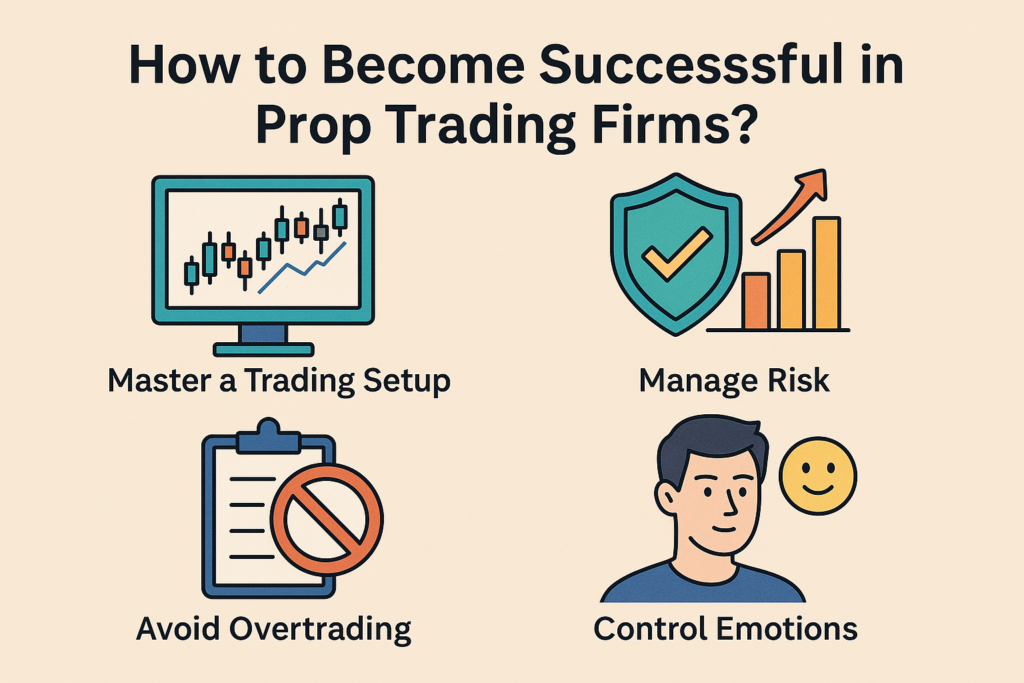
How To Become Successful In Prop Trading Firms?
A Complete Step-By-Step Guide for Traders**
Prop trading has become a powerful opportunity for traders who want to grow their capital without risking large personal funds. With funded accounts, scaling plans, and consistent payouts, proprietary trading firms are now the preferred career path for disciplined traders worldwide.
But the biggest question remains:
How can a trader become consistently successful in a prop trading firm?
This complete guide explains every major step, from building a reliable strategy to managing risk, improving psychology, and maintaining funded status with long-term consistency.
1. Understanding Prop Trading and What Prop Firms Expect
A prop trading firm gives traders access to its capital and shares the profits generated. In exchange, traders must follow rules, manage risk responsibly, and demonstrate consistency.
Prop firms mainly expect two things:
Protect the Firm’s Capital
Your first responsibility is to avoid unnecessary losses. Traders who trade aggressively or emotionally usually fail challenges quickly. A trader who protects capital automatically increases their chance of long-term profitability.
Show Consistency and Rule-Based Trading
Prop firms look for traders who think professionally, follow risk guidelines, avoid gambling behaviour, and maintain a stable equity curve. Consistency is valued more than sudden high returns.
2. Risk Management: The Foundation of Success in Prop Trading
Strong risk management is the most important skill that separates funded traders from losing traders. Prop firms are designed to reward traders who control risk above all else.
Key principles of proper risk management include:
Risk Only One Percent or Less Per Trade
Large position sizes can destroy an account quickly. Keeping risk between half a percent and one percent per trade maintains emotional control and trading discipline.
Respect Daily Drawdown Limits
If the prop firm allows a five percent daily drawdown, your personal limit should be around two to three percent. Stopping trading after reaching this level protects your account and prevents emotional decisions.
Use a Defined Position Size Formula
Use a standard formula to calculate your lot size based on risk percentage and stop loss distance. This removes guesswork and keeps risk consistent across all trades.
Create Your Own Maximum Loss Rule
Even if the prop firm allows a ten percent total drawdown, professional traders create their own limit well below it. This extra safety layer reduces stress and maintains consistent performance.
3. Develop a Clear and Repeatable Trading Strategy
A successful prop trader does not rely on luck or random trades. They follow a system built through experience, testing, and refinement.
Your trading strategy must contain:
Entry Rules
These rules define the exact conditions that qualify as a trade. Clear entry rules may include:
-
Market trend direction
-
Breakout, pullback, or retest conditions
-
Confirmation signals such as market structure shifts or indicator alignment
Exit Rules
You must know when to close a trade in profit and in loss. Exit rules may include:
-
Fixed risk-to-reward ratio
-
Trailing stop method
-
Exit based on opposite market signals
Market Conditions
Every strategy performs best in specific environments. Clearly define whether your system works in trending markets, ranges, or low-volatility conditions. Avoid trading when the market environment does not match your strategy.
4. Backtesting and Journaling: Building Confidence Through Data
Successful prop traders rely on data, not emotions. Backtesting and journaling provide insights that help you refine your performance and build confidence in your system.
Backtest Your Strategy Properly
Test your trading strategy on at least one to three years of historical data. Track key factors such as:
-
Average win rate
-
Risk-to-reward ratio
-
Maximum drawdown
-
Losing streak patterns
A strategy backed by data gives you the courage to stay consistent even during difficult market phases.
Maintain a Detailed Trading Journal
A journal should include:
-
Trade entry and exit details
-
Market conditions
-
Emotions before, during, and after each trade
-
Mistakes and improvements
Reviewing your journal reveals patterns and helps you eliminate weaknesses over time.
5. Trading Psychology: The Hidden Edge in Prop Trading
Most traders fail not because they don’t know strategy but because they cannot control their emotions. Prop trading requires a calm, focused, and disciplined mindset.
Key psychological skills include:
Patience
Professional traders know that waiting for the right setup is more important than being active. No setup simply means no trade.
Discipline
Following your plan even when tempted to break rules separates successful traders from inconsistent ones.
Emotional Control
Avoid trading under emotional stress. Fear, greed, anger, overconfidence, and frustration damage your decision-making ability.
Confidence Built from Evidence
Confidence should come from backtesting, experience, and journaling — not from random wins.
6. The Ideal Daily Routine for a Prop Trader
A structured routine keeps your mind clear and your decision-making consistent.
Before Trading
-
Review the economic calendar
-
Analyse higher-time-frame market structure
-
Mark important support and resistance zones
-
Establish a directional bias
-
Review your previous day’s journal notes
During Trading
-
Wait for trades that match your plan
-
Manage risk according to rules
-
Avoid overtrading and revenge trading
-
Stop trading after hitting your daily limit
After Trading
-
Log all trades in your journal
-
Take chart screenshots
-
Identify mistakes and key lessons
-
Prepare levels and bias for the next day
A routine eliminates randomness and brings discipline into your trading process.
7. Choosing the Right Prop Firm
Different prop firms offer different rules, evaluation types, and payout systems. Choosing the right one increases your chances of long-term success.
Important factors to consider:
Trading Rules
Look for clarity, fairness, and realistic drawdown limits.
Credibility and Reviews
Research payout proof, trader experiences, and trust ratings.
Trading Conditions
Spreads, commissions, and execution speed greatly impact profitability.
Support and Scaling Programs
A reliable support team and transparent scaling structure make a big difference in your long-term journey.
8. Step-By-Step Method to Pass Prop Firm Challenges
Follow these steps to pass challenges with consistency:
-
Trade one or two familiar instruments.
-
Risk a maximum of one percent per trade.
-
Aim for modest weekly gains instead of large single wins.
-
Avoid major news events unless your plan is designed for them.
-
Stop trading after achieving your daily target or loss limit.
-
Maintain emotional neutrality throughout the process.
This structured approach significantly increases your chances of passing evaluations.
9. How to Stay Funded and Receive Regular Payouts
Staying funded is more difficult than passing the challenge. Long-term success comes from disciplined consistency.
To stay funded:
-
Continue following your low-risk trading plan
-
Withdraw a portion of profits to secure earnings
-
Avoid random or emotional trades
-
Keep your strategy stable and do not over-modify it
-
Accept that some months will be flat or slightly negative
Consistency, not intensity, creates a sustainable trading career.
10. Common Mistakes That Lead to Prop Firm Failure
Avoid these mistakes to protect your account:
-
Overtrading or taking impulsive trades
-
Increasing lot size after a loss
-
Trading without stop loss
-
Chasing trades due to fear of missing out
-
Ignoring market news
-
Changing strategies frequently
-
Breaking daily loss limits
Removing these habits significantly improves your success rate.
11. Realistic Timeline to Become a Successful Prop Trader
A realistic success path may look like:
-
First three months: studying, backtesting, strategy building
-
Next three to six months: demo testing and consistency practice
-
Six to twelve months: attempting prop evaluations
-
After one year: maintaining funded accounts and scaling
Prop trading rewards patience and consistency, not shortcuts.
12. Final Conclusion: Your Roadmap to Prop Trading Success
To become successful in prop trading firms, focus on mastering the fundamentals:
-
Strong risk management
-
A clear, repeatable strategy
-
Solid emotional discipline
-
Proper journaling and review habits
-
Consistent execution
-
Selection of the right prop firm
Prop trading is a long-term professional journey, not a quick win. When you trade with discipline, protect capital, and follow a structured plan, you can build a stable and rewarding trading career with funded accounts and consistent payouts.
Your success begins when you decide to trade like a professional, not like a gambler. If you stay committed to discipline and improvement, the prop trading industry can become one of the most profitable opportunities of your life.
Visit our Social media pages:
https://www.instagram.com/hadyjfx_official/
https://www.youtube.com/@hadyjmentor7793
https://www.facebook.com/profile.php?id=61562232239915
Join our free telegram channel:
https://t.me/hadyjfx