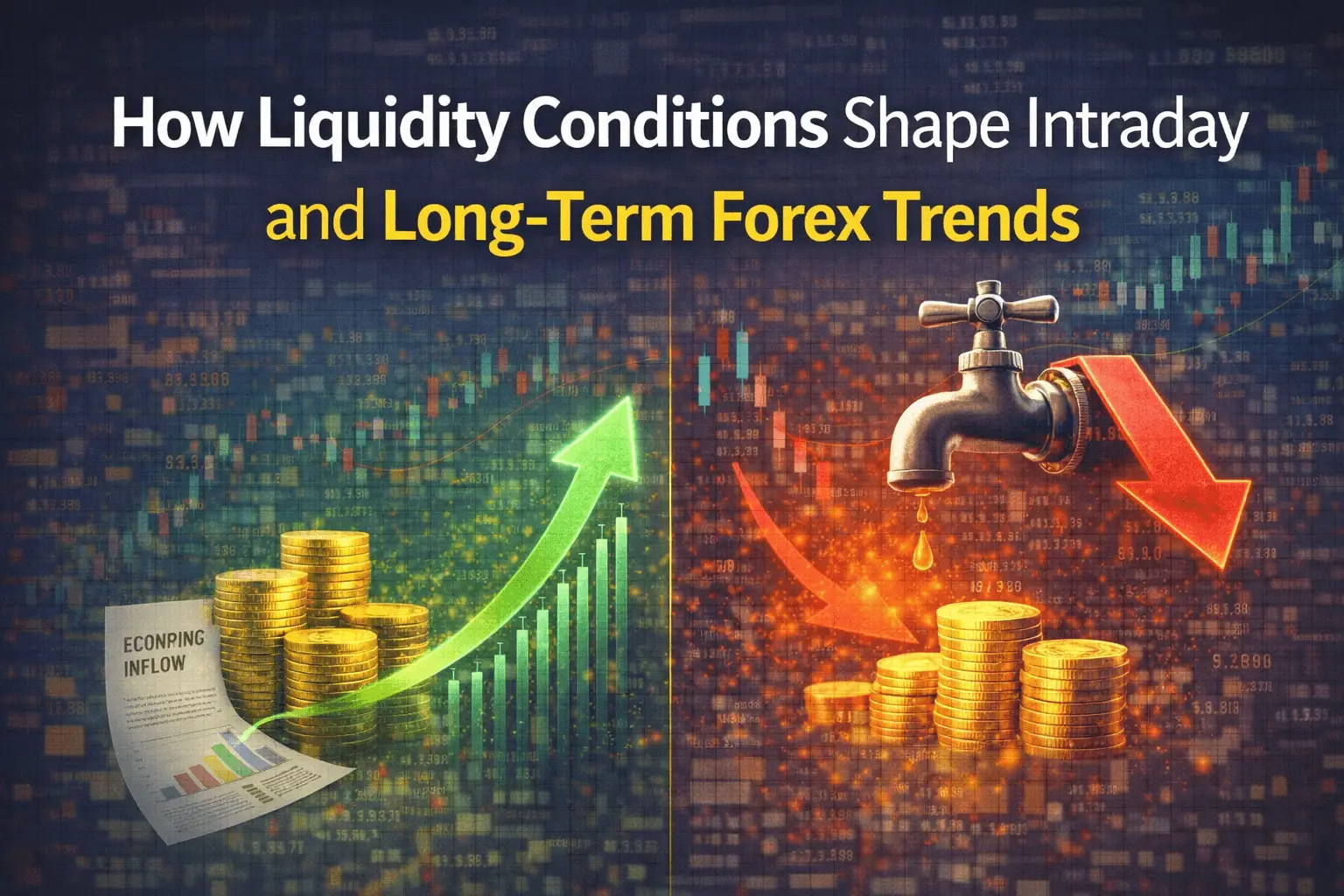
Liquidity is one of the most powerful forces in the forex market, yet it is also one of the least understood by retail traders. Many traders focus heavily on indicators, patterns, or economic data, but still struggle to understand why trends persist for weeks, why intraday moves suddenly accelerate, or why strong setups sometimes fail without warning. The missing piece in many cases is liquidity.
Understanding forex liquidity provides clarity on how price truly moves. Liquidity determines whether trends flow smoothly or stall, whether volatility expands or contracts, and whether price respects structure or breaks it violently. This is why liquidity plays a central role in both intraday trading and long-term liquidity and currency trends.
Liquidity in forex does not simply mean how easy it is to buy or sell a currency pair. In practical terms, liquidity refers to how much capital is available and willing to move through the market at any given time. When liquidity is abundant, price moves efficiently. When liquidity is scarce, price becomes unstable, erratic, and prone to sharp spikes.
Forex markets respond directly to changes in liquidity because currencies are the foundation of global capital movement. Every trade, hedge, investment, or capital transfer flows through currency markets. As a result, liquidity conditions shape the very structure of the forex market.
One of the most common misconceptions among traders is confusing liquidity with volatility. Volatility describes how fast price moves. Liquidity explains why it moves that way. High liquidity can actually reduce volatility by absorbing large orders smoothly. Low liquidity can increase volatility because even modest orders push price aggressively.
This distinction is essential for understanding forex market structure. A market can be highly volatile due to low liquidity, not strong conviction. Likewise, a calm market does not necessarily lack interest—it may simply have sufficient liquidity to process flows efficiently.
Central banks are the primary drivers of global liquidity conditions. Through interest rates, balance sheet operations, and policy communication, they influence how much capital flows through financial markets. When central banks provide accommodative conditions, liquidity expands. When they tighten financial conditions, liquidity contracts.
These changes do not affect forex markets instantly. They gradually reshape capital behavior, leading to sustained trends or prolonged consolidations. This is why liquidity cycles often explain long-term forex trends better than individual economic releases.
In high-liquidity environments, capital flows freely across markets. Risk appetite improves, participation increases, and trends develop smoothly. In these conditions, intraday price action tends to respect structure, pullbacks remain shallow, and momentum follows through more reliably.
Traders often describe these markets as “clean” or “technical,” but what they are really experiencing is stable liquidity supporting orderly price discovery.
When liquidity contracts, market behavior changes dramatically. Price becomes more sensitive, volatility increases, and false breakouts become common. Intraday moves may accelerate suddenly and then reverse just as quickly. Long-term trends may stall or transition into ranges.
This environment is challenging for traders who rely only on indicators. Without understanding liquidity, these moves appear random. In reality, they reflect reduced participation and tighter capital conditions.
Liquidity also explains why some trends last far longer than expected. When liquidity consistently supports capital flow in one direction, price continues moving even when economic data becomes mixed. Traders who fight these trends often get stopped repeatedly, believing price “should” reverse.
As long as liquidity remains aligned, trends persist. Reversals usually begin only when liquidity conditions start to shift, not when indicators signal exhaustion.
Intraday forex trends are also deeply influenced by liquidity timing. Liquidity is not constant throughout the trading day. It rises and falls based on market sessions, participation levels, and institutional activity.
When liquidity is high, intraday trends develop more clearly. When liquidity thins, price becomes erratic and prone to stop-driven moves. Understanding this helps traders avoid forcing trades during unfavorable conditions.
Liquidity also determines when trends accelerate. Acceleration occurs when new liquidity enters the market in the same direction as existing flow. This often happens after consolidation phases, policy shifts, or changes in risk sentiment.
Without fresh liquidity, trends slow down. Price may continue moving, but momentum fades. This is why strong breakouts often fail when liquidity does not follow through.
Many traders misinterpret volatility spikes as opportunity when they are actually warnings. Sudden volatility without supportive liquidity often leads to whipsaws rather than trends. These moves are driven by order imbalance, not conviction.
Liquidity analysis helps traders distinguish between meaningful movement and noise.
Retail traders often struggle with liquidity because it is not displayed directly on charts. However, its effects are visible through price behavior, follow-through, and structure respect. Markets with strong liquidity reward patience and trend-following. Markets with weak liquidity punish aggression.
Understanding this changes how traders approach entries, exits, and risk management.
Professional traders use liquidity as a framework, not a signal. They align trades with supportive liquidity environments and reduce exposure when liquidity deteriorates. This approach improves consistency and reduces emotional decision-making.
Rather than predicting price, they observe how liquidity shapes behavior.
Liquidity also explains why economic data sometimes appears irrelevant. If liquidity conditions dominate, data releases may cause only temporary volatility. If data alters liquidity expectations, reactions are stronger and more sustained.
This is why liquidity often overrides short-term information.
The most important lesson is that liquidity is not static. It expands and contracts over time, shaping both intraday moves and long-term trends. Traders who ignore liquidity often feel out of sync with the market. Traders who understand it gain context that indicators alone cannot provide.
In conclusion, liquidity conditions shape forex markets at every level. They explain why trends persist, why volatility changes, and why price sometimes behaves unpredictably. Forex liquidity is the foundation of liquidity and currency trends, and understanding it provides deep insight into forex market structure.
Traders who align with liquidity trade with the market. Traders who ignore it often trade against forces they cannot see.
Visit our Social media pages:
https://www.instagram.com/hadyjfx_official
/https://www.youtube.com/@hadyjmentor7793
https://www.facebook.com/profile.php?id=61562232239915
Join our free telegram channel:
https://t.me/hadyjfx