Silver often surprises traders with sudden and sharp price movements. While gold is generally seen as a stable store of value, silver can rise rapidly during optimism and fall just as quickly when confidence fades. This higher volatility leads many traders and investors to ask why silver behaves so differently, even though it belongs to the same precious metals category.
The answer lies in silver’s structure. Silver is not only a monetary metal but also a critical industrial commodity. This dual role makes silver price movement far more sensitive to economic expectations, market sentiment, and liquidity conditions than gold. Understanding this difference is essential for accurate silver market analysis.
silver’s dual role: industrial and investment demand
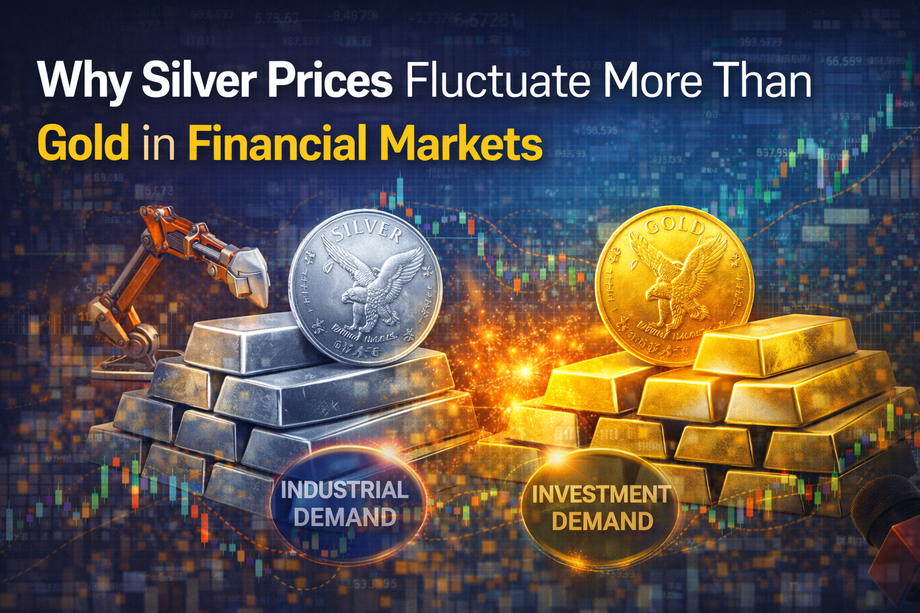
Silver demand comes from two main sources. One is investment demand, where silver is held as a hedge or alternative asset. The other is industrial demand, where silver is used in manufacturing, technology, energy, and medical applications.
Gold relies primarily on investment and reserve demand. Silver relies heavily on industrial consumption. Because industrial activity rises and falls with economic conditions, silver prices naturally fluctuate more as growth expectations change.
This dual role is the foundation of why silver prices fluctuate more than gold.
industrial demand amplifies silver volatility
Industrial demand makes silver closely tied to the economic cycle. When global growth expectations improve, demand forecasts for silver rise, supporting higher prices. When slowdown fears emerge, those demand expectations weaken quickly.
This creates larger price swings because markets constantly reassess future industrial usage. Gold does not face this pressure, as its value is not linked to production or manufacturing demand.
As a result, silver price volatility increases whenever markets debate the strength or weakness of global growth.
market size and liquidity effects
Silver trades in a more compact market structure than gold. With fewer participants and lower overall depth, changes in buying or selling pressure can move prices more aggressively.
When sentiment turns positive, silver can rally sharply as demand increases. When sentiment turns negative, selling pressure can cause rapid declines. Gold’s larger and deeper market tends to absorb these shifts more smoothly.
This difference in market structure explains why silver reacts faster and with greater intensity than gold.
silver versus gold behavior across market phases
Silver and gold often move together, but their performance differs depending on the environment. During periods of economic expansion, silver frequently outperforms gold as industrial demand strengthens. During periods of uncertainty or slowdown, gold usually holds up better due to its defensive role.
This shifting dynamic explains changes in silver vs gold behavior across cycles. Silver leads during optimism and lags during caution, while gold remains more stable.
Understanding this relationship helps traders avoid misreading price action.
impact of economic cycles on silver prices
Silver prices are highly sensitive to where markets sit in the economic cycle. Early expansion phases often support strong silver rallies. Late-cycle uncertainty increases volatility. Slowdown phases tend to pressure silver as industrial demand expectations weaken.
Gold, by contrast, often performs best when confidence declines. This divergence is why silver trends can reverse quickly during transitions between growth and slowdown.
Economic cycles are one of the strongest drivers of silver price movement.
sentiment changes affect silver more quickly
Silver reacts strongly to changes in confidence. Optimism around growth, technology, or infrastructure spending can lift prices rapidly. Fear or caution tied to recession risk can trigger sharp pullbacks.
Because sentiment shifts faster than fundamentals, silver prices can reverse suddenly even when conditions have not materially changed. This sensitivity makes silver market analysis highly dependent on expectations rather than confirmed outcomes.
common mistakes traders make with silver
Many traders treat silver exactly like gold. Others rely only on technical signals without considering economic context.
Ignoring silver’s industrial exposure often leads to confusion when prices move against expectations. Treating silver as a pure safe-haven asset oversimplifies its behavior and increases trading errors.
A balanced understanding improves consistency.
using silver market analysis effectively
Effective silver market analysis combines:
- Global growth expectations
- Industrial demand trends
- Market sentiment shifts
- Relative performance against gold
Silver should be analyzed as a hybrid asset, reflecting both economic activity and investment behavior.
final conclusion: why silver fluctuates more than gold
Silver prices fluctuate more than gold because silver sits between industry and investment. Its dependence on economic growth, combined with a more compact market structure, leads to sharper reactions to changing expectations.
This is why silver price volatility is higher, silver price movement is faster, and why silver prices fluctuate more frequently than gold. Silver amplifies optimism during expansion and exaggerates caution during slowdown.
For traders and investors, understanding these dynamics transforms volatility from confusion into opportunity. Those who recognize silver’s unique role trade with clarity. Those who ignore it often mistake structure for unpredictability.
Visit our Social media pages:
https://www.instagram.com/hadyjfx_official
/https://www.youtube.com/@hadyjmentor7793
https://www.facebook.com/profile.php?id=61562232239915
Join our free telegram channel:
https://t.me/hadyjfx