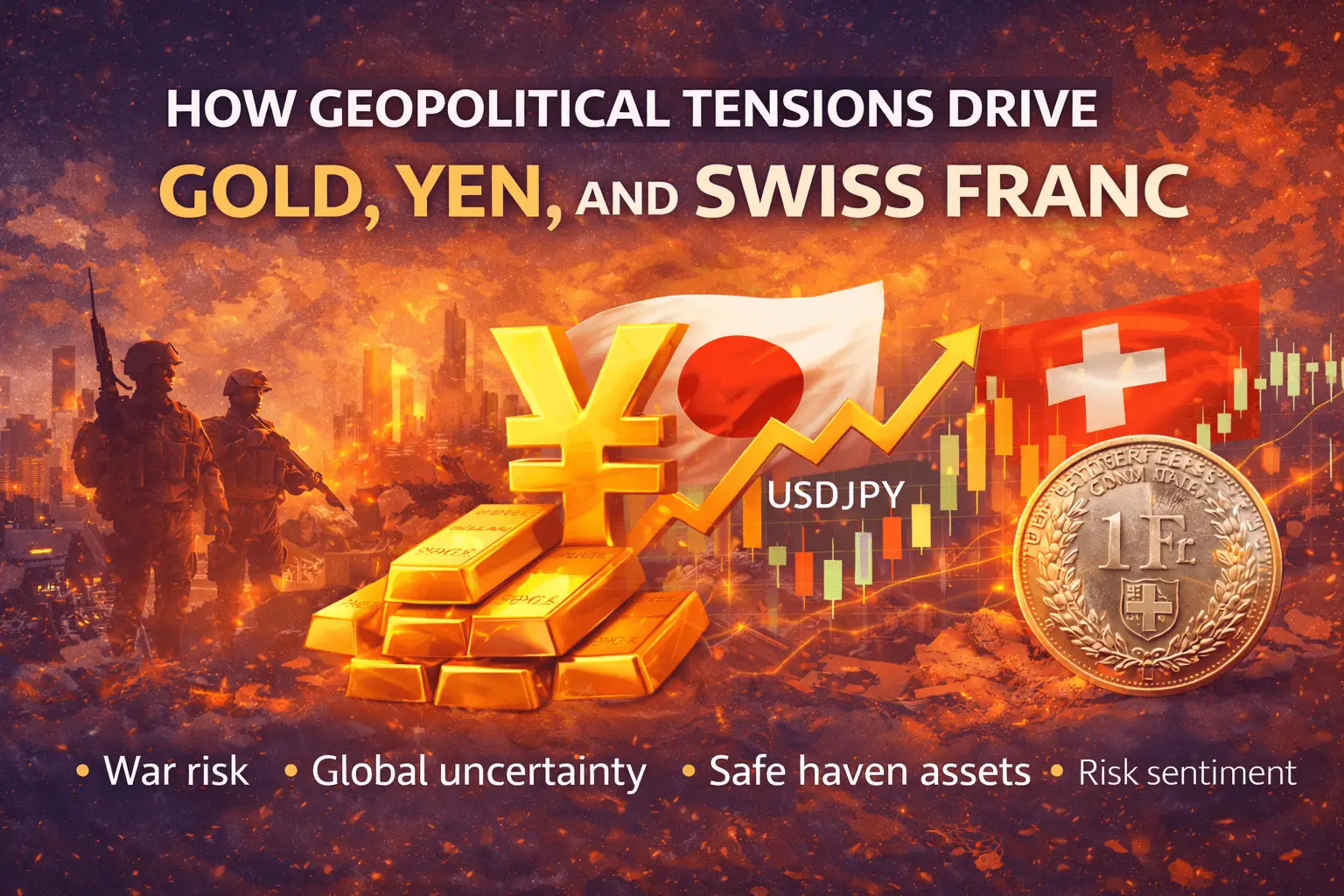
Financial markets are not driven only by numbers and economic releases. Some of the strongest and most sudden price movements occur when geopolitical risks rise. Wars, military escalations, sanctions, diplomatic breakdowns, and global political instability introduce uncertainty that cannot be measured through traditional data.
When uncertainty increases, investor behavior changes. Capital begins to move away from assets linked to growth and risk, and instead flows toward instruments associated with stability and capital protection. This shift is known as safe-haven flow.
Assets such as gold, the Japanese yen, and the Swiss franc historically attract demand during periods of global stress. For traders monitoring safe haven assets, understanding this behavior is critical for interpreting gold price news, USDJPY forecast, and CHF outlook during uncertain times.
Understanding Safe-Haven Assets
Safe-haven assets are financial instruments that investors prefer during periods of heightened risk. These assets are not chosen for high returns, but for their ability to retain value and remain liquid when market confidence declines.
Key characteristics of safe-haven assets include:
- High global liquidity
- Broad investor acceptance
- Low political or credit risk
- Stability during market stress
Gold, the Japanese yen, and the Swiss franc meet these criteria consistently, which is why they play a central role during geopolitical disruptions.
Why Geopolitical Tensions Change Market Direction
Geopolitical events introduce uncertainty that cannot be easily forecast or modeled. Unlike economic indicators, political and military developments can escalate or de-escalate rapidly, often without warning.
Examples include:
- Armed conflicts or military escalation
- Trade sanctions and restrictions
- Disruption of energy supply routes
- Political instability in key regions
When these risks rise, investors shift priorities. Growth and yield become secondary. The primary objective becomes capital protection.
This shift in mindset drives the demand for safe-haven assets.
Risk Sentiment: The Core Driver of Safe-Haven Flows
Market behavior during geopolitical stress is driven by risk sentiment.
- In a risk-on environment, investors favor equities, high-yield currencies, and emerging markets.
- In a risk-off environment, investors reduce exposure to uncertainty and seek stability.
Geopolitical tensions almost always trigger a risk-off response. This is when gold, yen, and Swiss franc typically strengthen together.
Understanding risk sentiment is essential for reading safe-haven price action.
Why Gold Gains During Geopolitical Stress
Gold attracts demand during global uncertainty because it operates outside the financial and political system. It is not issued by any government, does not depend on fiscal credibility, and does not carry repayment risk.
During geopolitical crises:
- Trust in institutions may weaken
- Currency risks increase
- Policy uncertainty rises
In such environments, gold is often used as a neutral reserve asset rather than a speculative instrument.
This structural independence explains why gold price news frequently turns bullish when geopolitical risks escalate.
Gold’s Structural Advantage Over Financial Assets
Gold differs from financial assets in several important ways:
- It has no issuer
- It carries no default risk
- Its value is not determined by policy decisions
Because of this, gold demand increases when investors seek insulation from political or systemic uncertainty. The move is driven by risk reduction, not emotion.
This is why gold often responds early when global tensions rise.
Why Gold Often Moves Before Economic Damage Appears
Markets do not wait for confirmation of economic impact. When geopolitical risk rises, investors act proactively.
Gold markets are deep and liquid, allowing institutions to shift capital quickly. This makes gold one of the earliest indicators of rising global stress.
As a result, gold often strengthens even before economic data reflects any slowdown.
The Japanese Yen as a Safe-Haven Currency
The Japanese yen is widely recognized as a safe-haven currency, even though Japan carries high public debt. This status comes from structural financial behavior, not economic strength.
Key factors supporting yen demand during crises:
- Japanese investors hold significant overseas assets
- During stress, capital is repatriated back to Japan
- The yen is widely used in carry trade strategies
When risk sentiment deteriorates, leveraged carry trades are reduced, leading to yen appreciation.
How Geopolitical Risk Impacts USDJPY
During periods of global tension:
- Risk appetite declines
- Investors reduce leveraged positions
- Yen buying increases
This often results in downward pressure on USDJPY. As a result, geopolitical headlines frequently influence the USDJPY forecast more than US economic data.
Why Yen Moves Can Be Sudden
Yen appreciation during crises can be sharp because:
- Carry trades unwind quickly
- Liquidity is deep
- Algorithmic trading amplifies momentum
This makes the yen highly sensitive to changes in global risk perception.
Swiss Franc: Stability Through Neutrality
The Swiss franc is another traditional safe-haven currency. Switzerland’s political neutrality, stable financial system, and strong institutional credibility make it a preferred destination during uncertainty.
Factors supporting the Swiss franc include:
- Long-term political stability
- Strong banking infrastructure
- High confidence in monetary discipline
When global uncertainty increases, capital flows into Swiss assets, supporting the franc.
CHF Outlook During Geopolitical Uncertainty
The CHF outlook is closely tied to global risk sentiment. During geopolitical stress:
- Investors seek stable jurisdictions
- Capital shifts toward Swiss financial markets
- The franc strengthens
This behavior often occurs regardless of Swiss domestic economic data.
How Safe-Haven Flows Develop in Real Markets
Safe-haven flows follow a consistent pattern:
- Risk assets are reduced
- Volatility increases
- Capital moves into stable, liquid assets
- Correlations across markets change
Gold, yen, and Swiss franc often strengthen together, though the magnitude varies depending on the nature of the geopolitical risk.
Why Economic Data Becomes Secondary During Crises
During geopolitical stress, markets pay less attention to:
- Inflation releases
- Employment data
- Growth forecasts
Instead, focus shifts to:
- Capital safety
- Liquidity
- Exposure reduction
This is why gold price news, USDJPY forecast, and CHF outlook often react more to global headlines than to scheduled economic releases during such periods.
Energy Risk, Conflict, and Inflation Concerns
Many geopolitical conflicts involve energy-producing regions or critical trade routes. This creates concerns about:
- Supply disruptions
- Rising energy prices
- Inflation pressure
Gold benefits in these situations because it offers protection against both uncertainty and purchasing-power risk.
Why Safe-Haven Moves Can Reverse Quickly
Not all geopolitical events lead to prolonged market stress. When tensions ease:
- Risk appetite returns
- Safe-haven demand fades
- Gold and safe-haven currencies may retrace
This is why traders must differentiate between temporary headline risk and sustained geopolitical escalation.
How Professional Traders Approach Safe-Haven Markets
Experienced traders:
- Monitor escalation trends, not single headlines
- Track risk sentiment across markets
- Avoid chasing late moves
- Use price structure for confirmation
They understand that safe-haven assets respond to perceived risk, not certainty.
Common Mistakes During Geopolitical Events
Retail traders often:
- Enter trades too late
- Overreact to individual headlines
- Ignore broader market context
- Underestimate volatility
Safe-haven trading requires patience and disciplined risk management.
Inter-Market Behavior During Risk-Off Phases
During geopolitical stress:
- Equity markets often weaken
- Bond prices tend to rise
- Gold strengthens
- Yen and Swiss franc appreciate
Recognizing these relationships helps traders align positions across multiple markets.
Final Conclusion: Why Geopolitical Tensions Drive Safe-Haven Flows
Geopolitical tensions reshape financial markets by altering risk sentiment. When uncertainty rises, investors prioritize capital preservation over returns. This shift drives demand for safe haven assets such as gold, the Japanese yen, and the Swiss franc.
Gold benefits from its independence from political systems, while the yen and Swiss franc strengthen due to structural stability and capital repatriation. During such periods, gold price news, USDJPY forecast, and CHF outlook are influenced more by global risk perception than by economic data.
For traders, understanding how geopolitical risk drives safe-haven flows provides clarity during volatile periods. Those who recognize risk-off environments early trade with confidence—those who ignore sentiment often trade against the market.
In uncertain times, markets may fluctuate, but the role of safe-haven assets remains consistent.
Visit our Social media pages:
https://www.instagram.com/hadyjfx_official/
https://www.youtube.com/@hadyjmentor7793
https://www.facebook.com/profile.php?id=61562232239915
Join our free telegram channel:
https://t.me/hadyjfx