Introduction
Most people who start forex trading do not fail because the market is too hard. They fail because they repeat the same mistakes again and again. These mistakes are not technical. They are behavioral, emotional, and psychological.
Beginners often focus on finding the “perfect strategy” or the “best indicator.” In reality, success in forex trading depends more on avoiding common errors than on finding advanced systems.
This article explains the most common forex trading mistakes beginners make and how to avoid them. If you understand these mistakes early, you can save time, money, and emotional stress.
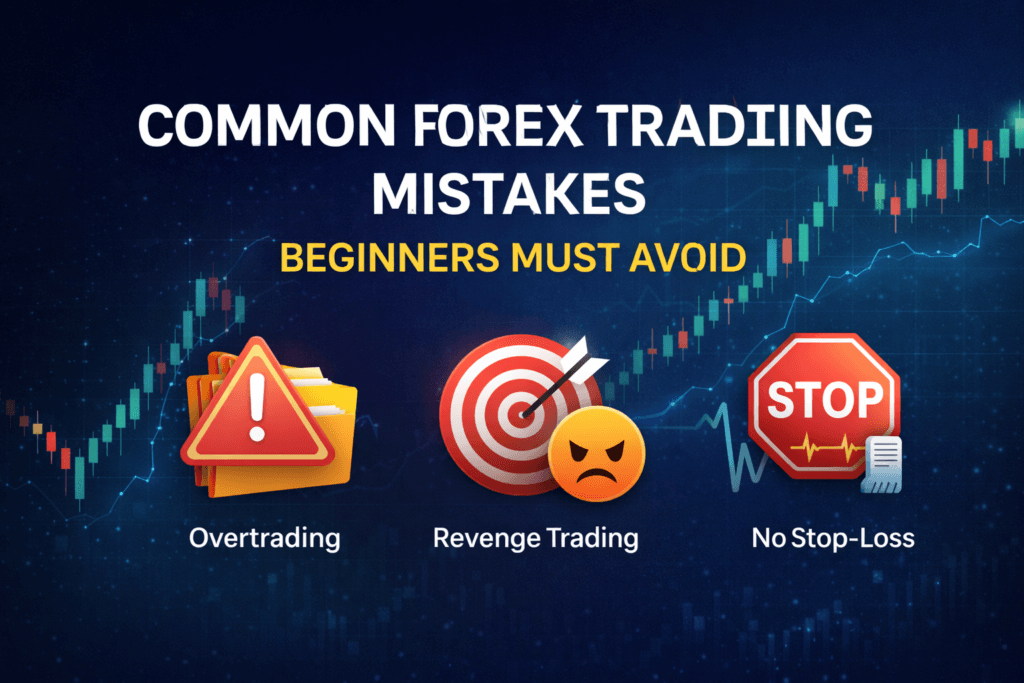
Mistake 1: Overtrading
Overtrading is one of the most common beginner mistakes.
Overtrading means:
- Taking too many trades
- Trading every small price movement
- Entering trades without clear reasons
Many beginners feel they must always be in a trade. When the market is open, they feel pressure to click buy or sell. This leads to unnecessary losses.
Professional traders understand that waiting is part of trading. They trade only when conditions are right.
Why Overtrading Is Dangerous
Overtrading causes:
- Higher transaction costs
- Poor trade quality
- Emotional exhaustion
- Loss of discipline
More trades do not mean more profit. Often, fewer high-quality trades perform better.
How to Avoid Overtrading
- Trade only planned setups
- Set a daily or weekly trade limit
- Accept that no trade is also a decision
- Focus on quality, not quantity
Mistake 2: Revenge Trading
Revenge trading happens after a loss.
Instead of accepting the loss, the trader:
- Enters another trade immediately
- Increases position size
- Trades emotionally
The goal is not analysis anymore. The goal becomes “getting money back.”
This mindset is extremely dangerous.
Why Revenge Trading Destroys Accounts
Revenge trading:
- Breaks trading rules
- Increases risk
- Removes logical thinking
- Creates large drawdowns
One emotional trade can wipe out days or weeks of disciplined work.
Professional traders accept losses calmly because they understand losses are part of the process.
How to Stop Revenge Trading
- Take a break after a losing trade
- Set a maximum daily loss limit
- Step away from the screen
- Remind yourself that losses are normal
Trading is a probability game, not a personal fight.
Mistake 3: Trading Without a Stop-Loss
Many beginners avoid stop-loss orders because they fear getting stopped out.
Some think:
- “I will close the trade manually”
- “Price will come back”
- “Stop-loss causes losses”
This is one of the most dangerous beliefs in trading.
Why No Stop-Loss Is a Big Mistake
Without a stop-loss:
- Losses can grow uncontrollably
- One trade can destroy the account
- Fear increases
- Decision-making becomes emotional
Markets can move fast and unexpectedly. A stop-loss protects you when you are wrong.
Professional traders never enter trades without knowing where they will exit if the idea fails.
How to Use Stop-Loss Correctly
- Place stop-loss before entering the trade
- Base it on logic, not emotion
- Accept the loss if hit
- Never move stop-loss to avoid loss
A stop-loss is not your enemy. It is your safety belt.
Mistake 4: Blindly Copy Trading Others
Many beginners copy trades from:
- Telegram groups
- WhatsApp signals
- Social media influencers
- Friends
They enter trades without understanding the logic behind them.
This creates false confidence and dependency.
Why Blind Copy Trading Fails
Blind copy trading fails because:
- You do not understand risk
- You do not know when to exit
- You panic during drawdowns
- The strategy may not suit you
When losses occur, beginners blame the signal provider instead of learning.
Professional traders build independent thinking.
How to Learn Without Blind Copying
- Use others’ trades only for learning
- Ask why the trade was taken
- Practice on demo accounts
- Build your own simple plan
Learning to think is more valuable than copying profits.
Mistake 5: Strategy Hopping
Strategy hopping means constantly changing trading methods.
Beginners often:
- Try one strategy for a few days
- Face losses
- Switch to another strategy
- Repeat the cycle
This creates confusion and inconsistency.
Why Strategy Hopping Prevents Growth
Strategy hopping:
- Prevents skill development
- Destroys confidence
- Creates unrealistic expectations
- Blames systems instead of behavior
Every strategy has losing trades. No system wins all the time.
Professional traders stick with one approach long enough to understand it fully.
How to Stop Strategy Hopping
- Choose one simple strategy
- Practice it for several weeks
- Track results
- Improve execution, not systems
Consistency matters more than complexity.
Mistake 6: Emotional Trading
Emotional trading includes:
- Fear of missing out
- Greed
- Fear of loss
- Overconfidence
Emotions push traders to act without logic.
Markets do not care about emotions.
How Emotions Damage Trading Performance
Emotional trading leads to:
- Early exits
- Late entries
- Rule breaking
- Over-risking
When emotions control decisions, consistency disappears.
Professional traders aim for calm execution, not excitement.
How to Control Emotions in Trading
- Use fixed risk per trade
- Follow a written plan
- Accept uncertainty
- Focus on process, not outcome
Discipline reduces emotional impact.
Mistake 7: Unrealistic Expectations
Many beginners expect:
- Fast profits
- Daily income
- No losing trades
These expectations create pressure and disappointment.
Forex trading is a skill, not a lottery.
Why Unrealistic Expectations Cause Failure
Unrealistic expectations cause:
- Over-risking
- Overtrading
- Emotional decisions
- Early burnout
Professional traders focus on long-term consistency, not quick results.
How to Build Realistic Expectations
- Focus on learning, not earnings
- Measure progress in discipline
- Accept slow growth
- Treat trading as a business
Patience builds longevity.
Mistake 8: Ignoring Risk Management
Some beginners focus only on entries and ignore risk.
They risk too much on single trades hoping for fast growth.
This leads to large drawdowns.
Why Risk Management Is Essential
Risk management:
- Protects capital
- Controls emotions
- Allows survival
- Supports long-term growth
Even good strategies fail without proper risk control.
Simple Risk Rules Beginners Should Follow
- Risk only 1–2% per trade
- Always use stop-loss
- Avoid increasing lot size emotionally
- Accept losses
Survival comes first.
Mistake 9: Trading Without a Plan
Many beginners trade randomly without structure.
They:
- Enter based on feeling
- Exit based on fear
- Change rules constantly
This creates inconsistent results.
Why a Trading Plan Matters
A trading plan:
- Creates clarity
- Reduces emotional decisions
- Improves consistency
- Builds confidence
Professional traders follow rules, not impulses.
What a Simple Trading Plan Includes
- Market to trade
- Timeframe
- Entry conditions
- Stop-loss and target
- Risk per trade
Simple plans work better than complex ones.
Mistake 10: Not Reviewing Trades
Beginners often repeat the same mistakes because they do not review trades.
They move on without learning.
Why Trade Review Is Important
Trade review:
- Shows patterns
- Improves discipline
- Builds awareness
- Accelerates learning
Professional traders learn from every trade.
How to Review Trades Effectively
- Screenshot charts
- Write reasons for entry and exit
- Note emotional behavior
- Identify mistakes
Progress comes from reflection.
Conclusion
Most forex traders do not fail because they lack intelligence or opportunity. They fail because they repeat common mistakes and do not correct them early.
By avoiding overtrading, revenge trading, trading without stop-loss, blind copying, strategy hopping, and emotional decisions, beginners can dramatically improve their chances of success.
Forex trading rewards patience, discipline, and consistency. Focus on building good habits, managing risk, and learning from mistakes. When errors reduce, results naturally improve.Trading success is not about being perfect. It is about avoiding unnecessary mistakes and staying in the game long enough to grow.